The Expectation That Drives Innovation
When a university research team wins a NASA grant, the celebration is always about the groundbreaking science. What often becomes a powerful engine for success is the essential secondary mission embedded in nearly every federally-seeded technology program: that this work will ultimately achieve a meaningful impact far beyond the agency that funded it.
This is a well-established and empowering idea, tracing its roots to the Bayh-Dole Act, which wisely granted universities ownership of federally funded inventions specifically to fuel commercialization. While understanding the policy is key, the real opportunity lies in proactively building a research program around dual-use potential. Many labs excel at the scientific discovery, and with a focused approach, they can equally master the market application. The shift is already happening as academic research adapts its workflows, incentive structures, and vocabulary to successfully integrate market pull with scientific inquiry.
What "Dual-Use" Means Here
In defense contexts, dual-use typically describes technology with both civilian and military applications. In the NASA university partnership world, the term carries a different weight. It means a technology that solves a genuine agency need (e.g. telemetry, life support, propulsion efficiency, autonomous navigation) while also addressing a problem someone in the private sector would pay to solve. A great example of this is ‘temper foam’ which you can read more about here.
Achieving the second part of dual-use is harder than it sounds. A sensor designed to operate in the radiation environment of low Earth orbit may be exquisitely well-engineered and completely irrelevant to any terrestrial buyer. The technical achievement is real; the commercial pathway is absent. Dual-use by design means building both considerations into the research architecture from the start, not retrofitting a market story onto a completed prototype.
Where the Gap Lives
The structural reasons for this gap are worth naming clearly:
- Incentive misalignment: Academic researchers are evaluated on publications, patents, and grant renewals, not on whether a licensed technology reaches manufacturing.
- Timeline mismatch: Commercial product cycles move in months. University research programs often span three to five years with significant uncertainty at every milestone.
- Vocabulary barriers: Phrases like "technology readiness level" and "market validation" belong to different professional communities that rarely share a room during proposal development.
- Missing intermediaries: The people who know how to translate between a NASA use case and a venture-backable product concept, such as technology transfer officers, industry liaisons, and mission-aware entrepreneurs, are often understaffed at many research universities.
The result is a frequent pattern: strong technical proposals include a commercialization section written just before submission, drawing on assumptions about market size that have not yet been tested by anyone on the team.
What Distinguishes Proposals That Work on Both Fronts
The research teams that genuinely succeed at dual-use development tend to share a few observable traits. They first identify a commercial problem, something a company or municipality already invests in, and then determine if a NASA use case can be served by the same solution path. This approach successfully reorients the usual direction of inquiry.
They also involve non-academic partners early. These are not token collaborators, but genuine co-designers who provide valuable feedback on whether the technology's performance truly matters to the market. For instance, a small satellite subsystem that doubles as infrastructure for precision agriculture monitoring benefits immensely from having an agronomist or a farm-tech company involved during the requirements phase, rather than waiting until the commercialization workshop three years later.
Finally, they treat the transition plan as a technical challenge, ensuring a smooth path to market. Key considerations include: Who owns the IP at each stage? What does a licensing pathway look like given the export control profile of the technology? How can this particular innovation successfully navigate the critical transition between lab demonstration and a manufacturable product?
Why This Matters Now
The commercial space economy has matured enough that NASA can credibly point to private sector demand as a validation signal, not just a hoped-for outcome. Falling launch costs, the emergence of an in-space servicing market, and new demand for Earth observation data have created buyers that didn't exist a decade ago.
That context changes what "dual-use potential" means on a proposal review panel. Reviewers increasingly know what a viable commercial pathway looks like and they can tell when one is absent. University teams that continue to treat commercialization as a compliance checkbox rather than a design constraint are leaving both funding and impact on the table.
The researchers who thrive in this environment are those who've done the harder work: mapping the stakeholder landscape, understanding what phase of development their technology is actually in, and building a team that spans technical depth and market fluency. These aren't opposing skills. They're complementary ones that the field has been slow to develop in tandem.
If you’re an MSI, be sure to check out the 2026 MUREP Partnership Learning Annual Notification on HeroX to see how you can participate.
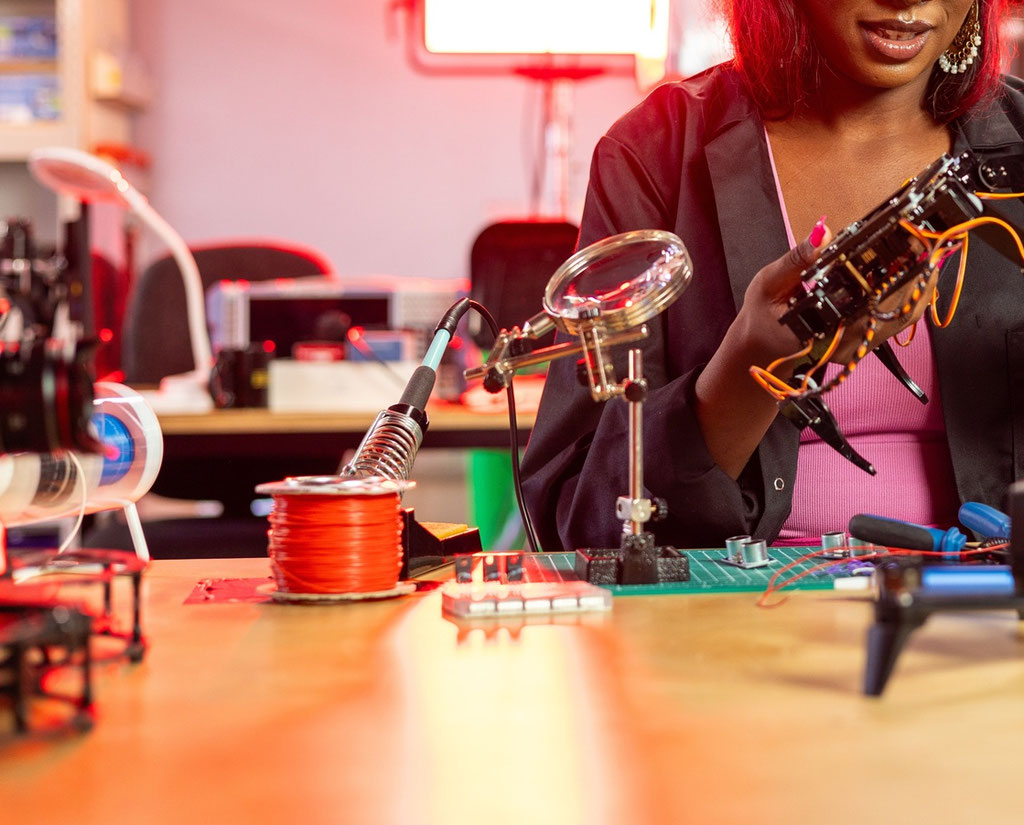
Image by This_is_Engineering from Pixabay