Blossom Johnston grew up on the Big Island of Hawaii, one of 12 children raised by a Native Hawaiian mother and an Irish father. Long before she became CEO of Idaho Partners for Good, she learned a word that would end up shaping her entire career: kuleana.
It means responsibility, but not the kind most of us think of. Not a to-do list. Not a job description.
"It means that we have a responsibility for not just ourselves for showing up well, but for our families, our communities, and the earth, the environment," Blossom explained on the latest episode of the HeroX Innovation Leadership Speaker Series. "It's not about self. It's about where we fit in the larger ecosystem of family, community, and the world."
That worldview is the engine behind everything she's built. And in a conversation that moved from nonprofit finances to community trust to the future of philanthropy itself, one thing became clear: Blossom isn't interested in incremental fixes. She's interested in rebuilding the system.
The Sector Is Asking the Wrong Question
.jpeg)
Idaho Partners for Good has worked with more than 180 nonprofits in five years, almost all of it pro bono. Boards trained. Budgets built from scratch. Organizations pulled back from the edge of losing their tax-exempt status entirely. But Blossom's real target isn't any single organization. It's the habits and mindsets that keep the whole sector underpowered.
Start with the question every donor asks: what's your overhead percentage?
"That cycle has produced starvation in the nonprofit sector," she said. "We have to stop asking the wrong questions and start asking the questions that will actually get the mission advanced."
What should donors ask instead? What's your impact? How is your team led? Are the people doing the work paid enough to stay in it? Because the alternative, she pointed out, is nonprofit employees who can't afford rent in the communities they serve, who end up relying on the very public benefits their own organizations exist to provide.
Her fix has a name, and it doubles as a mantra: give better to get better. Philanthropy has to retire its outdated, blunt-instrument approach to giving. Nonprofits have to retire their outdated, reactive approach to running an organization. Both sides of what she calls the philanthropic coin need to change at once, or neither does.
Run It Like a Business, Without Losing What Makes It a Mission
Idaho has roughly 10,500 nonprofits. Blossom's stance on that number is blunt: it doesn't need more. What it needs are leaders willing to treat their organizations the way smart entrepreneurs treat a company; with real financials, real governance, and real strategy, instead of bank statements standing in for a budget.
That doesn't mean abandoning the mission for margin. It means recognizing that mission requires the discipline most nonprofits never get the bandwidth to build. Most leaders, she said, already know exactly what their organization needs to fix. What they lack isn't insight. It's the resources and the permission to step back from the daily fire long enough to act on it.
That's where the idea of de-risking innovation comes in. Big, no-strings funding, the kind philanthropist MacKenzie Scott has become known for, gives leaders room to try something they'd never risk otherwise. Blossom wants more of it, and she wants it paired with the kind of mentorship most nonprofit boards don't even know is part of their job.
Two of her favorite examples prove the model works. The Boise Bicycle Project, supported through the chaos of COVID, came out the other side with a leader who went on to join the Boise City Council. Jesse Tree Idaho, after years of structural and design work together, spun off an entirely new statewide housing organization because its leader saw a bigger play and went after it.
The Real Competition Is Trust
Ask Blossom what single problem she'd put in front of a global crowd of problem solvers, and she doesn't hesitate.
"I'm not sure anybody has cracked the code at this point in time about the erosion of public trust," she said. "How do you begin, at a scalable place, to rebuild the trust between people and their leaders, and leader to leader? This is one of those challenges that is indicative of our times, and we need some of the biggest brains to be able to solve it from the grassroots level all the way up."
It's a problem she's already living inside. Her organization's newest initiative, Our Idaho Neighbor to Neighbor, is built on a simple bet: government isn't going to step in, so communities have to rebuild the instinct to show up for each other the way they once did, barn-raising style. That means making needs visible, mobilizing people around shared values, breaking down the silos between sectors, and strengthening the safety net underneath it all.
It also means confronting an uncomfortable truth she's seeing play out even among well-intentioned organizations: people in the same ecosystem, chasing the same grants, often default to competing instead of combining forces, even when collaboration would make every one of them stronger. Two of Idaho's largest nonprofits recently merged, and Blossom holds it up as proof of what's possible when leaders choose partnership over territory. She wants that to become the rule, not the exception.
Strive for the Summit
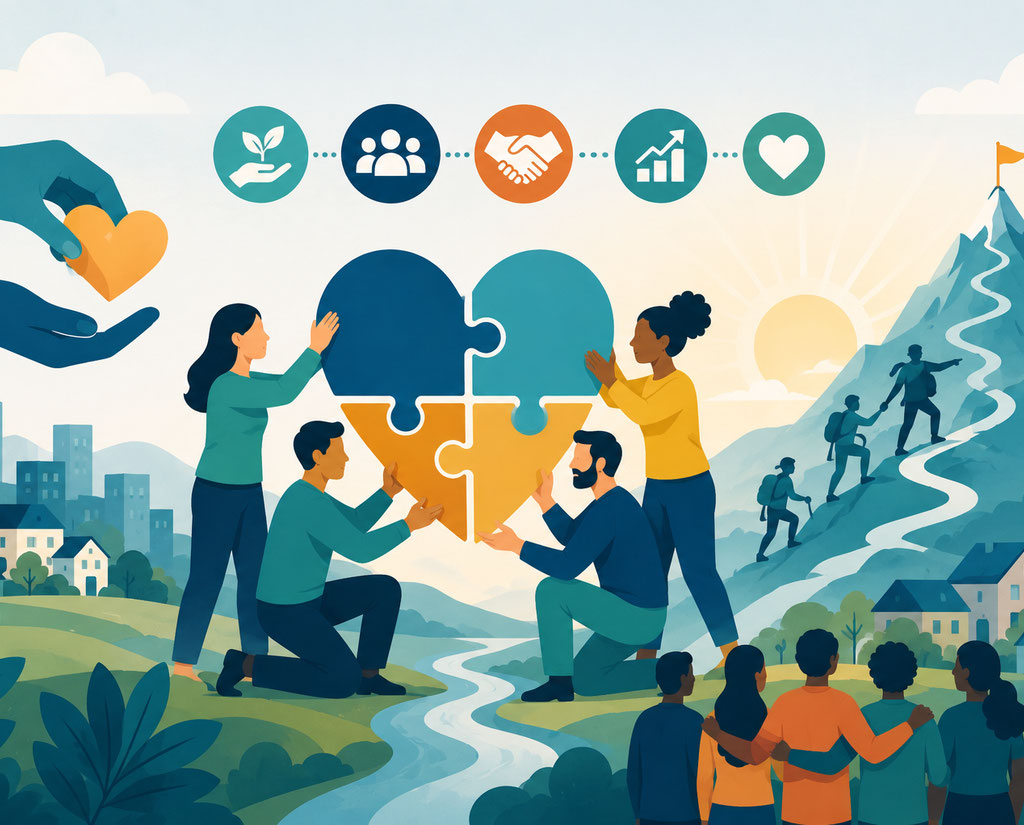
Blossom closed the conversation the way she opened it, in the language she grew up with: kūlia i ka nu'u. Strive for the summit. It's both an invitation and a challenge, aimed at anyone willing to lead from the front so others can find their way up behind them.
That's the thread running through everything she's built in Idaho: a refusal to settle for systems that are merely surviving when they could be transforming the people they're meant to serve.
Watch the full conversation below to hear Blossom Johnston's complete take on rebuilding trust, the case for running nonprofits with real strategic rigor, and what it actually looks like when an entire sector stops competing and starts solving problems together.