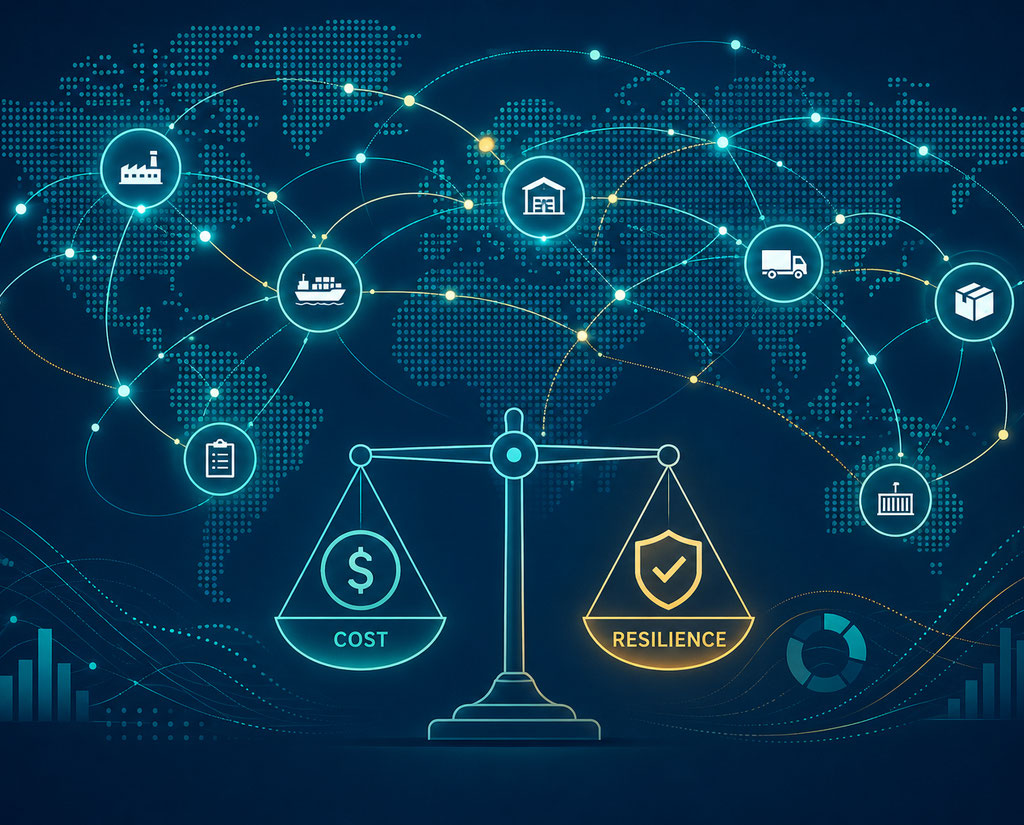
A deep dive with Dr. Morgan Swink on how the TCU Center for Supply Chain Innovation is training the next generation of supply chain leaders through hands-on experiential programs and cutting-edge research, all while guiding industry's critical pivot from a low-cost sourcing model to a more resilient, risk-weighted strategy.
From the Shop Floor to the Classroom
Dr. Morgan Swink's journey to leading TCU's Center for Supply Chain Innovation began where many great ideas do, on the factory floor. His early career in engineering and product development at Texas Instruments gave him something rare in academia: a visceral understanding of what he calls "the whole end-to-end innovation process." But it was the pull toward research and teaching that ultimately led him to pursue a PhD in Operations and Supply Chain Management, bringing that practical experience into the classroom.
Today, that unique perspective shapes everything the Center does, from curriculum design to corporate partnerships. And the timing couldn't be better.
"Supply Chain Is Now Top of Mind"
Remember five years ago, when supply chain professionals had to explain their jobs at dinner parties? Dr. Swink does:
"Five years ago, I would go to a party, and they'd say, oh, you're a professor, what do you teach? I say supply chain. They go, what is that? They have no idea. Now I say supply chain and everybody knows what I'm talking about."
The whirlwind years since 2020 have transformed supply chain from back-office function to boardroom priority. Pandemic disruptions, geopolitical tensions, and trade wars have made one thing clear: the old playbook of simply chasing the lowest cost is broken. The question now isn't just, "How cheap can we source this?" but, "How resilient is our entire network?"
This uncertainty isn't just creating challenges; it's driving a wave of innovation in both talent development and sourcing strategy.
Innovation by Design

When TCU launched its Center for Supply Chain Innovation, the name was intentional. While other schools opted for "centers of excellence," Dr. Swink and his team wanted to signal something different to corporate partners: this would be a place where innovation happens, not just education about best practices.
The Center pursues a two-pronged mission: solving real business problems while simultaneously innovating in how supply chain leaders are trained. And they're doing both through hands-on, experiential programs that look more like R&D labs than traditional classrooms.
Crowdsourcing the Future
Each year, the Center hosts a graduate-level Case Competition that's part hackathon, part pressure cooker. Student teams from over 20 schools descend on TCU for a 24-hour sprint to solve a real-world problem presented by a company partner, judged by 60-70 executives. It's intense, practical, and remarkably effective at surfacing fresh thinking.
Then there are the Capstone Projects: full consulting-style engagements where students and faculty tackle everything from applying AI to scheduling problems to planning for foreign direct investments driven by trade tensions. These aren't theoretical exercises. They're solving problems companies are grappling with right now.
Sound familiar? It should. This model mirrors what HeroX has proven at scale: when you open complex problems to diverse solvers, innovation accelerates. Just look at the Watts on the Moon Challenge, where university and startup teams developed breakthrough solutions faster than traditional market approaches could deliver.
"Sometimes students can be really great sources of innovation and knowledge and cutting edge thinking."
Academia, it turns out, is the new R&D lab.
The Hidden Cost of Trade Wars
Dr. Swink's research reveals something fascinating about how uncertainty kills innovation. His work on "Trade Policy Effect Uncertainty" shows that the 2018-2019 trade war didn't just disrupt supply chains; it actively suppressed R&D investment and patent filings, especially among companies with exposure to China.
Fast forward to today, and we're seeing the consequences play out in real-time as companies scramble to implement "China Plus One" strategies and ramp up investment in Mexico. The cost of that earlier uncertainty? Years of suppressed innovation that companies are only now trying to recoup.
The Unexpected Innovation Enablers
Dr. Swink also discussed research on financial analysts as unlikely catalysts for supply chain innovation. When an analyst follows both a buyer and supplier in a relationship, something remarkable happens:
"We found that if you have an analyst that follows both the buyer and supplier in a buyer-supplier relationship, these analysts can act as information intermediaries... we see a net increase, almost 33% higher investment in R&D."
By reducing information asymmetry and perceived risk, these third-party analysts enable suppliers to invest more confidently in relationship-specific innovation. It's a 33% boost that many companies don't even know they have access to.
The New Strategy: Risk-Weighted Thinking
The lesson for innovation leaders? The era of purely cost-driven supply chain strategy is over. Success now requires what Dr. Swink calls a "risk-weighted approach," balancing cost against resilience, diversification, and the ability to innovate quickly when markets shift.
This isn't about abandoning efficiency. It's about recognizing that the cheapest option today might be the most expensive when the next disruption hits. And in a world where uncertainty is the only constant, that shift in thinking isn't optional; it's survival.
Ready to see how crowdsourcing can help your organization build a more resilient, innovation-driven supply chain? Watch the full conversation with Dr. Morgan Swink on HeroX to learn how tapping into diverse networks of talent can solve your next supply chain challenge—faster and smarter than traditional approaches.
External Links: