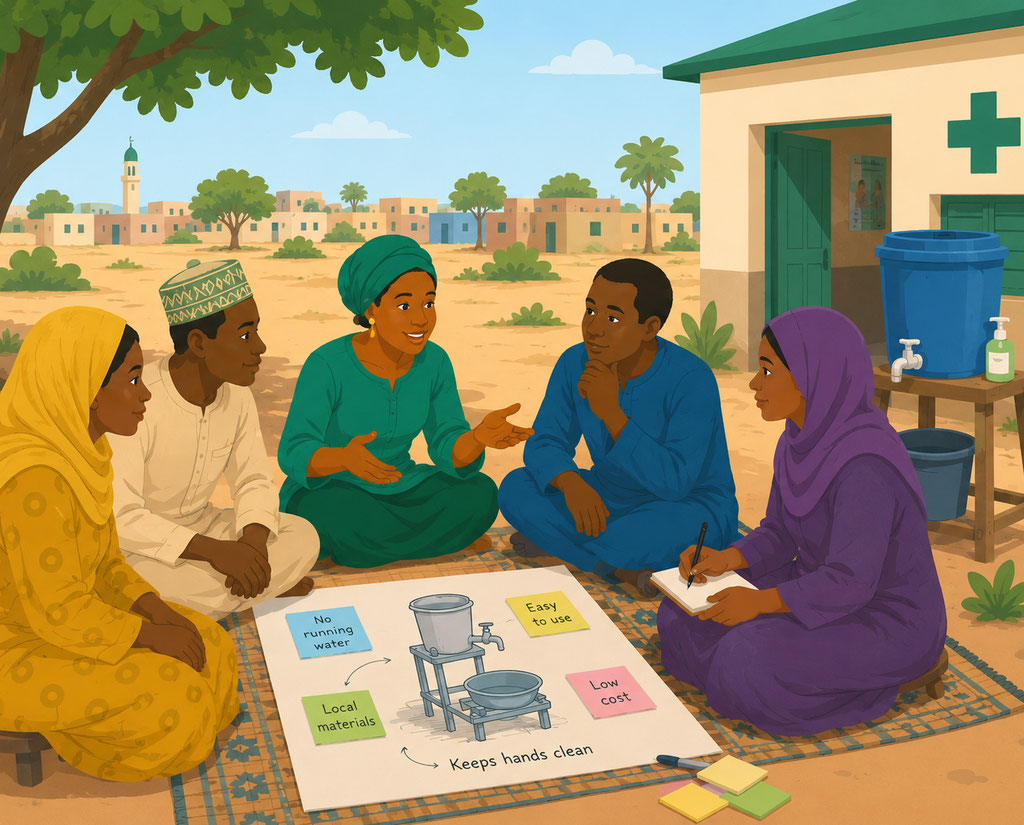
Carla Lopez has spent her career solving problems most people would call impossible. Life-threatening malnutrition in children under five in the Sahel. Hospital-acquired infections in clinics without running water. Containing Ebola while the science on it changed by the hour. Along the way, she's developed a sharp, practical philosophy about what innovation actually requires, and it has almost nothing to do with the disruption-and-shiny-new-thing version of the word that's become so common.
In the latest episode of the HeroX Innovation Leadership Speaker Series, Carla joins host Jamie Elliott to talk about her journey from global health work in Papua New Guinea, Haiti, and Angola to leading human-centered design at the International Rescue Committee. What emerges is a clear-eyed account of why so much well-intentioned public health work fails, and what it actually takes to fix that.
The Problem With Telling People What's Good for Them
Carla's early career was spent with Population Services International, delivering contraceptives, HIV prevention, and malaria nets through local markets rather than top-down government programs. She quickly ran into a wall that anyone in public health will recognize: the field's default mode is lecturing people into compliance.
"Smoke cigarettes and you will get cancer and die. Don't use a condom and you'll get HIV and die. Don't sleep under a malaria net and you'll get malaria and die. There's a lot of finger-wagging, and it absolutely does not work. Otherwise nobody would smoke and everyone would sleep under a net."
That observation sent her toward IDEO.org, where she learned to formalize an instinct she already had: start with the people experiencing the problem, not the experts diagnosing it. It sounds obvious. In practice, almost nobody does it.
Innovation Isn't a Framework, It's a Muscle

One of the most striking parts of the conversation is Carla's account of serving as country director in Liberia during the Ebola outbreak. There was no playbook for a crisis where the facts on the ground changed between morning and afternoon. The existing systems for communicating health information to communities were actively eroding trust, because the message kept changing and nobody had built in a way to explain why.
That experience reshaped how she thinks about innovation entirely. It isn't a checklist or a set of phases to march through.
"Innovation for me is not about having a handbook and going through these set phases. It's about doing that enough times that you understand what you're trying to achieve, and then having the confidence to approach a new situation and understand what to keep and what needs to shift based on the constraints you're facing."
That's a sharper definition than most strategy decks offer, and it's one built from working inside actual emergencies, not theorizing about them.
The Real Bottleneck Isn't the Solution
Ask Carla where good ideas come from and she'll redirect you. The harder, more underrated work is defining the problem in the first place. Sitting with people closest to the problem, she's found, often resembles a therapy session more than a strategy meeting, and that's by design. People who've spent years failing to fix something need space to be heard before they can help you see what's actually fixable.
This is also where her hand hygiene work comes in. Hospital-acquired infections, often driven by poor provider hand hygiene, are a massive global health burden. The emerging solutions, like far-UVC light disinfection, are being optimized for hospitals in places like Germany. Carla's question, raised through a crowd-solving challenge run with Harry Sangree, was different: what if that same innovation were designed from day one for a rural health post with no running water?
It's a quiet but pointed challenge to how innovation pipelines actually work. The biggest opportunities for impact often sit outside the markets that get the R&D budget first.
Failure Is Data, Not a Verdict
Carla doesn't romanticize this work. She describes a project recruiting Syrian refugees in Jordan into an ideation process meant to co-design solutions for their own communities, an effort she calls an honest failure. People who had survived that journey weren't looking for an invitation to brainstorm. They needed the problem solved, not another project to participate in. The real insight came from what shifted afterward: using those same participants to validate solutions developed by others, rather than asking them to generate ideas from scratch.
That distinction, between co-creation and validation, between asking people to invent and asking them to weigh in, is the kind of nuance that only comes from getting it wrong first.
Why This Conversation Is Worth Your Time
If you work anywhere near global health, humanitarian response, or public sector innovation, Carla's framework for separating real constraints from inherited assumptions is worth sitting with. Her core argument is simple and uncomfortable: most of what gets called innovation is really just doing the familiar thing slightly differently, and the field rarely admits how rare genuine problem definition actually is.
Watch the full conversation below to hear Carla and Jamie dig deeper into the donor risk paradox, why public health philanthropy says it wants disruption but funds incrementalism, and how crowd-solving challenges might finally bridge the gap between field evidence and published research.