Trust in democracy isn't disappearing because people have stopped caring. According to Nick Vlahos, it's disappearing because too many people no longer believe the systems meant to represent them actually hear them. His work is focused on changing that from the ground up.
That's the world Nick Vlahos has spent the last 15 years trying to redesign. As managing director of the Center for Democracy Innovation at the National Civic League, Vlahos works with local governments across the country to rebuild the systems that decide how communities solve problems together. The League itself dates back to 1896, founded by reformers like Louis Brandeis and Teddy Roosevelt to fix the patronage and clientelism plaguing early modern city government. More than a century later, Vlahos is tackling a different version of the same problem: people who've stopped trusting the institutions meant to represent them.
The numbers back him up. Trust in political institutions is falling. Anti-system populism is rising. And according to Vlahos, the reason isn't apathy. It's that the systems for being heard haven't kept pace with how complicated the problems have gotten.
"There's an innate need, as a political society, to solve problems, to be involved, and to be the owners of the laws and policies we live under."
That belief shapes everything his center builds. One major focus is charter reform, essentially rewriting the local constitution that governs how a city operates. Unlike the U.S. Constitution, which is nearly impossible to amend, city charters get revisited every couple of decades, sometimes sooner. Vlahos and his team help communities use that window to embed civic participation directly into the structure of government, not as an afterthought, but as a written-in value.
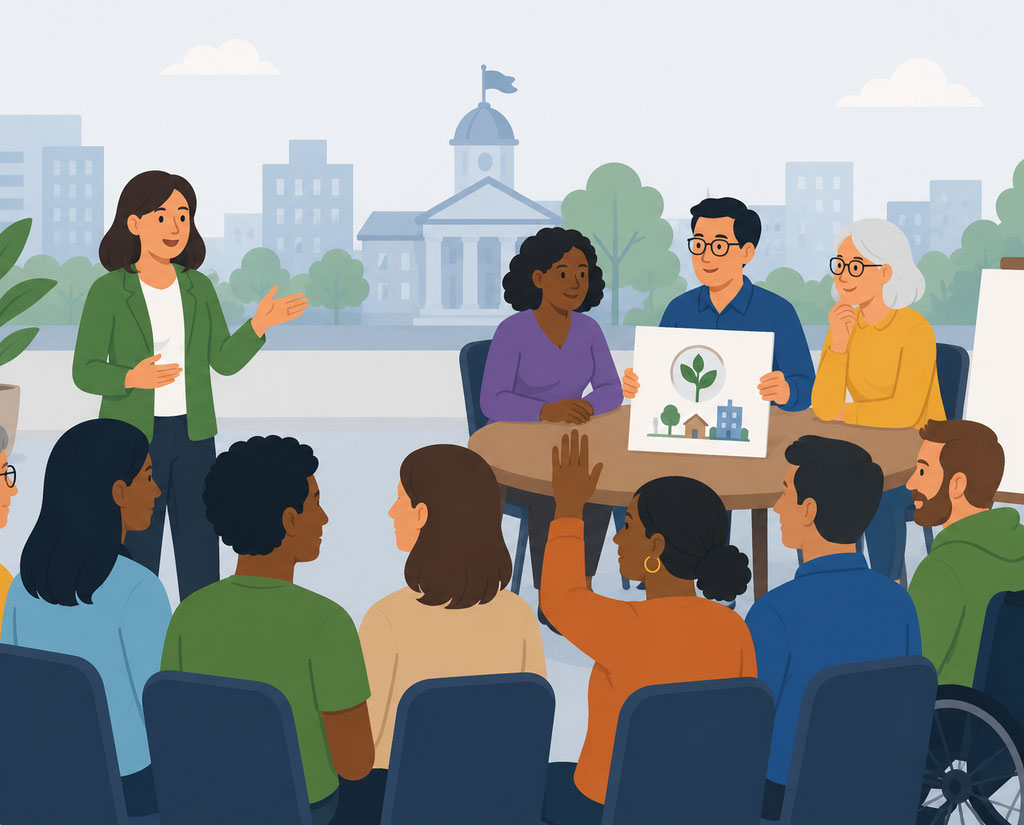
The other major piece of his work is something most people have never heard of: citizens' assemblies. Through a process called sortition (essentially a civic lottery), a demographically representative group of residents is randomly selected to spend months learning about a complex issue, debating it, and reaching consensus. Vlahos has seen these groups untangle electoral systems, weigh in on AI policy, and tackle questions most elected bodies avoid entirely.
"These have proven very successful in navigating very complicated technical information. The public are able to learn over several months and challenge each other's opinions to come to some sort of consensus."
It's a strikingly different model from the one most people associate with democracy. No campaign ads, no debates designed to score points, just citizens with no political stake sitting in a room long enough to actually understand a problem before deciding what to do about it.
Vlahos is careful to separate this from partisanship. His work happens almost entirely at the local level, where party lines matter less and the real question is more practical: how do you get a community to trust the information in front of it, and trust each other enough to act on it? He doesn't pretend local government is immune to bad information or bad actors. But after interviewing roughly 150 local elected officials over his career, he's landed somewhere more hopeful than cynical.
"I do think that public administrators are trying to present neutral, fact-based information. Their challenge is the broader information ecosystem, which is problematic, to say the least."
One story sticks with him more than the data ever could. In Franklin, Tennessee, a community wanted to boost youth civic engagement. So they tried something deceptively simple: an 8 a.m. event called Breakfast with the Mayors. Four hundred fifty people showed up. Sixty of them were teenagers, voluntarily getting up early to talk about how to make their city better. It's the kind of story that never makes the national news, but it's exactly the kind of thing Vlahos believes should be studied, replicated, and celebrated. That instinct is part of why the National Civic League runs the All-America City Award each year, recognizing communities doing exactly this kind of work.
What's next for Vlahos is even more ambitious: a charter reform project in Kingston, New York, deeper work with the city's civic engagement commission and community boards, and a growing interest in the connection between economic mobility and democratic participation. He's increasingly convinced the two aren't separate conversations. Places with stronger civic social capital tend to see stronger upward mobility too, and as AI continues to reshape the job market, he thinks democratic participation and economic opportunity will become even more tightly linked.
If you're someone who builds systems for collective problem-solving, in government, innovation, or anywhere people need to trust a process enough to engage with it, Vlahos's work is a masterclass in treating "feeling heard" as a design problem instead of a soft goal.
Watch the full conversation with Nick Vlahos below to hear more about citizens' assemblies, the future of charter reform, and why he believes the health of our democracy and the health of our economy are more connected than we think.