
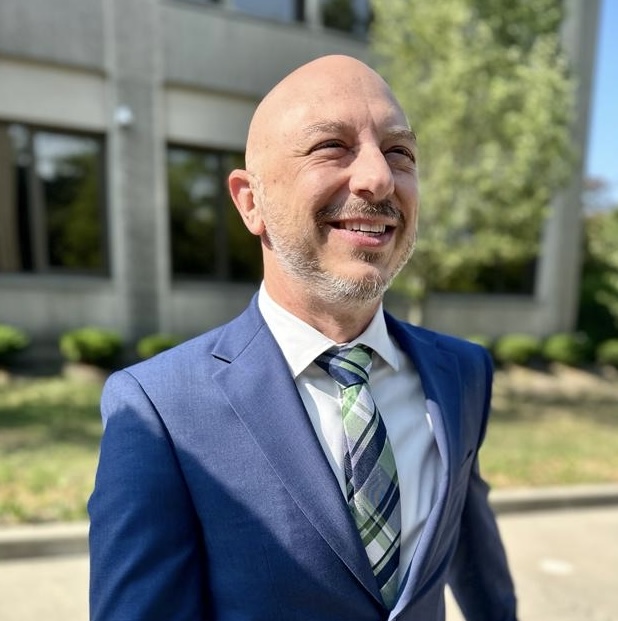
When Matt Callison walks into a room, he brings a question with him: What if school could actually prepare kids for the world they're about to enter?
As Director of Innovation and Strategic Partnerships at South Fayette Township School District, Matt has spent years turning that question into action. His journey from classroom teacher to innovation director wasn't a straight line; it was a series of curious detours, bold experiments, and the kind of stubborn optimism that makes bureaucratic walls feel temporary.
And in his conversation on the HeroX Innovation Leadership Speaker Series, he laid out a philosophy that every educator, administrator, and organizational leader would do well to hear.
Redefining the Purpose of School
Matt's starting point is a fundamental one: if students can access any piece of content knowledge on their phones in seconds, what is school actually for?
His answer cuts through the noise.
"To me, the purpose of school is increasingly about learning how to connect with humans, and build relationships, to build those durable skills. We all feel we're connected because we have a phone, but we're isolated, lonely…"
The new mandate, in his view, isn't to fill students with information; it's to build the human skills that no algorithm can replace. Empathy. Collaboration. Relationship-building. The ability to sit across from someone and solve a problem together.
That belief is the bedrock of everything South Fayette does.
The Three-Part Filter That Drives Every Decision
So how do you build a school culture around that belief? Matt's team uses a three-part strategic filter for every program, project, and partnership they pursue: Future-Focused. Student-Centered. Innovation-Driven.
If a new initiative can't check all three boxes, it doesn't move forward. Simple as that.
But within that framework, two specific strategies stand out as especially powerful.
First: the Authentic Audience mandate. Projects must engage students in real work for a real audience outside the classroom. When students know their work matters to someone beyond their teacher, motivation shifts. Purpose shows up. Researcher David Yeager's work on adolescent meaning-making backs this up, and South Fayette has built it into their DNA.
Second: the "Who, Not How" principle. Borrowed from the book of the same name, this approach flips the typical innovation bottleneck on its head. Instead of getting stuck on how to fund or execute an idea, Matt asks: who already has what we need? That means identifying the right teacher partner (someone open, willing, and ready) and building an ecosystem of external collaborators who can fill the gaps.
Innovation in Action
The results speak for themselves. South Fayette has built a Hydroponic Farm and Data Science Pathway, a Mobile Classroom and Streaming Studio, and an Immersive Reality Space developed in direct partnership with Carnegie Mellon University. These are more than flashy add-ons; they're integrated learning environments where students tackle genuine challenges for real community partners.
Students have solved actual business problems for All-Clad. They've designed assistive devices for staff members living with Multiple Sclerosis. The classroom walls, quite literally, don't contain the learning anymore.
None of this happened by writing big checks. It happened by thinking ecosystem-first.
"Yes, everything costs money… But thinking about ecosystem partnerships, a team approach — we've been able to do a lot of things."
Getting Educators Out of the Building
One of Matt's most underrated strategies? Taking teachers on field trips. Site visits to companies like Duolingo and local robotics firms get educators out of their routines and into environments that spark new thinking. Matt sees his role as the person who asks "how might we?" and then removes the bureaucratic barriers so teachers can actually try things.
"It's important for myself and for our educators to be out of the classroom, to see what's happening in the real world."
He calls it planting "little bets" (based on the book by Peter Eagle Sims), small pilots that build confidence, generate evidence, and create the momentum for bigger change.
The Work Is Never Done
Even with all this momentum, Matt is honest about what remains hard: ensuring every student knows these opportunities exist, and genuinely feels they belong in them, is an ongoing challenge. South Fayette is partnering with CMU's Human Computer Interaction Institute to tackle this belonging gap head-on. Because an innovation ecosystem that only reaches some students isn't finished yet.
Watch the Full Episode
Matt Callison's approach is a masterclass in building innovation culture without waiting for perfect conditions or unlimited budgets. It's a reminder that the right who will always outpace the elusive how.
🎙️ Catch the full conversation with Matt on the HeroX Innovation Leadership Speaker Series, below. Whether you're leading a school district, a company, or a community initiative, his framework for authentic impact is one worth stealing.
Inspired by Matt's ecosystem approach? Contact us and learn how HeroX Design Thinking Workshops can help your team tackle your next big challenge — in education, organizational design, or beyond.
Resources
- South Fayette Township School District
- Carnegie Mellon's Human-Computer Interaction Institute
- David Yeager's Research
- Who Not How by Dan Sullivan and Dr. Benjamin Hardy
Image by Gerd Altmann from Pixabay