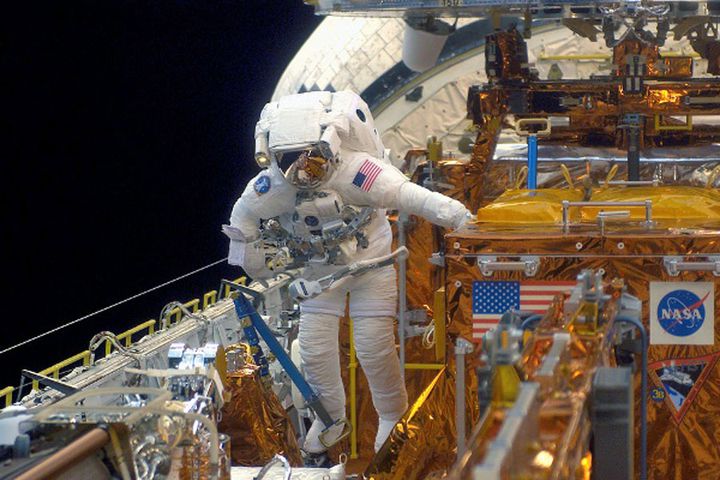
Did you ever dream of being an astronaut as a kid? Did you ever beg your parents to be sent to Space Camp (who didn’t??) Well, we can’t all be worthy of those handsome orange suits, but that’s not the only way to leave your mark on the legacy of human spaceflight. Now, there’s’ a chance to really make a lasting impact with the Space Poop Challenge. It’s a $30,000 incentive prize for a NASA-worthy system for spacesuits that routes human waste away from the body, hands-free. But before you go rushing to the drawing board to try and solve this one (and we know it’s tempting to want to get started immediately), consider the status quo of waste management in space today. There’s a good chance you haven’t done a whole lot of reading on this subject, after all.
Waste Management is a Serious Issue
The space stations of today aren’t exactly 100% self-sustaining – they can't grow their own food up there, and they require regular shipments of water, fuel, and other supplies. But the ISS does feature a variety of systems designed to recycle and reuse almost everything, a trend that’s sure to continue with longer ranger missions in the future.
It's important to note that it’s expensive to send cargo to outer space. Really expensive. The cheapest option right now is via unmanned carriers provided by SpaceX. Using the new Dragon spacecraft, launched on a Falcon 9 rocket, cargo reportedly costs about $9,100.
This may seem extremely high, but the good news is that the cost is going down. Compare that to their closest competitor, the Cygnus spacecraft by Orbital Science: it hauls cargo at a price of about $43,000 per pound!
This prohibitively high cost of cargo means that the crew on board the ISS and the engineers back home have to do everything they can to recycle -- well, everything they can. And it turns out they do a great job of just that.
Hand Me That Space-Plunger
How does plumbing work in zero-g? Technically it's microgravity up there, but no real difference.
Your body pumps blood and fluid, no matter how you're oriented. It works best when you're on Earth, though, and gravity is generally pulling it towards your feet – that's why astronaut's head's swell up in space, when that pull is taken away.
The ISS actually has a circulatory system too, embedded between the outer skin and inner walls. This life-support system uses pumps and fans to recycle and circulate the vital liquids and gases the crew needs to survive, and the ISS needs to keep going. In between cargo drops, the space station runs on a fixed amount of air and water. And that means everything needs to be ship-shape or a major problem could arise.
Getting a plumber over can sometimes be a bit stressful on Earth. Now imagine how you'd feel when your super-duper space toilet breaks down (again). It's a situation you want to avoid, to say the least.
Drinking Your Friend's Sweat and Other Fun Space Tricks
On the ISS they manage to reclaim about 93% of the water they use. They do it with a very fancy liquid recycling system, which can handle greywater, urine, and sweat. It absorbs moisture from the cabin air, and also has a direct line from the urine hose.
So that means when you grab a drink of water on the ISS, you're drinking what was once your friend's sweat. And your sweat. And yes, your urine.
But never fear, aspiring astronauts: the water you drink on the ISS is actually more pure than what you're getting on earth, thanks to the quality of the purification system.
And when it comes to number 2 – don't worry, you won't be re-ingesting that. On the ISS, feces is collected, treated to prevent bacterial growth, and later sent to burn up in the atmosphere like a shooting poop star.
So solid human waste is not recycled at the moment, though there's talk of eventually using feces to line the walls of future space missions as a radiation shield. Not the inside of the walls, I assume.
The ISS isn't self-sustaining, but it sure does a great job at recycling waste. Unfortunately, astronauts don't have the same high-tech solutions going on in their spacesuits. But the time of the astronaut diaper may soon be over, and you can be a part of the solution.
The Space Poop Challenge
NASA is looking for a new spacesuit system to collect human waste and route it away from the body, entirely hands-free. The Space Poop Challenge is offering up to $30,000 for the best solutions to this crappy problem, so check out the challenge page to learn more and get registered!