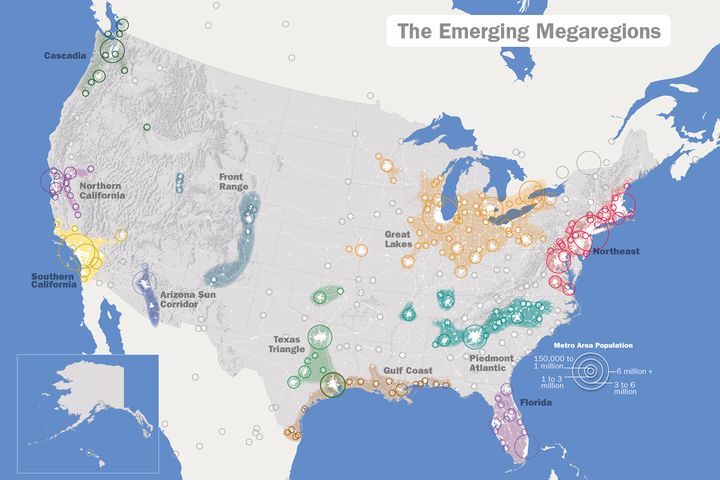
Culture and politics may seem like fickle and ephemeral subjects, far-removed from the objective and tangible nature of something like transportation infrastructure. In the funny way of human societies, however, one could easily make the case that culture, politics, and infrastructure are three parts of our national whole. These three aspects of civilization, are inseparable in the ways they shape and influence each other.
- Politics shape infrastructure: statewide budgets, municipal demand, and federal bureaucracy all play a tremendous role in what gets built and what never makes it past the pages of the proposal.
- Infrastructure, especially related to transportation, strengthens and even creates patterns of behavior in markets and individuals. These patterns dictate the segregation, integration, and eventually evolution of regional culture.
- Culture, commuting patterns, and market factors directly influence public opinion and voting, and thereby influence politics.
...and around and around we go.
Parag Khanna, the author of the book Connectography, shed some light into this infra-cultural-political intersection in an essay seen here. Khana makes the case that, although the intersection of culture infrastructure is immutable, the American political system does not fully recognize its position within this triumvirate.
As Khana states, many of the nation’s political problems stem from the fragmentation of modern city-states -- a direct result from state borders drawn more than 100 years ago. The political-economic state of the nation may see conflicts regarding “red states” vs. “blue states,” when in fact the real conflict is closer to “connected hubs" vs. "disconnected backwaters," so to speak.
Reshaped by Density and Infrastructure
In his essay, Khanna describes how the present 50 state model handicaps cities and rural areas. State capitals are often small isolated cities, which means that funding and policy become disconnected from the flow of resources and assistance.
This “capital disconnect” has left the regional planning up to groups like the Western High-Speed Rail Alliance and CG/LA Inc. The argument is that with disconnected capitals, these organizations have been left alone to pull America into a shape which better matches the global economy. Imagine if state officials were aligned, geographically and mentally, with these socio-economic developers.
Khanna cites shifts in China which are redefining the Chinese political landscape beyond that of simple regionalism. By utilizing a network of “Megacity Clusters," population density and emerging economies actively shape subsidies and supply chains in a way that connects resources to those who need them most.
While this perspective yields some insights that might shape a national high-speed rail, it encourages the development of a political system which does not become hamstrung by arbitrary borders. Presently, as borders limit the reach of funding and planning, essential progress is discouraged simply because of the disconnect between representatives and "outside" constituencies.
What additional thoughts do you have when it comes to developing an Infra-Cultural-Political system that is as responsive and resilient as the neural networks of the human mind? Dream with us at Infrastructure Vision 2050!