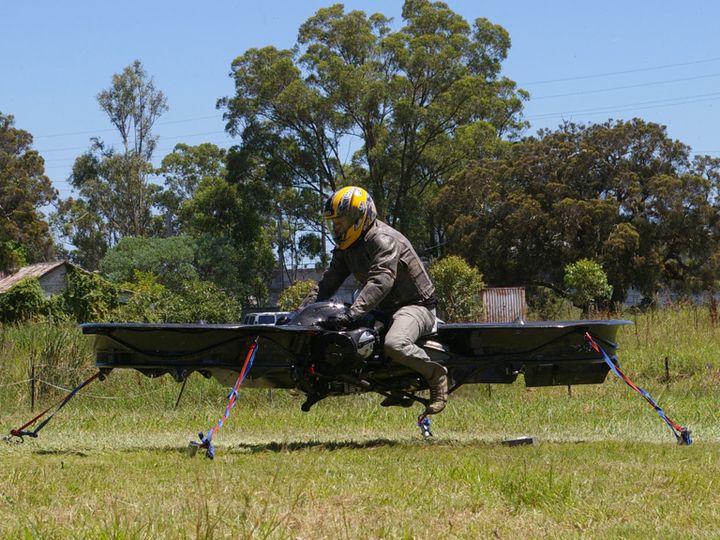
Humans sure love to think about flying personal transportation. We had the flying cars of the Jetsons, the skateboard in Back to the Future, and the speeder bikes of Star Wars VI: Return of the Jedi. While it's still not a reality for most consumers, there's a company trying to change all that. The idea is called Hoverbike, and it's now getting attention from the military.
"We combined the simplicity of a motorbike and the freedom of a helicopter to create the world’s first flying motorcycle," Malloy Aeronautics officials wrote in a Kickstarter campaign last year. "When compared with a helicopter, the Hoverbike is cheaper, more rugged and easier to use - and represents a whole new way to fly. The Hoverbike flies like a quadcopter, and can be flown unmanned or manned, while being a safe, low-level aerial workhorse with low on-going maintenance."
As of last year, the company was working on a 1/3-scale prototype. The next stage after that was an engineering prototype to show aircraft certifiers their stuff, and to try to seek approval. Then earlier this month came a breakthrough, that the U.S. Department of Defense would add its support to that of the crowdfunders.
Malloy will now team up with SURVICE Engineering Co. for a development contract with the U.S. Army Research Laboratory, which is intended to be a new kind of Tactical Reconnaissance Vehicle, a press statement on Malloy's website said. The amount of the contract was not released in the statement, nor a deadline for its development. But in a news report from the Baltimore Sun, Malloy officials said the vehicle could be ready in three to five years.
"The full-sized Hoverbike model — currently housed at the Malloy labs outside London but coming to the United States later this year — can fly carrying up to 200 pounds, its developers say," the Sun added. "A workable military version would need to carry two to four times that weight — 400 to 800 pounds, or a soldier plus his or her gear."
But the article also cites several objections from Tim Brown, senior fellow at the think tank GlobalSecurity.org. Some of the concerns he cites includes how it will handle terrain, and whether there is room for this concept in an era of shrinking budgets. Unmentioned by him, but also paramount, is safety. Having just anybody climb on to a hoverbike could offer more potential for disaster, especially since they are navigating in three dimensions.
There are other open questions, too. How would the Federal Aviation Administration handle a surge in personal vehicles that can fly? How would you train drivers? Protect buildings? Stop the small vehicles from interfering with flights, particularly around airports? What about the potential for terrorism in a whole new realm? These are just some of the things that should be considered.
That said, though, having your own personal airplane would be a lot of fun. Have a vision for how to make this possible? Launch a HeroX challenge and let the world know how you would do it.
Top image: Hoverbike. Credit: Kickstarter