Space junk. It sounds like an esoteric problem until you realize the cosmic billiards could destroy satellites. And indeed, it has happened before. In 2009, for example, a dead Chinese satellite smashed into a working Iridium satellite operated by the United States. Well, the Iridium was not operational any more as the force of the crash shattered it.
"Since satellites may disintegrate when struck by fast-moving space junk, the crash focuses concern that a future dramatic satellite collision may one day start an ablation cascade of increasingly more collisions. The result could then render future human space flights increasingly risky and expensive satellite lifetimes increasingly short," wrote NASA's Astronomy Picture of the Day of the incident.
Before we can discuss how to get rid of the junk, we need to track it. One of the U.S. military's functions is to watch where satellites are in space (including defunct ones). But the problem is epic, with an estimated half-million pieces of stuff up there. Ranging in size from paint flecks to machines, travelling as fast as 17,500 miles per hour. In the past, it forced the space shuttle to move; today, it occasionally threatens the International Space Station.

An infographic on space junk (click on the graphic for a larger version). Credit: NASA/Column Five/Good
After tracking, there is prevention. Astronauts on spacewalks are urged to keep careful track of where they stow items, lest they drift away and pose a hazard to the space station in the future. Manufacturers of space rockets are encouraged to design them to reduce space junk. As for old satellites, best practice these days is to steer them towards Earth's atmosphere when they're running out of fuel.
That takes care of the problem before it starts, but what about those hundreds of thousands of pieces that are up there? While some will naturally fall into the Earth's atmosphere over time, that could take years or decades. Further, there are many that orbit too high for that to be a factor. So snagging the space junk is something that is being discussed.
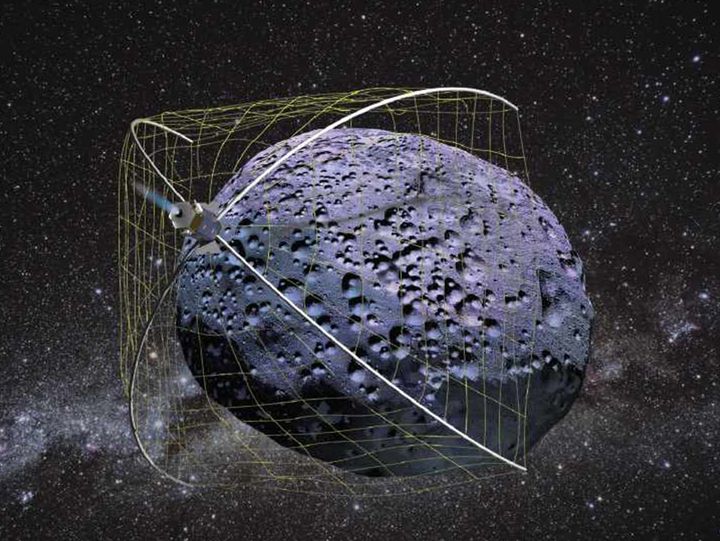
One example: NASA's Innovative Advanced Concepts program, which provides a bit of funding for early-stage programs, has in its portfolio a system called WRANGLER (Weightless Rendezvous And Net Grapple to Limit Excess Rotation). Essentially, it uses a large net to capture a piece of space debris or an errant space rock making its way towards Earth. Then a small satellite would move the object from harm's way.
Or how about fuelling or salvaging satellites to keep them going for longer? That technology is being tested on the space station and is also being considered by entities such as DARPA (Defense Advanced Research Projects Agency). The market is untested, but with this big interest being demonstrated, it's possible that it could be a reality in a few decades.
Do you have a neat idea to deal with space junk? Let HeroX know by creating a challenge, and marshalling a community to help you out.
Top image: The NASA Innovative Advanced Concepts program has provided early stage funding for WRANGLER, technology that could send away asteroids and space debris alike. Credit: NASA