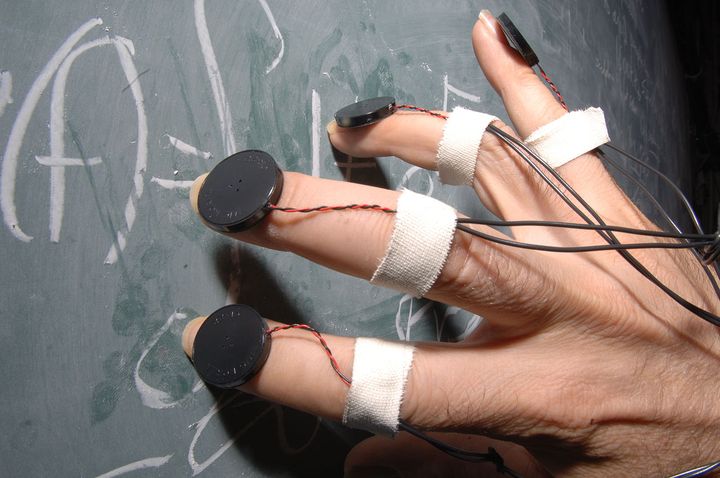
A close-up of wearable computer researcher Steve Mann using a "scratchable input" on his hand. Credit: Wikimedia Commons
Is Steve Mann a cyborg? The University of Toronto researcher says the term is not an accurate one to describe the wearable computers he uses and researches, but it presents some interesting questions.
Mann has been criticized for wearing computers that can record video and perform other functions that we are more used to seeing humans do than other people. And as bionics become more advanced, we are now implanting computers in our bodies instead to supplement or even enhance our native capabilities.
Cochlear implants (which are electronic devices) are now regularly used to give the sense of sound to somebody who previously couldn't hear. And a few weeks ago, Minnesota's Allen Zderad received a bionic eye that allowed the 68-year-old, who had a degenerative eye disease for two decades, to see his wife for the first time in 10 years. So there are definite medical uses for some devices, but how far should we go?
While the human body is a powerful machine, we definitely have certain limitations. Bats, for example, can locate objects using sound waves. Echolocation is something that humans can only do in limited form (in the case of blind people, for example). Or how about the number of animals that can see in wavelengths other than what the human eye perceives? Being able to see in infrared would show us which objects are warmer and cooler, simply at a glance. And X-ray vision has the (disturbing) potential to see underneath clothing and other objects to peer at what is underneath. Perhaps it could be used for building inspectors to spot defects in a structure, for example.
Bionic implants, however, face many of the same medical dilemmas as other emerging technologies such as DNA testing and cloning. Is the technology safe for humans? Is it ethical to use it? What are the possible side effects? How can we regulate some of the potential problems, such as using bionic implants for unfair athletic abilities in the Olympics or to perform covert surveillance for personal or other purposes? With the technology being so new, there are far more questions than answers. Still, the research forges ahead.
There also is the real fear of computers embedded in the human body. Perhaps one of the more famous science-fiction examples showing that fear was the Borg of the Star Trek universe. These were aliens portrayed as invading other civilizations, acquiring their knowledge and then assimilating them into a greater computer-like "collective." When Captain Jean-Luc Picard was captured by the Borg, receiving the implants was portrayed as a terrifying experience that marked him for life, even after the implants were removed.
But there are numerous examples out there that could offer benefits to humans, if the technology is proved safe and effective. An Australian engineer has developed a bionic heart that could last 10 years later than traditional artificial hearts, since there wouldn't be as much part deterioriation, although the device is only tested on sheep so far.
There also is the example of a bionic hand that was able to give new nerve signals to move the digits of people who previously had those abilities affected in accidents. And in Sweden, there is at least one amputee wearing an arm prothesis that is hooked into the bones, nerves and muscles in his body.
For now, it appears that bionic implants are mostly used to give so-called "normal" human abilities to people who lost them or never had them in the first place, such as restoring limb movements or senses such as sight or hearing. But as the technology advances, inevitably there will be those that want to use them to become more powerful than before. How this could be a benefit? It's hard to say right now, but ready or not, we should start having those discussions now as microcomputers become ever more powerful.