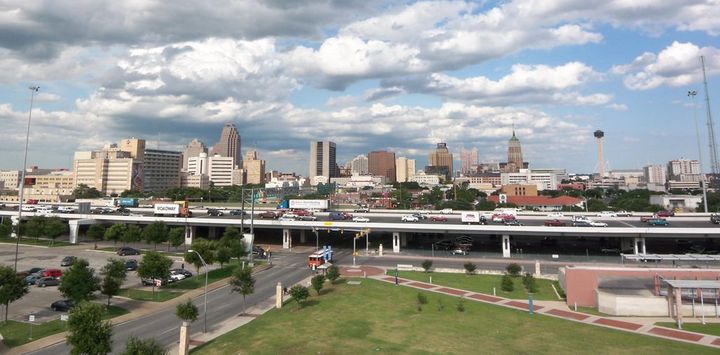
San Antonio is a community full of opportunities for Mexicans. With roughly 63% of the population identifying themselves as Hispanic, according to the 2010 census, it's one of the largest such communities in the United States.
Hispanic-owned businesses are also a large part of the community -- nearly 40% in 2007, according to the same census -- but there is still plenty of room for more, the creators of the Mx Challenge say.
The goal is to build a bridge of companies with strong connections between Mexico and San Antonio. Such a connection would be a huge boon to Hispanics, says program director Jesus "Tito" Salas.
"It's our whole purpose and whole mission," he says. "We put in a half a million dollar prize for the contest to bring in more and more companies."
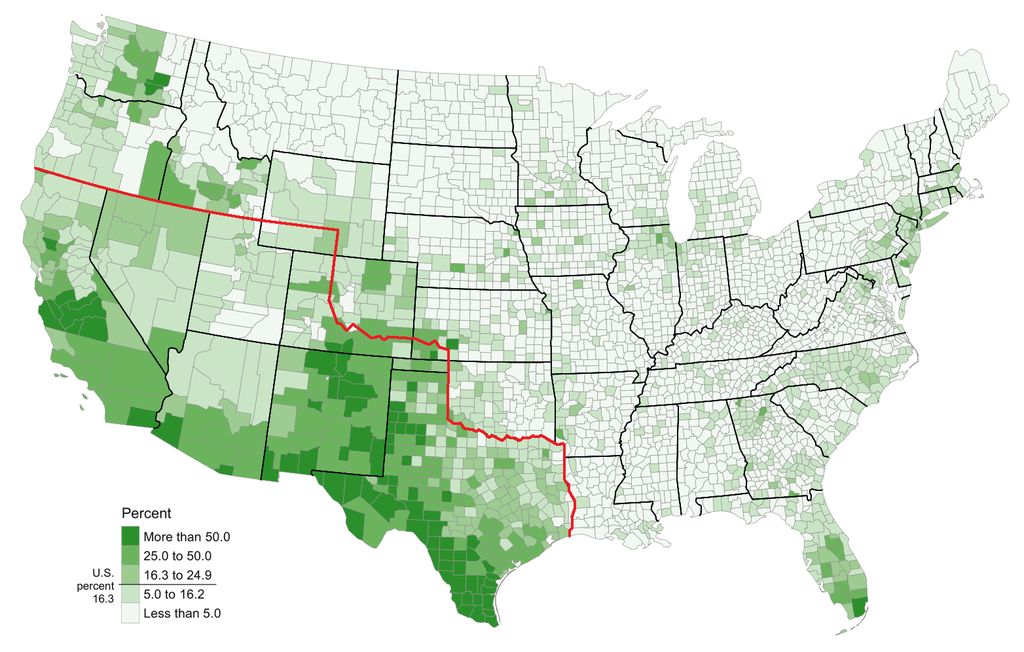
The Hispanic and Latino American population in the United States in 2010, with the old 1836 Mexican border shown in red. Credit: Wikimedia Commons
There are numerous reasons. San Antonio's strong Mexican community provides an easy point of entry for Mexican businesses because of the shared language and culture, something that may not necessarily be true in larger cities. Also, the cost of living in San Antonio is less than in a place such as San Francisco or Chicago, making it easier for small businesses to do well.
Additionally, a Mexican business looking to expand to the United States has better access to venture capital than they would in their home country, the Mx Challenge says.
"There's a lot of commerce flowing. It's the perfect community," Salas adds.
Funding and advertising from the venture are coming through Geekdom, a collaborative coworking space in San Antonio. It has been heavily promoting the challenge through HeroX, through local events and also at trade shows.
There are more than 100 contestants who have signed up so far, and later this month -- when the competition is soft launched -- Salas expects to see a surge in registrations.
In the next 18 months to two years, Salas expects to see an increase in Hispanic-owned businesses because of the venture. And that will just be the beginning.
"What I see and what I envision in the next two years is a stronger Hispanic business community," he says. "It will be more multicultural, having more companies from Mexico and linking the ecosystem in San Antonio with the one in Mexico."
Top photo: Wikimedia Commons