Let’s be honest – solutions are usually pretty dull. And I don’t mean that in a negative way. Solutions lack hype. They’re direct, particular, and often lack the “it” factor for which commercial endeavors froth at the mouth.
Case in point: The Great Pyramid.
For centuries, humans have wondered at the immensity of this engineering feat. How could the pharoahs have transported these massive rocks given the physical challenges and technology of that time? It’s this sense of mystery that humans love to love. Whenever someone suggests extraterrestrial involvement as a possibility, it’s safe to say our imaginations have been captured.
But as is often the case, the actual answer – “Just add water!” – doesn’t really live up to the hype.
An experiment was recently conducted, called Sliding Friction on Wet and Dry Sand, that brought together researchers from the Netherlands, France, Germany, Iran and India. They published their findings a few months ago.
The long and short of it is that if you add 3-5% water per volume of sand, it creates a fine line between loose sand and mud that cuts frictional resistance in half. And the presumption is that in Egypt 4500 years ago, this would have been common knowledge.
Supporting evidence is found in this image of a bas relief made of the transportation of Djéhoutihétep’s colossus.
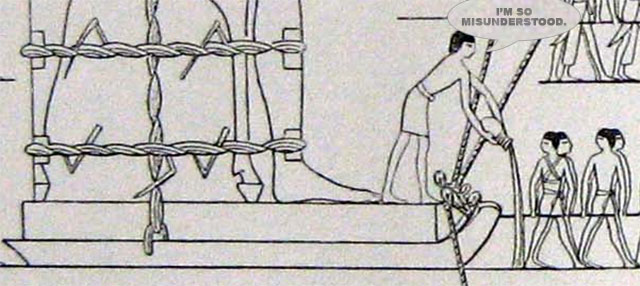
Egyptologists had relegated this guy at the front of the sled to mere holy cleanser status. Turns out he may have actually had a reason to be there.
Lesson learned: if you strip away the mystery or hype of a part of the machine, you can start to see that part for its practical purpose.
Thanks, Egypt. Thanks, scientists.