In the pursuit of computers that can not only read but interpret documents, Dynamic Risk - North American's leading pipeline integrity management provider - launched the Cognitive Computing Challenge. With $200,000 available in prizes, this challenge seeks to award the creation of software that can not only process information from different types of documents, but map it to target fields in a larger database.
And this is just one of many attempts to harness the growing fields of machine learning and artificial intelligence. All over the world today, software developers and computer programmers are working towards the creation of machines that are capable of reasoning and possessing this thing we call "awareness". And in that respect, a group of Roboticists at the Rensselaer Polytechnic Institute (RPI) in New York recently made a major step in that direction.
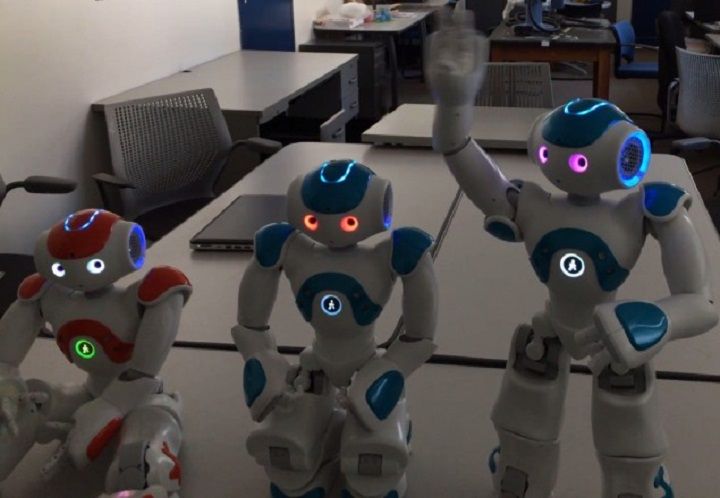
For the sake of their experiment, the Rensselaer roboticists used three NAOs, a series of 58 cm-tall humanoid robots produced by French robotics company Aldebaran. They then subjected these robots to a modified version of the King’s Wise Men Test - in which three wise men are tasked with inductively trying to figure out the color of their hats - and one of them passed.
In this version of the test, two of the three robots had been given "pills" (in the sense that their volume switch had been turned off, rendering them unable to speak), while one of the robots had been given a "placebo" - i.e. its volume switch had been left on. None of the robots knew which of them were given the pills and which the placebo, and the challenge was for the robots to figure out which one of them could still talk without addressing each other.
As the video above demonstrates, one of the robots raised its hand and declared that they did not know the answer. At this point, they realized that they were the one given the placebo and, after hearing its own voice, stated: “Sorry, I now know!” This realization, while certainly limited, was nevertheless a successful demonstration of basic self-awareness.
Naturally, this is still a far-cry from machines that demonstrates true self-awareness, in the sense that they are capable of abstract reasoning, rather than simply following their programming. But it is a step in the right direction. For one, logical puzzles that require an element of self-awareness are essential in the development of robots that can understand their role in society.
What's more, as Selmer Bringsjord - the team leader and chair of the department of cognitive science at RPI - stated, tests like these could be used by roboticists to develop machines with increasingly complex abilities that would make them more useful to humans.
These particular robots were programmed with a proprietary algorithm developed by RPI called DCEC, or Deontic Cognitive Event Calculus. This algorithm uses a well-defined syntax and a proof calculus that’s predicated on natural deduction. Programming like this, which essentially allows for common-sense reasoning, could enable all kinds of abilities that would allow robots to engage in more meaningful conversations, such as discussing things like the meaning of life.
Bringsjord's work will be presented at the RO-MAN conference in Japan, which runs from August 31st to September 4th, 2015, at the Kobe International Conference Center. This year's theme is "Interaction with Socially Embedded Robots."
Interested in making machines that can not only read, but interpret information? Then register in the Cognitive Computing Challenge for a chance to win the $200,000 prize!
Top Image Credit: Michelle Starr/CNET