Think about the number of social networks that make use of location. Could wifi do the same? Whether it's trying to find a local restaurant, searching for love or seeing what events are happening nearby, countless apps make use of location technology to tell people what's up in the neighborhood. Some of the smarter advertisers even send targeted ads.
But from a machine-to-machine perspective, a new entrant called WiFi Aware has been announced. What it does is it lets devices talk to the each other if they are reasonably nearby, without the need of using GPS, cells or even hotspots. It's low power (meaning it won't drain your battery) and can be controlled by privacy settings.
"Wi-Fi Aware will make it easy to find information and services available in an area that match preferences set by the user – and is optimized to work well even in crowded environments," wrote the Wi-Fi Alliance (a non-profit trade organization with big computer companies as members.) "Wi-Fi Aware will be a key enabler of a personalized social, local, and mobile experience, enabling users to find video gaming opponents, share media content, and access localized information all before establishing a connection."
As TechCrunch points out, however, it won't be alone in this cell-phone communication market. Low-energy Bluetooth and push notifications already offer similar services. But there is one differentiator, the website added. "The key is that the device is constantly aware of everything in close proximity, but only chooses to connect to relevant sources of information. It’s going to be an interesting trick once it rolls out," it wrote.
Fortune also points to another technology called beacons, which retailers and venus use to get in touch with users through Bluetooth. The service, however, requires Bluetooth transmitters; Wi-Fi Aware doesn't need any special hardware. This could make the idea easier to spread since it sounds a little more open-source, although how buggy it is would be a factor.
But here's the thing -- current phones likely won't be able to participate. Fortune says that it will require another generation of devices, because the Aware program doesn't appear to be backwards-compatible. That said, it's possible the first devices for the tech could be ready at the end of this year.
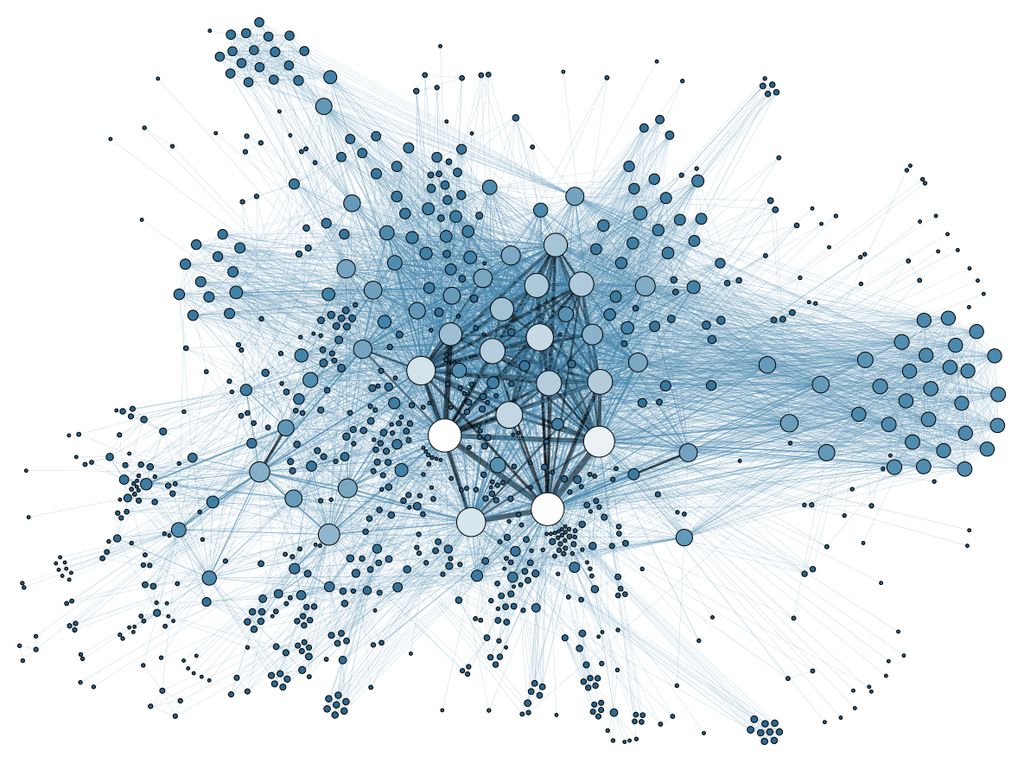
Visualization of a social network. Credit: Wikimedia Commons
Although privacy appears strong, it will likely take real-world experience to see how useful it is. Will devices come with the technology turned off by default? Could it be possible to run a program and accidentally turn the tech on through a routine action? With the technology so new, it's hard to say for sure. We'll be interested to see what the program holds when it is released.
Do you have an idea for how to use this technology for social good? Launch a HeroX challenge and tell us about it.
Top image: Wikimedia Commons