We've written before about the devastating earthquake that hit Nepal late last month (some ideas to donate are here). While the news fades from media view, the rescue and recovery effort is ongoing -- as well as planning how to help the communities in the weeks and months to come. But amid the grim news comes some faint sounds of hope.
An experimental technology that seeks people out by heartbeat was successfully used in Nepal. The device tracked down four men who were stuck under a pile of 10 feet of debris. The device is co-developed by NASA and the Department of Homeland Security and is called FINDER (Finding Individuals for Disaster and Emergency Response).
"The true test of any technology is how well it works in a real-life operational setting," Reginald Brothers, DHS under-secretary for science and technology, said in a statement. "Of course, no one wants disasters to occur, but tools like this are designed to help when our worst nightmares do happen. I am proud that we were able to provide the tools to help rescue these four men."
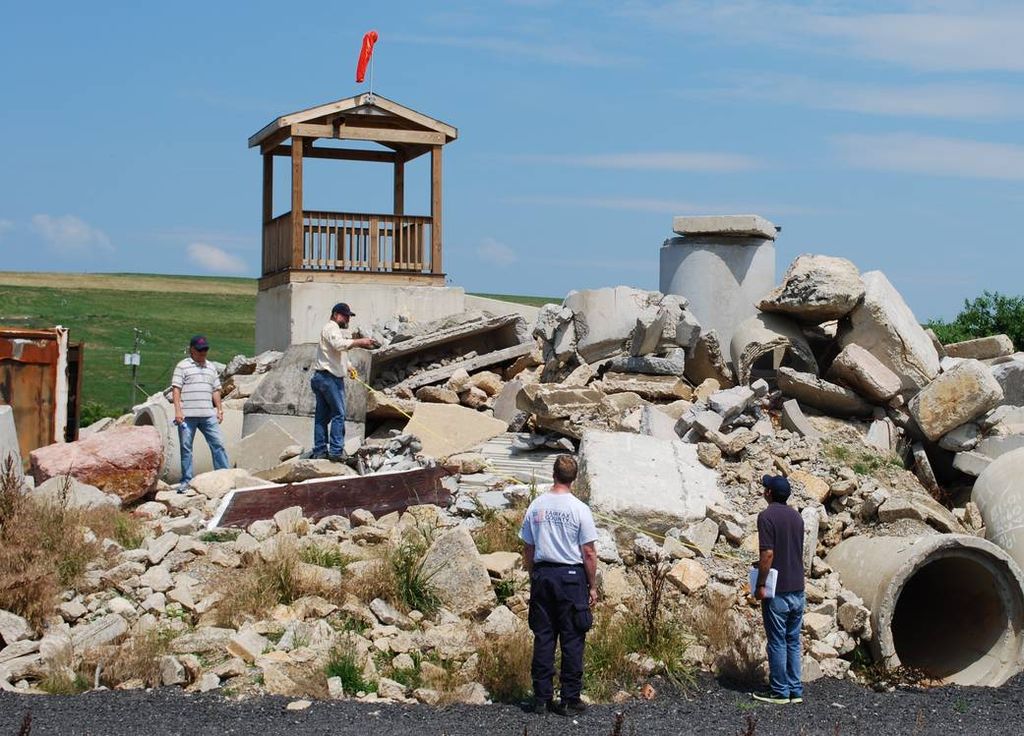
Researchers test out FINDER at the Virginia Task Force 1 Training Facility in Lorton, VA. Credit: DHS/John Price
Here's how the technology works, according to information provided by NASA in 2013: the device sends out radar signals into the debris and then "listens" for what it hears back. As you would expect, however, debris is not smooth and this makes it hard to hear heartbeats or any signs of life.
Space, however, uses radar signals all the time -- including (in an experimental sense) for docking spaceships. And radar is regularly used to parse information about the surface of another planet or moon, yielding information about mountains or depressions. This means that NASA (and the Jet Propulsion Laboratory, a NASA center managed by the California Institute of Technology) has expertise in this matter.
"JPL uses advanced data processing systems to pick out faint signals," NASA wrote. "The microwave radar technology is sensitive enough to distinguish the unique signature of a human's breathing pattern and heartbeat from that of other living creatures, such as rats. The advantage of this technology is to allow first responders to quickly ascertain if a living human is present in the debris. The technology is sensitive enough that victims, whether conscious or not, can easily be detected, which helps responders decide the most efficient course of action."
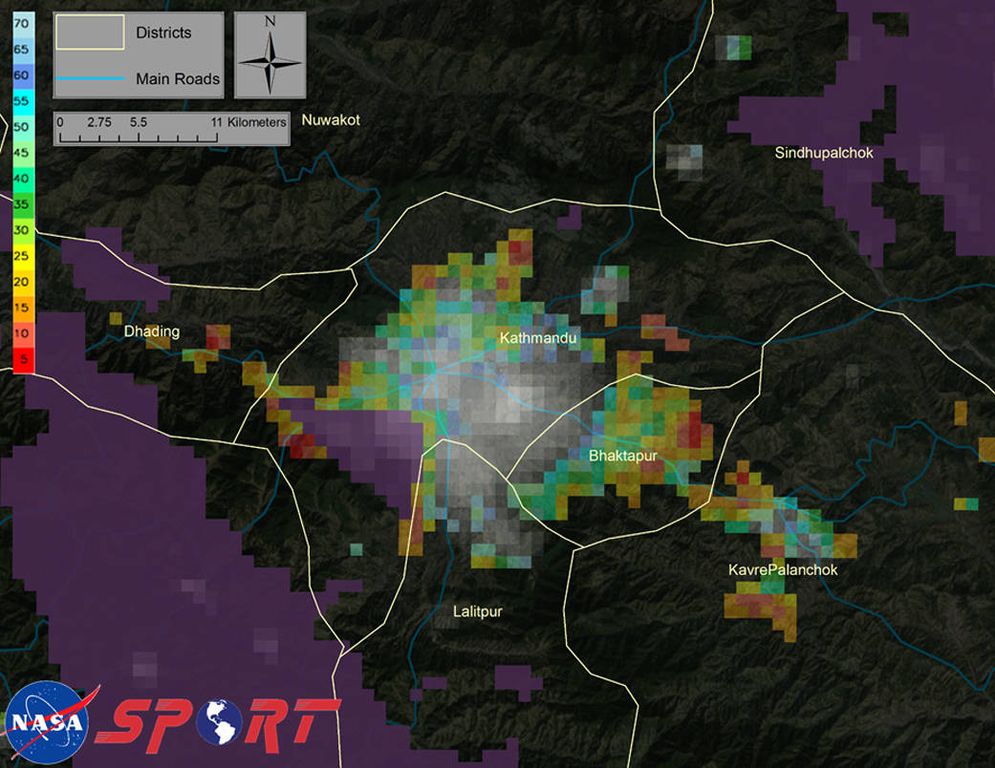
A satellite image showing decreased light emissions (most especially in red and yellow) in Kathmandu, Nepal. The imagery could be used to help emergency workers pinpoint electrical outages. Credit: Short-term Prediction Research and Transition (SPoRT) team at NASA’s Marshall Space Flight Center in Huntsville, AL
The challenge is getting this advanced technology out to devastated areas quickly. Officials in Nepal had two of these devices ready to use, but one would assume that it took a long time to get them out there -- narrowing the window of opportunity for when these can be used. However, with time and with higher production, it will be easier to deploy these devices.
Earthquakes are an opportunity to use other kinds of technology to help, ranging from robots to portable medical kits. There is even new technology being pioneered from space to help victims in Nepal. The NASA Short-term Prediction Research and Transition (SPoRT) team is experimenting with looking at differences in light emission over Kathmandu to see which spots may be affected by electricity outages.
It is comforting to know that amid the devastation, every year technology offers tools to improve the outcome of areas hit by disaster.
Top image: A heartbeat, graphed. Credit: Wikimedia Commons