
Remember how mind-blowing it was to go from dialup Internet to something faster? In a house that was still sucking down the WWW from a phone line, I remember watching the movie Contact in 1997 and being amazed that the scientists were discussing alien civilizations via videoconference. These days, of course, we take videoconferencing for granted.
Just think of all the benefits. Families that live in different cities or countries can still stay connected in between visits. Students wanting to take classes from a university without actually going in can, in many cases, watch the proceedings on the Internet -- sometimes for credit. If there's a conference you want to attend but cannot afford to see in person, many of them now offer at least partial livestream options. In sum, what this means for the ordinary person is you can do a heck of a lot more at your desk.
On the institutional side, big Internet is a boon for research. Imagine a network of supercomputers able to speak directly to each other. It could make it easier to run simulations of how the universe formed. To find the best compound possible to fight cancer. To calculate the most efficient algorithm for airplanes, while saving on fossil fuels. The benefits of lightning-fast Internet are beyond belief.
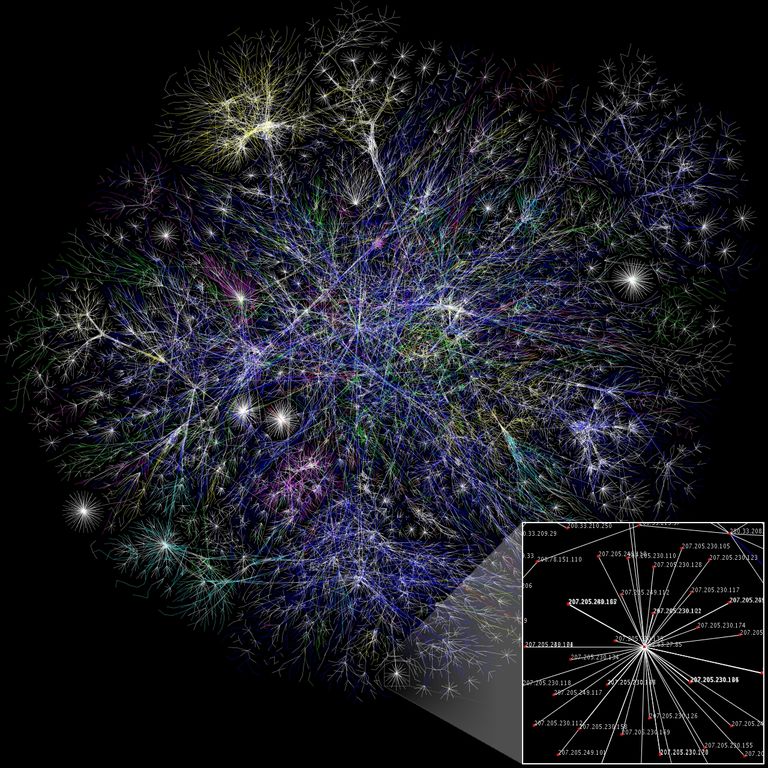
A visualization of the Internet's connections about a decade ago. Imagine how much more dense they are today. Credit: Wikimedia Commons
In the United States, Internet giant Comcast is preparing to deploy gigabit Internet, the first cable provider to do so. (For the non-technical among us, that's incredibly fast.) According to Ars Technica, certain employees of Comcast are testing the service at their houses. Consumer service should be widely available within a year.
The technology is based on a chip for cable modems created by Broadcom, which Ars Technica says uses a faster version of the Data Over Cable Service Interface Specification. (DOCSIS is the way many of us get our cable, which is provided through coaxial cables.) Currently, you can only get gigabit service in certain jurisdictions using fiber.
Of course, many other companies are trying to appeal to the customer in the fast-Internet market. Google is among them, offering a gigabit fiber service in some cities in the United States. Benefits of the service, according to the tech giant, include very fast Internet, watching television in high definition and making it even easier to back up your files.
Once considered a separate entity from ourselves, we use the Internet as a regular signpost for business, education and other applications. Credit: Wikimedia Commons
Of course, the fact that only certain jurisdictions have access to gigabit Internet for now is creating a new digital divide -- perhaps the largest one seen since dialup was slowly replaced across North America. But if we can get around these hurdles, the Pew Research Center notes several benefits. Among them: advances in health and education, the rise of "life-logging" (digitally cataloging your life), greater emphasis on telepresence, and even augmented reality for gaming and other applications.
Pew also notes a progression with every stage of Internet speed boost: modems allowed e-mail, faster modems gave us faster websites, broadband brought in sharing of music, and quick broadband allowed us to get into video streaming services such as Netflix. We now use the Internet everywhere, including on our smartphones. The real question is what we plan to do with more Internet as we get it.
It's hard to predict the next startup technology in this environment, but it sure would be great if it brings our world a little closer together. What do you think it would be?
Top image: We take today's connected world for granted. Credit: NASA