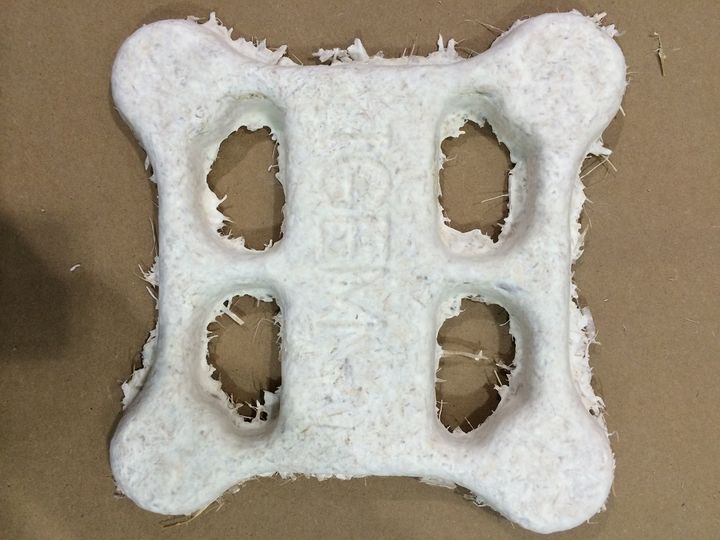
Unmanned aerial vehicles (aka. drones) are becoming a very common feature in our world. In addition to conducting airstrikes and surveillance overseas (and perhaps here at home), they are also being used to deliver books, map our environment, keep track of wildlife, monitor natural disasters, watch over sensitive installations, and even explore other planets. As a result, making drones that are eco-friendly just makes sense.
As more and more drones appear in our everyday world, we can expect that some will crash, be lost, and need to eventually be disposed of. And if the lessons of landfills and ewaste have taught us anything, it's that metals, plastics and electronic components require careful and expensive disposal if they are not going to simply pile up or pollute the environment.
Hence why a team of researchers from Standford, Brown, and Spelman collaborated NASA's Ames Research Center to create the world's first bio-drone constructed out of biodegrable materials.
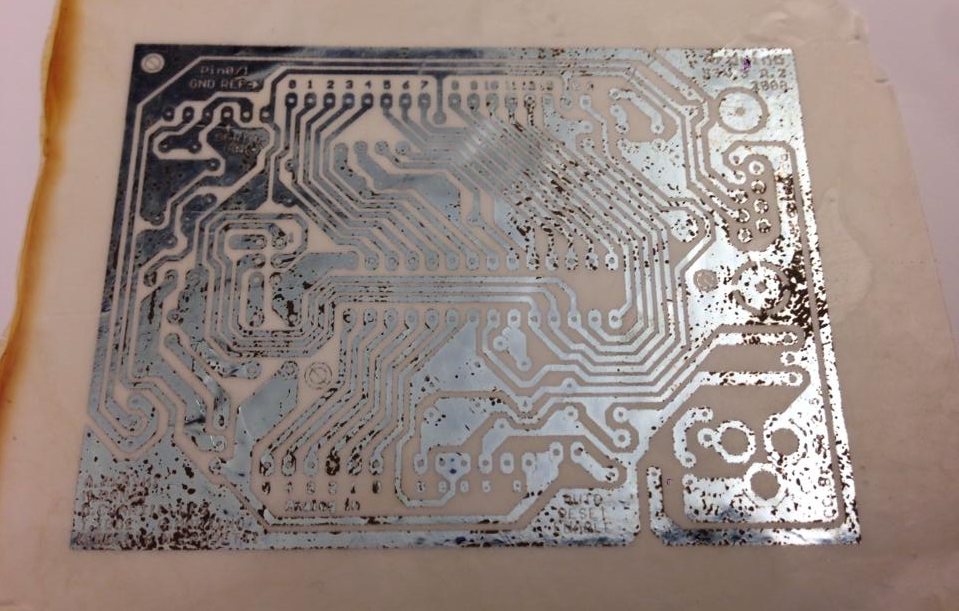
The team also recieved help from Ecovative, a company that specializes in the creation of biomaterials. Using a mushroom-like material known as mycelium to create the shell, the team coated the exterior with the same organic protein that makes wasps nests waterproof. The team then added a circuit board that they printed using silver nanoparticle ink (also biodegradable), as well as some non-biological components - like the rotors and electronics.
Of all biological materials that could have been used - such as cornstarch foam or bioplastics - mycelium was a natural choice because it is lightweight and strong. In addition, it is easy to produce and very eco-friendly. For the sake of creating their materials, Ecovative relies on a process where agricultural waste and fungal mycelium are combined to create what they call "mushroom materials".
Though the material is naturally biodegrable on its own, the students designed it with a self-destruct feature to ensure it would break done. This took the form of special enzymes which become active after a certain period of time, or as the result of a sudden impact. The reason for this was to ensure that the ecological impact could be minimized, if and when hundreds or thousands of drones likes these are flying around the world.
As Lynn Rothschild - an evolutionary biologist and astrobiologist at NASA's Ames Research Center and one of the team's instructors - explained to Engagdet: "This project was started as a way to minimize environmental impact when UAVs are used to monitor environmentally sensitive areas such as coral reefs. There are many other peaceful uses of UAVs where a biodegradable body would be useful."
The team was also able to cut down on the drone's weight by using a cell-layer that has bio-sensing capabilities, which meant that they were able to do away with electronic analytic sensors which can be quite bulky and heavy. Bio-engineered "Hell Cells" were also added in order to offer protection against extreme conditions, such as extremes in pH, temperature, moisture, and even radiation.
Combined with the bioplastic's ability to grown in just about any environment, this extreme-survivability makes this kind of bio-material ideally suited for space exploration. On Mars, where temperatures vary considerably (between 20 °C and -153 °C) and exposure to radiation is a serious hazard, drones that are capable of conducting research and then melting down harmlessly into the environment would be extremely useful. What's more, it could be sent there as a culture of bacteria and biomass that could assemble on site and then immediately get to work.
As Ian Hull, one of team members from Standford University, said in an interview with Co.Exist: "The problem with trying to bring anything to space is it's expensive to take mass up there, and you want anything you bring to be easily modified. Instead of taking parts and backups, you can just take a tiny sample of the bacteria or fungus you need to grow something like this drone."
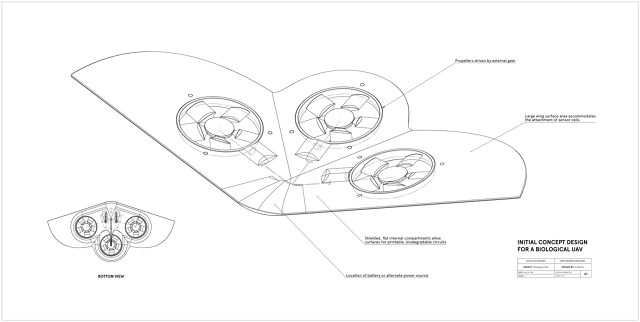
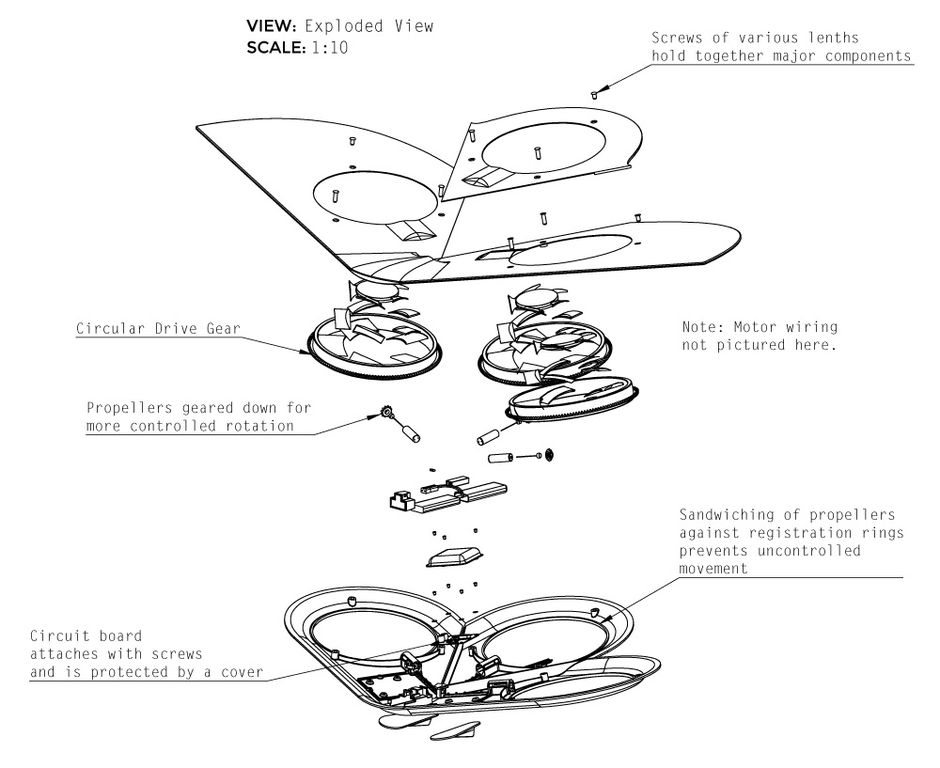 After assembling their UAV, the team began experimenting with multiple chassis designs and came up with some concepts (like the one shown above) which they made available online. In so doing, they hope to inspire other scientists and designers to fashion their own bio-drones with additive manufacturing technology. These files are all 3D printable and can downloaded by going onto the team's IGEM page.
Their drone was also one of this year's entries in the International Genetically Engineered Machine - a worldwide synthetic biology competition where teams of students are assigned a kit of biological parts which they are then responsible for building into biological systems. Though they did not place among the winning teams, their concept has certainly earned them a great deal of attention.
The mind immediately reals at the potential for extra-secretive military drones - machines built from bioplastics that can break down in the event that they are lost behind enemy lines. But the larger implications are arguably for commercial use and society as a whole. Beyond eco-friendly UAVs, the Standford-Brown-Spelman team managed to further demonstrate the sheer versatility bioplastics can have in modern construction.
Using programmed proteins, natural growth processes, and specialized bacteria cultures and fungi, engineers and programmers could assemble just about anything from flying machines to entire buildings. Best of all, the materials would be welcomed by the surrounding environment because of their bio-compatibility, and could be degraded on command once they fell into disuse.
Synthetic biology is a field of intense research and speculation for a reason, and the possibilities it presents are quite staggering! In the meantime, don't be surprised if you spot a drone melting into a puddle of sugar water in the near future.
Sources:
- igem.org/Team.cgi
- www.ecovativedesign.com/
- www.engadget.com/2014/11/13/biodegradable-drone-mycelium/
- 2014.igem.org/Team:StanfordBrownSpelman/Building_The_Drone
- www.fastcoexist.com/3038984/this-bio-drone-grows-itself-and-then-melts-into-a-puddle-of-sugar-when-its-done-flying
Image Credits:
- All Images: 2014.igem.org