Viasat’s signature global STEM competition is coming to Australia , inviting university and TAFE students across the country to develop new applications of satellite technology that improve life on Earth. Whether your background is in engineering, computer science, environmental studies, business, or any other discipline — your ideas and perspective matter.
Viasat: Space for Good Australia features three phases over approximately 22 weeks, progressing from written concept submissions through digital media presentations to an in-person finals event in Sydney in December 2026 — all expenses paid by Viasat.
Milestone
Date
Pre-Registration Opens
Now
Phase 1 Opens (Concept Submission)
Monday, 13 July 2026
Phase 1 Submission Deadline
Sunday, 23 August 2026
Phase 1 Scoring & Review
24 August – 6 September 2026
Phase 2 Opens (Digital Submission)
Monday, 7 September 2026
Phase 2 Submission Deadline
Sunday, 27 September 2026
Phase 2 Scoring & Review
28 September – 9 October 2026
Phase 3 Begins (Finals Preparation)
Monday, 12 October 2026
Finalist–Mentor Matching
Wednesday, 14 October 2026
Finals — In-Person (Sydney)
Tuesday, 8 December 2026
Eligibility: Open to all university and TAFE students in Australia, including undergraduate, graduate, and doctoral-level students, across all study areas and years of study. All participants must be at least 18 years of age at the time of entering the program.
Prizes: Top three finalists will be awarded prizes.
1st Place: $20,000 AUD
2nd Place: $15,000 AUD
3rd Place: $10,000 AUD
Want to be the first to know when the competition opens? Follow this challenge to receive a notification the moment Phase 1 registration goes live.
Guidelines
Space for Good empowers students in Australia to combine their love of space with their formal learning to develop new applications of satellite technology that demonstrably improve life on Earth. We are specifically seeking concepts that have concrete impact in one or more of the following 11 focus areas described below.
Detailed descriptions of each focus area are provided in the Educational Resources tab, along with learning content designed to deepen your understanding and support your concept development.
Three Phases
Phase 1 — Concept Submission (6 weeks) Phase 1 is open to all eligible university and TAFE students in Australia. You will answer a series of written questions (each up to 750 words) that explain your high-level "Space for Good" concept — the problem it solves, the inspiration behind it, its commercial viability, and how it connects to Viasat's capabilities and the broader space sector.
Phase 1 is designed to be an accessible starting point. We provide learning content within the platform (see the Educational Resources tab) that directly supports your concept development, your understanding of Viasat's capabilities, and your knowledge of the space sector. While not required, we strongly encourage you to engage with this content before submitting.
Phase 1 will be scored by two AI systems (one Viasat, one HeroX) with close human oversight. The Viasat team will review the combined highest-scoring 50–60 submissions to determine which 30 advance to Phase 2.
Phase 2 — Digital Submission (3 weeks) The 30 highest-scoring concepts from Phase 1 will advance to Phase 2. Students create a 3-minute digital submission — a video, podcast, animation, or other digital format — that goes deeper on their concept in key areas. Phase 2 will be scored by Australia-based Viasat employees and partners using a rubric aligned with Phase 1.
Phase 3 — The Finals (8 weeks, with in-person finals in the final week) The 6 highest-scoring students from Phase 2 advance to the Finals. Finalists will be invited to Sydney, Tuesday, 8 December 2026 (all expenses paid by Viasat) to present their concept in person to a panel of industry experts. Finalists will be matched with Viasat employee mentors and will develop an elevator pitch, executive summary, and final presentation. Judges will be partially guided by a scoring rubric, but the panel will ultimately deliberate and determine 1st, 2nd, and 3rd place.
Focus Areas
Your concept should address one or more of the following 11 areas. When submitting Phase 1, you will select which area(s) your solution impacts.
1. Equitable and Sustainable Access to Space The fair and just opportunity for all nations and communities — regardless of their level of development — to engage with and benefit from space resources while ensuring the long-term viability of the space environment for future generations and ensuring space remains a shared resource for peaceful purposes and human development. This area is inclusive of space law, policy, and international agreements and consortiums.
2. Direct to Device (D2D) and IoT Satellite communication technology that enables standard, unmodified devices — such as smartphones and Internet of Things (IoT) sensors — to connect directly to satellite networks without the need for specialized terrestrial hardware like ground stations or large external antennas. By positioning satellites as "cell towers in the sky," D2D provides a supplemental coverage layer to bridge gaps in remote, rural, or disaster-stricken areas where traditional cellular infrastructure is unavailable.
3. Rural and Remote Digital Empowerment Ensuring geographically isolated communities have the tools, skills, and infrastructure needed to participate fully in the digital economy by using satellites to bypass the physical and financial hurdles of laying fiber-optic cables in difficult terrain. This ensures that regardless of geographic distance, these populations gain reliable access to telemedicine, online education, and commerce, greatly reducing the digital divide.
4. Space Industry Collaboration (Open Architecture) A non-proprietary design approach that uses standardized protocols and interfaces to ensure interoperability between hardware and software from different vendors. Rather than relying on "closed" or "black box" systems locked to a single manufacturer, an open architecture allows government agencies, commercial startups, and international partners to "plug and play" their own components — such as sensors, antennas, or software algorithms — into a shared ecosystem.
5. Multi-Orbit Constellations Integrated satellite networks that operate across different orbital altitudes — typically Low Earth Orbit (LEO), Medium Earth Orbit (MEO), and Geostationary Orbit (GEO) — to provide a layered communication service. Instead of relying on a single orbital regime, these architectures use software-defined networking to dynamically route traffic based on the specific needs of the application, such as latency, bandwidth, or geographic coverage.
6. Space Cybersecurity The specialized practice of protecting the end-to-end mission architecture — including the space segment (satellites), link segment (radio frequencies), and ground segment (control centers) — from unauthorized access, disruption, or data interception. Unlike traditional IT security, it must account for long-lived hardware in a physically inaccessible environment where a successful breach can result in the permanent loss of a billion-dollar asset.
7. Sovereign Nations A country's ability to independently access and control its own space-based assets and data without relying on foreign entities. This strategic autonomy ensures that a nation can maintain secure, uninterrupted communications and operational freedom, particularly during geopolitical crises or supply chain disruptions.
8. Disaster and Humanitarian Space technology and satellite communications provide a critical "eye in the sky" and a resilient backbone for data when terrestrial infrastructure fails. These technologies are integrated into every phase of the disaster cycle — from predicting an event to coordinating the long-term recovery and humanitarian response. Space-based communication systems are used for tracking, mitigation, response, and rebuilding, particularly when terrestrial connectivity is not available or has failed.
9. AI in Space AI is shifting space technology from manual, ground-dependent operations to autonomous, self-optimizing systems. By processing massive datasets faster than humans, AI enhances everything from satellite health to global connectivity. This includes areas like satellite health and telemetry, earth observation, traffic management, and more.
10. Data Centers in Space Data centers in space are high-performance computing (HPC) facilities hosted on satellite platforms or orbital stations. Rather than just acting as a "bent pipe" that mirrors signals back to Earth, these systems process, store, and analyze data on-orbit. This shift moves the cloud from terrestrial server farms to the "edge" of the space environment, potentially lessening the environmental impact data centers have on the Earth.
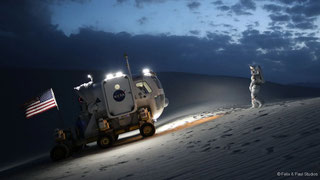
11. Lunar Communication Lunar communications are transitioning from specialized, one-off "direct-to-Earth" links to a standardized, interoperable "Internet-at-the-Moon." This new approach aims to provide seamless connectivity for the hundreds of institutional and commercial missions planned over the next two decades, supporting everything from deep space mining and resource extraction to scientific and medical research.
Phase 1 Questions
Your concept should be your own work, well-researched, directly related to the prompt, and reflective of one or more of the 11 focus areas listed above. AI is permitted, but it is important to remember that AI will not be present when you're asked to explain your concept to a space industry expert — so please ensure the core of your concept is your own idea and your own thinking.
Please answer the following questions thoroughly and thoughtfully. Each answer should be no more than 750 words.
Which area(s) does your solution impact?(Select all that apply from the 11 focus areas)
Please summarize your "Space for Good" solution.
What inspired you to develop this solution and what specific problem does it solve?
How have you assessed commercial viability? Please provide evidence that shows your market research, viability assessment, and connection to Viasat's and our partners' capabilities.
What are the primary challenges and roadblocks you see with your solution? How will you address these challenges?
Who are your primary stakeholders (individuals, private companies, governments, governing bodies, etc.) and why?
Please provide a brief overview of how Viasat and our partners could implement this solution directly and indirectly into our future business.
What are 4–6 metrics you will use to determine the impact and success of your solution?
What else would you like us to know about your solution?
If you have questions regarding Phase 1 or experience technical difficulties, please use the Q&A Forum on this challenge page or contact us at solve@herox.com.
Scoring Rubric
While the questions required for Phase 1 are relatively straightforward, we encourage you to work through the learning content provided within the platform, carefully review this scoring rubric, and work through a few drafts of your answers prior to submitting.
Category
Points
What We're Looking For
Concept, Clarity, and Depth
15
How clearly is the solution summarized? Can someone with a limited technical background understand the concept? Is the technical logic sound?
Mission Relevance
15
Does the solution directly address one or more of the 11 focus areas? Is the connection to improving life on Earth clear and compelling?
Innovation and Creativity
15
Is this a novel application of satellite technology? Does the student clearly explain the inspiration for their idea?
Viasat Capability Alignment
15
Does the student demonstrate understanding of Viasat's technical capabilities, products, services, and partner ecosystem?
Commercial Viability
15
Is there evidence of market research? Is the assessment of stakeholders and opportunities to scale realistic and specific?
Feasibility and Risk Awareness
10
Has the student identified realistic roadblocks? Are their mitigation strategies technically and logically sound?
Metrics and Impact
10
Are the 4–6 success metrics quantifiable and logical? Do they actually measure impact on Earth and society?
Quality and Professionalism
5
Is the writing polished, well-researched, and free of grammatical errors?
TOTAL
100
Scoring Ranges (applied by category):
0–40% of points: Vague, incomplete, or missing; demonstrates little understanding
41–67% of points: Basic coverage; clear but lacks depth, specifics, or evidence
68–80% of points: Comprehensive; sound logic with moderate detail and examples
81–100% of points: Exceptionally clear, compelling, and ready to present to industry experts
Eligibility
Open to all university and TAFE students of any study area and any year
Must be legally resident in Australia at the time of registration
Must have internet access
Must accept the Challenge-Specific Agreement (Terms & Conditions) before submitting
Important Information
All submissions must be in English
Each answer is limited to 750 words maximum
You may submit as an individual
Phase 1 submissions are scored by two independent AI systems with human oversight
All platform activity is logged for transparency and accountability
By submitting, you agree to the Challenge-Specific Agreement
With the deadline two days away, use the About Viasat module to sharpen your submission. Judges expect you to understand the ecosystem your idea lives in — and this module gives you that context directly. Watch the 2025 Year in Review, explore the VS3 constellation, read the FY2025 ESG Impact Report, or try the interactive VR site showing Viasat's full satellite network. You can also listen to previous quarterly earnings calls to understand what's driving the business and what problems are still unsolved. Head to the Learning Resources tab, review what you have, and submit before the deadline.
The space industry is entering a new era of growth, and the next generation of satellite professionals is finding a powerful launchpad in vocational education.
A New Frontier for Talent
Imagine a ground station at three in the morning, where a dedicated technician is working with precision to ensure a satellite remains perfectly aligned. The challenge is technical and hands-on: calibrating a servo motor or refreshing a heat-cycled connector. In this moment, the most valuable asset isn't a theoretical thesis, but the methodical expertise and practical problem-solving skills that keep our world connected.
The space sector is growing fast, but the path into it is not always obvious. The Careers in the Space Sector module features people who have been there: Thad Sandidge and Samyukta Muruganantham (former Viasat interns now full-time engineers in the US and India), Rida Zainab (Senior Spacecraft Software Engineer at CGI), Faith Tng from the Space Generation Advisory Council on the skills the sector is looking for, and Zamara Rodriguez from SIAA on how to get noticed. Learning Resourcestab. Five days to the deadline.
Viasat is actively involved in Project Moonlight — the ESA-led initiative to build a permanent communications and navigation network for the Moon. The Lunar Communication module includes the ESA program overview, Viasat's press release on its Telespazio partnership, and two expert interviews: ESA's Charles Cranstoun and Ben Colton on the complexity of building this program, and Viasat's Ular Kaldasaun on the technical realities of connecting the Moon. Learning Resources tab — deadline August 23.
In a nation defined by its vast beauty, we are redefining connection, ensuring that every community stays united, informed, and resilient (no matter the challenge).
Australia’s vast and rugged geography is a testament to the nation’s spirit, and today, that spirit is being bolstered by incredible advancements in technology. While nature can test our resolve, our ability to stay connected is growing stronger every day, ensuring that even in the most remote corners of the continent, safety and coordination remain paramount.