menu

Evolution 2 Prize

 964,943

Artificial Intelligence + Origin of Life Prize, $10 Million USD

How can life's origin & genetic code lead to superior AI? Solve science's #1 mystery for a $10M prize w/ patent. $100K for proof of concept.
stage:
Enter
prize:
$10,000,000
more
Summary
Timeline
Updates26
Forum
Teams3.3K
Summary

Overview

What is the Secret of Life?

Solve the #1 Question in all of Science

Origin of Life is the hardest question in science. No one knows how the first cell came about. But there’s a simpler, more fundamental question: Where did the information come from? An answer will trigger a quantum leap in Artificial Intelligence. This may be as big as the transistor or the discovery of DNA itself. A new $10 million prize seeks a definitive answer.


"Evolution 2.0 is a sign of a shifting emphasis in biology from regarding

life primarily as a chemical system, to looking at the flow of information."

-Financial Times Science Editor Clive Cookson


SCIENTIFIC PAPERS ABOUT INFORMATION AND BIOLOGY 

Biology transcends the limits of computation 

The role of quantum mechanics in cognition based evolution 

Cellular and natural viral engineering in cognition-based evolution


Judges:

 
George Church, Harvard & MITDenis Noble, FRS, CBE, Oxford University    

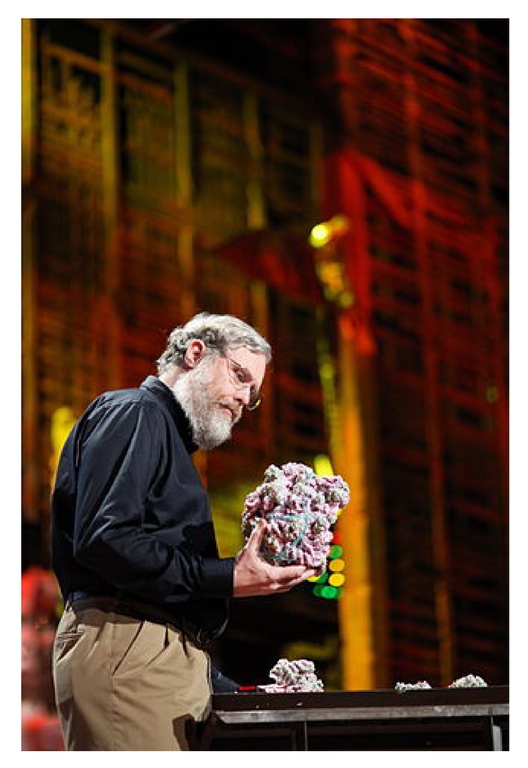
George Church

George Church is a geneticist, molecular engineer, and chemist. He is Professor of Genetics at Harvard Medical School and Professor of Health Sciences and Technology at Harvard and MIT, and was a founding member of the Wyss Institute for Biologically Inspired Engineering at Harvard. Developed methods for the first genome sequence. Director, BRAIN Project & PersonalGenomes.org. He is co-author of 509 papers, 143 patent publications & the book "Regenesis". He was also one of Time Magazine’s 100 Most Influential People in 2017.

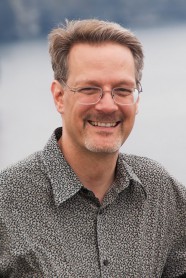
(photo By Steve Jurvetson from Menlo Park, USA - Life, Synthetic Life!)  Conflict of Interest Disclosures

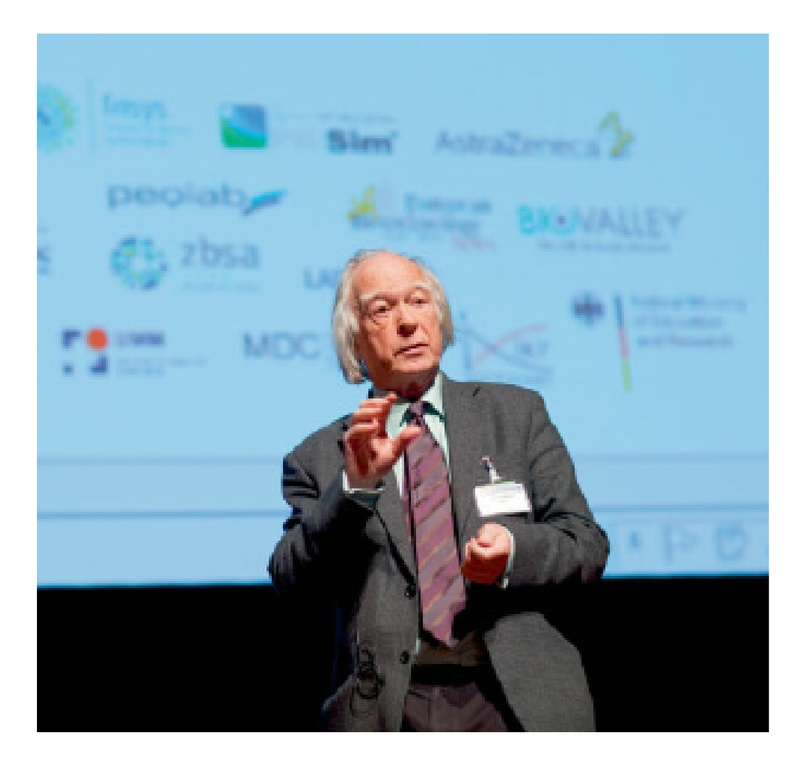
Denis Noble

We have Oxford Professor Denis Noble on board as prize judge and technical advisor. He’s one of the top 100 scientists in the UK. Denis was the first person to build a computer model of an organ. It was the heart. He did this in 1960 using punch cards. His discoveries made pacemakers possible. He is a fellow of the Royal Society. He is editor of the society's journal Interface Focus and he holds a Commander of the British Empire medal from Queen Elizabeth. He organized the Royal Society’s 2016 conference “New Trends in Biological Evolution” in conjunction with the British Academy. He is president of the International Union of Physiological Sciences. Denis is an accomplished musician and pioneer of the field of Systems Biology. He is author of The Music of Life and Dance to the Tune of Life: Biological Relativity.


Is $10 Million Enough Money for a Discovery of this Magnitude? 

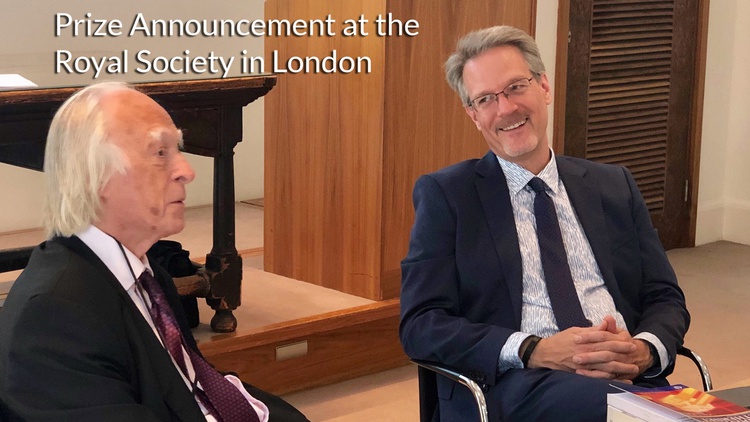
Denis Noble, Perry Marshall and Kevin Ham at the Royal Society


The Mystery

Every cell reproduces itself from digital instructions, stored in DNA. DNA has the same features as modern digital devices: Layers of digital encoding, decoding and data storage; error detection, error correction and repair. Plus an ability to adapt that beggars the imagination.

How do living things repair and heal themselves, adapt to any situation you can imagine, and make choices? The genetic engineering capabilities of cells, which are discussed in the book Evolution 2.0, are not known to most people. But an answer suggests staggering implications for medicine, technology and the environment.

Cells re-engineer themselves, in real time, in hours... even minutes. The reason you have to finish your antibiotics is, germs can hyper-mutate at terrifying speed - then kill you with a vengeance.

How do cells “know” how to evolve? No human software does that. Give software millions of chances and billions of years and all it will do is crash. But life adapts relentlessly. How does it do this? What do cells know that we don’t?

And what about consciousness? In the human realm, only conscious beings create and modify code. Where does consciousness come from? Are cells self aware?

The Evolution 2.0 Prize focuses these issues down to one central question:

How do you get from chemicals to code? How do you get a code without designing one?

Perry Marshall and private equity investment group Natural Code LLC have issued a technology prize to find a person who can solve this.

What You Must Do to Win The Prize
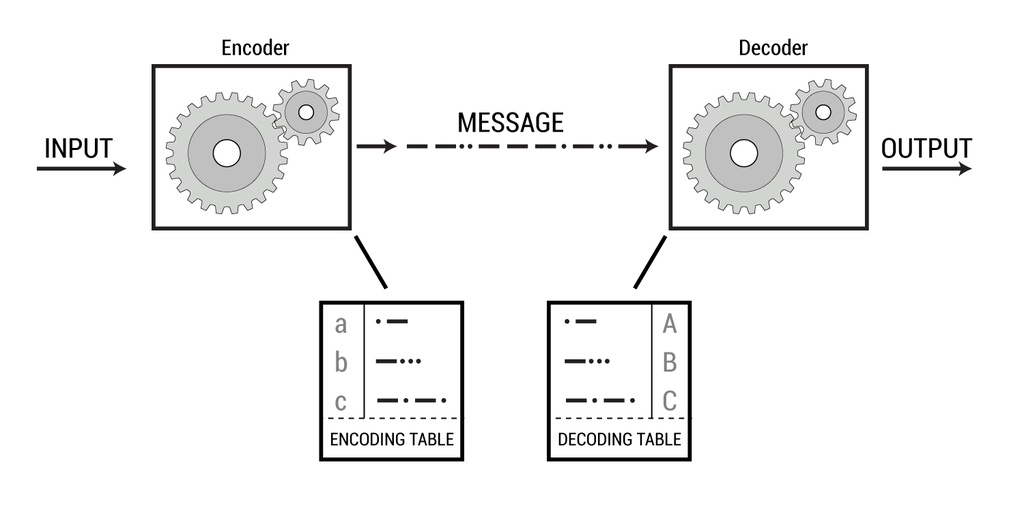
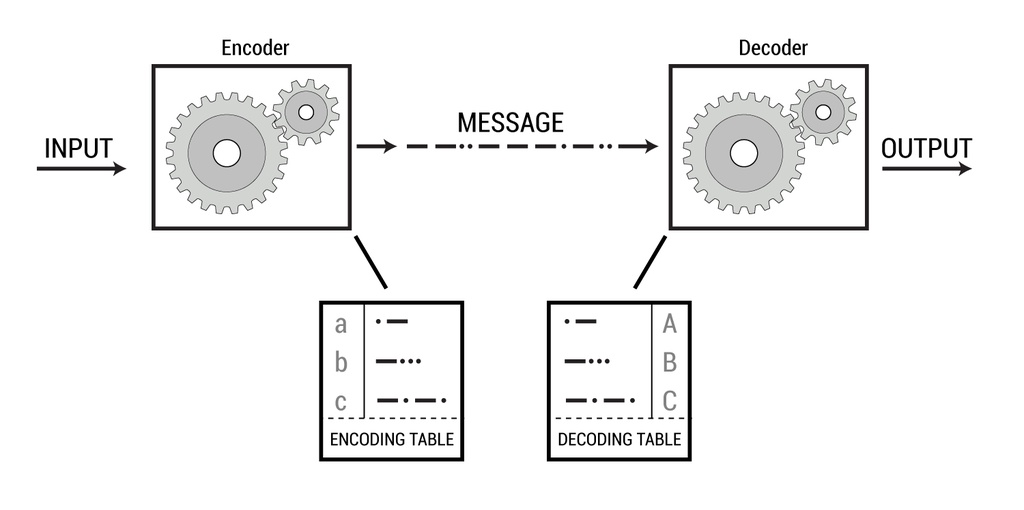
You must arrange for a digital communication system to emerge or self-evolve without "cheating." The diagram below describes the system. Without explicitly designing the system, your experiment must generate an encoder that sends digital code to a decoder. Your system needs to transmit at least five bits of information. (In other words it has to be able to represent 32 states. The genetic code supports 64.) 

You have to be able to draw an encoding and decoding table and determine whether or not the data has been transmitted successfully. 

So, for example, an RNA based origin of life experiment will be considered successful if it contains an encoder, message and decoder as described above. To our knowledge, this has never been done.

Does life harness undiscovered laws of physics? Are there unknown emergent properties in nature?

With CRISPR gene editing technology and exponentially accelerating AI, these are questions of burning importance.

If we can unearth the underlying forces that create and propel life, we stand to reap enormous benefits in Artificial Intelligence, engineering, computer science, nutrition, aging, health, cancer research, disease treatment and prevention.

Watch the $10 million prize announcement at the Royal Society of Great Britain with Professor Denis Noble, Courtesy of Voices From Oxford

The Problem

Natural Code LLC is a Private Equity Investment group formed to identify a naturally occurring code. Our mission is to discover, develop and commercialize core principles of nature which give rise to information, consciousness and intelligence.

Natural Code LLC will pay the researcher $100,000 for the initial discovery of such a code. If the newly discovered process is defensibly patentable, we will secure the patent(s). Once patents are granted, we will pay the full prize amount to the discoverer in exchange for the rights. Our investment group will locate or develop commercial applications for the technology.

The discoverer will retain a percentage of ongoing ownership of the technology, sharing in future profits of the company, while benefitting from the extensive finance, marketing and technology experience of our investment group. Prize amount as of May 31, 2019 is $10 million. 

Code is absolutely necessary for replication and for life. Code is needed for cells to have instructions to build themselves; code is required for reproduction. Code that has the ability to re-write itself is essential for any kind of evolution to occur. 

We define code as a symbolic information passed between an encoder and a decoder (Claude Shannon 1948).

So… where did the information in DNA come from? This is one of the most important and valuable questions in the history of science. Currently, no one knows the answer.

A solution to this problem will become one of the most pivotal scientific and technical discoveries of the 21st century. The winner will receive substantial recognition.

The Challenge Breakthrough

To solve this problem is far more than an object of abstract religious or philosophical discussion. It would demonstrate a mechanism for producing novel, naturally forming information systems, thus opening new channels of scientific discovery.

Such a find would have sweeping implications for Artificial Intelligence research. This would provide a solution to the most perplexing transition currently faced by the Origin Of Life field, namely the origin of coded information.

How could the genetic code (or any coding system) come into being? This would represent a landmark discovery in the history of science and alter our fundamental understanding of the universe.

What You Can Do To Trigger A Breakthrough

  • Click "Follow" above to be notified of any status updates to the challenge.
  • Click "Accept Challenge" above to register for the challenge. You will be notified of any status updates and be able to create an entry to the challenge when it opens.
  • Click on the "Share" button or social media icons above to share this challenge with your friends, your family, or anyone you know who has a passion for discovery.
  • Leave a comment in our Comments Thread to join the conversation, ask questions or connect with other innovators.

ADDITIONAL RULES

Who can participate

The Challenge is open to all individuals and organizations who are legally allowed to participate, and who comply with all the terms of the Challenge as defined in the Challenge-Specific Agreement.

Selection of Winner

Based on the winning criteria, one prize will be awarded for a total of $100,000. If the discovery is defensibly patentable, the full amount of the prize will be awarded for a total of $10 million. In case of a tie, the winner will be selected at the discretion of the Judging Panel.

Registration and Submissions

All submissions must be received online, via the Challenge website, and all uploads can be in PDF format only. Submission reporting requirements are detailed in Judging.

Challenge Guidelines are subject to change. Registered competitors will receive notification when changes are made, however, we highly encourage you to visit the Challenge Site often to review updates.

**IMPORTANT NOTE** General essays presenting a ‘Theory Of Everything' and metaphysical constructions about the history of life, unfortunately, cannot be considered. Please do not submit materials of this kind. We are looking for entries that offer quantifiable technological progress.

~

Perry Marshall is endorsed in FORBES and INC Magazine and is one of the most expensive business consultants in the world. His Evolution 2.0 Challenge, announced at the Royal Society in London, is the world’s largest science research prize. His book Evolution 2.0 harness a communication engineer’s outsider’s perspective to reveal a century of unrecognized discoveries. 

His reinvention of the Pareto Principle is published in Harvard Business Review, and NASA's Jet Propulsion Labs uses his 80/20 Curve as a productivity tool. He wrote the world’s best-selling book on digital advertising, Ultimate Guide to Google AdWords and has consulted in over 300 industries. He has a degree in Electrical Engineering and lives with his family in Chicago.


Guidelines

**IMPORTANT NOTE** General essays presenting a ‘Theory Of Everything' and metaphysical constructions about the history of life, unfortunately, cannot be considered. Please do not submit materials of this kind. We are looking for entries that offer quantifiable technological progress. ALSO, physical experiments that achieve the objectives of this challenge could potentially be dangerous. Our judge, George Church, has cautioned us that such experiments must be carried out under highly controlled conditions. Public safety is of paramount importance to Evolution 2.0. 

Maximum length of proposal is 20 pages. (If you have much more data than that then submit a summary and we can review your full data at a later step.)

Challenge and Winning Criteria Defined

1. The Evolution 2.0 Challenge (the “Challenge”) is sponsored by Natural Code LLC, a Nevada limited liability company, also sometimes referred to in these Challenge Guidelines as “Sponsor.” Each entrant to this Challenge who submits a solution to the Challenge is referred to in these Guidelines as an “Innovator.”

2. The Evolution 2.0 Challenge is to discover a purely chemical process that will generate, transmit and receive a simple code--a process by which chemicals self-organize into a code without benefit of designer.

3. To be clear, what the Sponsor is looking for is a process where some chemicals, at some particular concentration of compounds, at the right temperature and pressure, etc. generate, transmit and receive a simple code, without any intelligent being or other life-form creating, transmitting or receiving the code.

4. A successful solution to this Challenge would mean that chemicals alone, without the benefit of minds or brains belonging to humans or the assistance of other living things, have built a simple communication system from scratch. In effect, the jar of chemicals on its own would be assigning meaning to symbols. The configuration of chemicals and not the human inventor would be making creative linguistic choices and creating a coded communication system. Basically, the Sponsor is looking for a formula or transformation process that turns matter into information—directly, with no intelligent being or other life-form making it happen.

5. The coded communication system submitted as a solution to this Challenge must be digital, not analog. So, for example, a system that merely transmits vibrations from one place to another or from one form of energy to another is not acceptable for this Challenge.

6. The system submitted as a solution to this Challenge must have the three integral components of communication, i.e., encoder, code, and decoder, functioning together.

Essential Components of a Communication System (after Claude Shannon, 1948):

All communication systems have an encoder, which produces a message, which is processed by a decoder. DNA transcription and translation matches the pattern in the above diagram. The Sponsor of this Challenge is seeking discovery and proof of a naturally occurring code, which also matches this pattern.

7. The message passed between the encoder and decoder components must be in a sequence of symbols forming characters of a finite alphabet. For this purpose, a “symbol” is a group of k bits considered as a unit. (A more complete definition of “symbol” in the context of this Challenge is set forth on page 340, numbered paragraph 8, of the book, Evolution 2.0). A “character” is a group of n symbols considered as a unit. (For a more complete definition of “character” in the context of this Challenge, see numbered paragraph 9 on page 340 of the book, Evolution 2.0). In the system, n+k must be equal to 5 or more, such that it is a 2-layer system which can represent at least 32 digital states.

8. The submitted solution must contain encoding and decoding tables filled out with their values arising from the submitted system or process.

9. It must be possible to determine objectively whether encoding and decoding have been carried out correctly. For any given system, a procedure should exist for determining whether input correctly corresponds to output. One analogy that demonstrates what the Sponsor means by this is the cause and effect relationship of a keyboard and a computer screen. Pressing an “A” on a computer keyboard should result in the letter “A” appearing on the screen; there is an observable correspondence between the two. The keyboard and screen analogy violates rule #10 below.  However, a successful entry will receive a set of (32 or more as in rule #7)  digital states on the input end (for example, a defined set of chemical concentrations, temperatures, pressures and light), convert them to an intermediate alphabet (or set of physical-chemical states) in its communication channel, then produce a corresponding set of states in its output.  Said entry will not violate rule #10.

10. Human beings may design the experiment that demonstrates the process, employing all manner of state-of-the-art laboratory equipment, creating ideal conditions, etc. However, the actual system submitted for demonstration of the solution to this Challenge may not be preprogrammed with any form of code whatsoever. Any system found to have preprogrammed code in it in any form will be disqualified from the competition.

11. The system submitted for demonstration of the solution to this Challenge may not be directly from any living organism, virus or similar entities. So, for example, phenomena such as bee waggles, dog barks, RNA strands derived from cells, mating calls of birds, etc. are not acceptable elements of a winning solution to this Challenge. RNA that forms spontaneously from simple sets of non-living chemicals (like glycolaldehyde) would be acceptable. Entrant must be prepared to show that their results are not contaminated by previously existing biological material. The submitted material will be examined for containing any pre-existing living entity, or derivatives of previously living entities, with exacting standards. Detection of such materials is an automatic disqualification.

12. The origin of the system submitted for solution to this Challenge must be documented to show that its process of origin can be observed in nature and/or duplicated in a real-world laboratory according to the scientific method.

Partial Solutions to the Problem

Winning of the prize is only assured for the first solver who meets all points of the specification. The specification here outlines the simplest known configuration that constitutes a proper communication system, based on Claude Shannon’s seminal paper “A Mathematical Theory of Communication” (Shannon, 1948). All living organisms rely on this system, which is both a communication system and a Turing machine (Yockey, 2005).

If you have a solution which meets a significant fraction of this specification, the judges and backers of Evolution 2.0 consider such discoveries potentially valuable.

The backers of this prize have extensive business, finance, marketing, distribution, technology and product development expertise, as well as access to capital. Any solution indicating commercial potential is subject to discussion and we are interested in exploring commercial applications of your work. If your solution constitutes significant progress towards the Origin Of Information problem, you should submit your solution. Efforts that do not solve significant portions of the problem will be rejected.

The ultimate winner will need to:

-Provide data showing they have met all portions of the specification
-Conduct a live demonstration of the operation of said system
-Have their work verified by at least three independent judges appointed by Evolution 2.0

Proposal and Data Requirements

13. The merit of Innovator’s submission will be assessed based first on the content of the write up that Innovator submits. The write-up of the proposed solution should be thorough, specific, clear, and easy to read. The Judges will evaluate the content of the write-ups and will invite various Innovators to demonstrate their solutions under laboratory conditions in the presence of the Judges.

14. The write-up should include descriptions of processes, tools, and techniques utilized in the solution. Be sure to go into sufficient detail, especially in areas there your approach may deviate from conventional or traditional methods.

15. Proposals must be uploaded as a single unlocked PDF document, 20 MB maximum. Embedded hyperlinks to external content, such as videos or animations (maximum two minutes duration recommended) or anything else that might help the Judges come to a decision on a winning idea or concept, are allowed. However, there is no guarantee that the Judges will view that external content, so the proposal document itself must stand on its own.

Prizes to be Awarded

Challenge MilestonePrize to be Awarded
Sponsor awards initial prize to Winning Innovator (chosen by Judges)$100,000.00 USD
Winning Innovator who has assigned patent rights in the Technology to Sponsor obtains a Viable Patent on the Technology from the United States Patent and Trademark Office$10 million USD (as provided in Challenge Guidelines) and an equity interest in Sponsor

16. The first person to submit and successfully demonstrate such a process to the satisfaction of the Challenge Judges will receive from the Sponsor a cash prize of One Hundred Thousand Dollars ($100,000.00) USD. Only one $100,000 Prize will be awarded, and that to the first Innovator in this challenge who successfully demonstrates to the satisfaction of the Judges of this Challenge that Innovator has found a solution to this Challenge that meets all the criteria specified in these Challenge Guidelines. The demonstration of the process must be made at a location in the continental United States of America. All costs associated with this demonstration, except for travel expenses and fees for the Challenge Judges, must be borne by Innovator.

17. If the prize-winning process is also patentable, the “Winning Innovator” (the Innovator who has won the $100,000 Prize) is also eligible to receive the balance of the Prize Fund, provided the Winning Innovator complies with all of the rules and guidelines detailed below and the Innovator’s chemical process proves to be “Viably Patentable” (as that term is defined in these Guidelines). When the patent has been granted, Sponsor’s investors are legally bound to fund a Prize Fund of at least $10 million USD. Sponsor anticipates that it will take a minimum of one year, perhaps longer, to obtain this patent, from the time that the initial $100,000 Prize is awarded. If a Viable Patent is granted on the winning process by the United States Patent and Trademark Office, and the Winning Innovator has complied with all the Guidelines detailed below, the Winning Innovator will receive the balance of the Prize Fund, net of the $100,000 prize money already awarded to the Winning Innovator, the balance to be paid when the patent is granted on the winning process.

18. If Innovator intends to qualify ultimately for the award of the entire Prize Fund and not just the basic $100,000 Prize, Innovator’s initial submission to the Challenge must be made in a confidential manner and meet the disclosure criteria of the United States Patent and Trademark Office. Violation of those criteria voids any agreement made between Innovator and Sponsor.

19. Definition of “Viably Patentable”: The invention is valuable enough and sufficiently protectable by a patent (granted by the United States Patent and Trademark Office) for an investment in the development of this invention to pay for itself before the patent expires. Such a patent granted which appears to be commercially viable in Sponsor’s sole opinion is referred to in these Rules as a “Viable Patent.” If the patent yields $10 million dollars in aggregate, via sales, licensing or contractual deals to any set of people involved in the patent or licensing by the time of the award, then that will be considered unambiguous, and not require an opinion as to whether it meets the definition of a “Viable Patent” in these Rules.

20. The decision of whether the invention is Viably Patentable is in the sole discretion of Sponsor (except as specified in Rule 20). Innovator agrees to make every effort to work with Sponsor and identify a Viably Patentable configuration, if Innovator wins the $100,000 Prize and chooses also to pursue the award of the balance of the Prize Fund. 

21. By submitting an entry to this Challenge, every Innovator gives Natural Code LLC the right of first refusal to buy the patent rights to the technology, process and system (the “Technology”) which forms the Innovator’s solution to this Challenge, regardless of Innovator’s pursuit of the balance of the Prize Fund beyond the award of the $100,000 Prize. This right of first refusal provision will be part of the Non-disclosure Agreement that Innovator must sign and will take the form of an option granted to Sponsor by Innovator to purchase the patent rights to the Technology at the same price and terms offered in writing to Innovator by a bona fide purchaser unrelated to Innovator. If Natural Code LLC declines to exercise its right to purchase the patent rights to the Technology, the Innovator is released to pursue other buyers.

22. Natural Code LLC agrees to cover all patent fees if the Winning Innovator agrees to sign over all patent rights in the Invention to Natural Code LLC and a Viable Patent is obtained from the United States Patent and Trademark Office.

23. If the Winning Innovator signs over all patent rights in the Invention to Natural Code LLC and a Viable Patent is granted by the United States Patent and Trademark Office on the process the Winning Innovator submits to solve the Challenge, the Winning Innovator will get the balance of the Prize Fund, net of the $100,000 Prize already paid to the Winning Innovator and will also receive an equity interest in Natural Code LLC or in the business entity created by Natural Code LLC to hold the patent rights on the Technology, as that term is defined in these Guidelines.

24. Both the Winning Innovator and Sponsor will agree in writing to work together, believing in good faith that the discovery of this invention is scientifically, technologically and commercially very valuable. A Non-disparagement clause will be included in the document conveying Winning Innovator’s patent rights to Sponsor.

25. The investing members of Natural Code LLC are legally bound to fund a Prize Fund of at least $10 million USD.

Judges

26. The Innovators’ submissions of solutions to this Challenge will be screened initially as for viability by certain officers or members of Sponsor. As potentially winning solutions are received, Sponsor will engage a minimum of three (3) judges (“Judges”) with appropriate scientific background and credentials to evaluate further the submissions to this Challenge which passed the initial screening. These judges will evaluate those submissions and will determine whether any of these Innovators should be invited to demonstrate their solution in the presence of the Judges under laboratory conditions.

27. The Judges’ decisions, including as to whether any particular solution merits the $100,000 Prize, are final and binding. Sponsor reserves the right in its sole discretion to disqualify at any time any entry that it determines does not comply with the criteria stated on this webpage or with these official Challenge Guidelines generally.

28. Natural Code LLC will post non-qualifying submissions of all entrants who grant permission to do so. Several non-qualifying submissions have been posted and can be viewed at www.evo2.org/submissions.

Communication

29. English is the official language for submissions, proposals, presentations, and all communications.

30. Applicants may be contacted for follow-up information by Sponsor; telephone or Skype interviews may be requested.

Eligibility – Who May Submit Entries

31. The Challenge is open to all individuals or groups of individuals who are over the age of majority in their province, state, territory or country of residence. It excludes employees representatives, relatives, dealers and agents of Natural Code LLC and/or HeroX (and their respective affiliates).

32. You do not need to be an engineer or scientist to enter this Challenge. Anyone from any academic field or discipline may enter the Challenge.

33. Any individual, business entity or other organization may submit their own solutions to the Challenge. However, any solution so submitted must be the original discovery of the Innovator and not a mere reporting of someone else’s discovery.

34. Sponsor reserves the right, at its sole discretion, to disqualify any Innovator who is (i) found to be tampering with the entry process or with the operation and administration of the Challenge; (ii) acting in an unsportsmanlike or disruptive manner, or with the intent to disrupt or undermine the legitimate operation of the Challenge; (iii) or in violation of the Challenge Guidelines at any point. 

35. Automated entries or votes sent via bots will be disqualified. Automated and/or repetitive electronic submissions (including but not limited to entries made using any script, macro, bot or contest service) will be automatically disqualified and transmissions from these or related accounts may be blocked. Sponsor reserves the right to seek damages and other remedies from any such Innovator to the fullest extent permitted by law, including but not limited to criminal prosecution.

36. Innovators must comply with these Challenge Guidelines. Innovators will be deemed to have received, understood and agreed to these Challenge Guidelines through their participation in this Challenge, as evidenced by their submitting a solution to the Challenge.

37. No purchase or payment of any kind is necessary to enter or win the competition.

38. Each Innovator must sign a Non-Disclosure Agreement with Sponsor before that Innovator’s initial submission is accepted for review by the Judges.

39. Innovator is responsible for all state, Federal and local income and other taxes, etc. which may be levied against Innovator as a result of winning any of the prizes offered in this Challenge.

40. Innovator is responsible for all expenses related to the initial development of the invention into a demonstrable solution to this Challenge. In other words, all of the costs associated with developing, preparing, demonstrating and submitting a solution to this Challenge will be borne by the Innovator, including Innovator’s transportation and travel expenses if asked by the Judges to demonstrate Innovator’s solution.

Governing Law

41. The Challenge is subject to applicable Federal, state and municipal laws and regulations and is void where prohibited by law. All issues and questions concerning the construction, validity, interpretation and enforceability of these Challenge Guidelines or the rights and obligations as between the Innovator and Sponsor in connection with the Challenge shall be governed by and construed in accordance with the laws of the State of Illinois and the laws of the United States of America as applicable, including procedural provisions, without giving effect to any choice of law or conflict of law rules or provisions that would cause the application of any other jurisdiction’s laws.

42. The decisions of Sponsor and the Judges of this Challenge with respect to all aspects of the Challenge are final and binding.

Licensing and Copyright

43. Any submission made in connection with this Challenge must be an original work created by the Innovator or the Innovator team members, and the Innovators must have all necessary rights in and to the submission.

44. The submission must not infringe upon or violate any laws or any third party rights, including, but not limited to, copyright, patent, trademark, trade secret, privacy, publicity or confidentiality rights or other proprietary or contractual rights and must not include material that is libelous, defamatory, or tortious.

45. Innovators must obtain, and make available to Natural Code LLC upon its request, all necessary permissions, licenses, releases, waivers of moral rights and other approvals from third parties necessary for Natural Code LLC to use and exploit the submission, in whole or in part, including without limitation, to reproduce, make derivatives, edit, modify, translate, distribute, transmit, publish, license and broadcast the submission and the results of Innovator’s demonstration worldwide, by any means.

46. To participate in the Challenge, Innovators must agree to these terms, as amended from time to time during the time period of the Challenge.

47. Applications and submissions will be retained by Sponsor; information and data will be accessed only by Sponsor and its competition partners and not sold or shared.

Disclaimers

48. The specifications posted at http://www.naturalcode.org regarding the competition to provide the winning invention or solution to this Challenge, as well as similar text published in the book Evolution 2.0 (by Perry Marshall), have been expanded and clarified by these Challenge Guidelines.  Therefore if there are any contradictions among these sets of published rules and guidelines, the provisions in these Guidelines, as may be later amended, shall govern.

49. These Challenge Guidelines are subject to change. Registered Innovators will receive notification when changes are made. However, Innovators are encouraged to visit the Challenge Site often to review updates.

50. Sponsor is not responsible or liable for late, lost, incomplete, illegible, misdirected, stolen, delayed, damaged or destroyed entries, notifications, or replies; nor for lost, interrupted, inaccessible or unavailable networks, servers, Internet Service Providers, websites or other connection, related to the Challenge; nor for errors of any kind, including but not limited to human, electronic, mechanical and/or technical in nature; nor for failure or technical malfunction of any telephone network or lines, computer and online systems, servers, computer equipment, software, e-mail, players, or browsers on account of technical problems or traffic congestion on the Internet, any websites related to the Challenge, including without limitation the Challenge Webpage, or any combination thereof or otherwise; nor for any injury or damage to Innovator, Innovator’s computer, or any other person’s computer related to or resulting from participating in or downloading material in connection with the Challenge; nor for incorrect or inaccurate information; nor for weather conditions, event cancellations, delay or rescheduling or other factors beyond the Sponsor’s control.

51. CAUTION: ANY ATTEMPT TO UNDERMINE THE LEGITIMATE OPERATION OF THIS CHALLENGE MAY BE A VIOLATION OF CRIMINAL AND CIVIL LAWS AND SHOULD AN ATTEMPT BE MADE, NATURAL CODE LLC RESERVES THE RIGHT TO SEEK DAMAGES OR OTHER REMEDIES FROM ANY SUCH PERSON(S) RESPONSIBLE TO THE FULLEST EXTENT PERMITTED BY LAW.


Natural Code AI GPT

Entries that don't conform to the specifications will be rejected. Before you formally submit, we strongly suggest you use the Natural Code AI GPT to check your entry and make sure it conforms to the requirements. It will assist you and give suggestions.

Timeline
Updates26

Challenge Updates

26 updates
October 2026
Evolution 2 Prize · Oct. 30, 10:40 a.m.

Biology Doesn’t Obey Mathematics. Biology Creates Mathematics.

Physics always obeys equations. Biology does not. It does sometimes… but not always! There is scarcely any formula in biology that is 100% true. In biology, there is NO precise definition of life, species, individual, gene, allele, inheritance, intelligence, sentience, function, or fitness. Compare this to physics, where gravity, waves and particles have incredibly precise mathematical definitions.

This isn’t simply because biology is complex, it’s because biology has agency and the ability to make choices. These choices are not an illusion; they are the only reason life can flourish. This fact, backed by formal mathematical proofs, has vast implications for the very definition of science itself.

In this talk at the American Scientific Affiliation in Boston, Perry Marshall unpacks the vast implications of this.

Based on the paper “The Reasonable Ineffectiveness of Mathematics in the Biological Sciences“

Perry Marshall: Good afternoon.

Great to be at ASA. My name is Perry Marshall. I’m from Chicago. 22 years ago, I went to China to visit my brother. He was a missionary. He had a seminary degree. He was teaching English, and, he had been there for four years, and he said, “Perry, I don’t believe this stuff anymore. I’m not a Christian. I’m quitting my job and going home, and, I’m done with this Christianity stuff.”

And we’re both pastors’ kids, and We were having some existential arguments for a long time, and he was dragging me with him, but I didn’t expect that. And we got into an argument, and I said, “Bryan, look at the hand at the end of your arm. This is a nice piece of engineering, and I’m an engineer, I should know.

You don’t think this is a random collection of accidents, do you?” And he goes, “Hold on.” And he came right back , “All you need to get a hand is random DNA mutations and natural selection, and you’ll eventually get a hand.” And I just stopped right [00:01:00] there and I thought, “That does not sound right to me.

I’ve never heard of that working anywhere else. But I know a bunch of biologists would nod their heads and agree with him and not me, and I’ve never studied this. I’m not getting anywhere in this argument. I’m gonna shut up, and I’m gonna go home, and I’m gonna figure this out.” That is actually why I’m here.

It was because we had this argument in this bus 22 years ago.

Speaker 4: Wow.

Perry Marshall: And I had no idea how deep and fascinating this question was going to become. And the only biology I had ever taken was high school biology, I didn’t like it. I was an electrical engineer. I had designed the speakers in the Jeep Cherokee and the Honda Civic.

I had written an Ethernet book. I had been a manufacturing engineer at Kellogg’s. I had done a lot of things, and I thought, ” Any theory of [00:02:00] evolution is a theory of engineering. And I’m an engineer, so if this is valid-” this should eventually make sense to me. So I started buying books and obsessing about this, and I just, I went as deep as I possibly could.

And after a while, I started to get my bearings, and I started to understand the terminology. And the deeper I went I had two opposing tensions. One of them was, as far as I can tell, an evolutionary narrative appears to be true. I see lots and lots of anecdotal evidence that would suggest common descent and adaptation, all of that.

I have no problem with that. But the story I’m being told of how this works doesn’t make sense. I’m an engineer. [00:03:00] I build things for a living. If you’ve ever been in a profession where if a bunch of products are coming back in pallets as warranty returns, and you go into a design review meeting, and you get your head bashed in, you have an appreciation for how carefully engineers design things.

And I saw a design in biology. and, and like these… Everybody made it sound like these two ideas were incompatible. and in fact, I was appalled, especially in the popular books that you would go buy at Barnes & Noble. I was appalled at the intellectual slop that passed for science in evolutionary biology.

The explanations were vacuous and smoke and mirrors. And I suddenly had a epiphany when I discovered Barbara McClintock, Lynn Margulis, James Shapiro, Conrad Waddington, Evelyn [00:04:00] Witkin. it took about two years to get there, but all of a sudden I discovered an enormous vein of literature that was very well documented that shows that organisms cut, splice, rearrange, re-engineer their DNA, respond to hostile situations at enormous speed, do merger acquisitions in real time, hours, not millions of years.

And I was like, “Why isn’t anybody talking about this?” And so I ended up writing a book called Evolution which came out in 2015. that has led to all kinds of interesting things. it led to a $10 million prize for the origin of the genetic code, to, co-founding the Cancer and Evolution Working Group of the American Association of Cancer Research, which has 5,000 members.

Perry: it led to me co-founding a cancer early detection startup a year and a half ago. I wrote a paper with Sy Garte and [00:05:00] Stu Kaufman a year ago, and it was a springboard off of… This is Eugene Wigner, and he wrote a paper in 1960 called The Unreasonable Effectiveness of Mathematics in the Natural Sciences.

And in this paper, it’s almost a meditation on how beautiful and incredible it is that in physics, everything obeys mathematics, and that there are discoveries that were made in mathematics 150 years ago, somebody with nothing but a piece of paper, and suddenly that exact same thing appears in particle physics, and it works perfectly.

And he’s meditating on the beauty of the correspondence between physics and math. And one day, Sy Gart and I were talking-

Sy Garte: At a meeting of ASA …

Perry: and Sy said, ” We need to write a paper [00:06:00] called The Reasonable Ineffectiveness- … of Mathematics in the Biological Sciences.” Because in unlike physics, and I’m electrical engineer, so I totally get physics.

In biology, there is almost no equation that is always true. Yeah. Almost none. And we published this in Entropy, and I wanna explain the rationale behind this paper because I think this reveals a bottleneck that’s been going on in science for about 100 years. So in, in life, in the world, I see three very different levels of causation that exist.

The first level is physical, chemical laws, and those are the things that Eugene Wigner was talking about in his paper. Gravitation and electromagnetics and waves, and all the things in physics that very often, exact equation, exact answer And that is one level of causation. And as far as I know, if you go to a dead planet with no life on it, that is the only kind of causation that you will find, as far as I am aware.

But then there’s another level so this, these are universal laws and change over time within these laws is order to disorder, entropy

Then there, the second layer is logic, symbolic logic, like we have in computers or DNA. Symbols, communication, computation, languages, machines, algorithms, genetics. That occupies a middle level. And as far as we know, this i- these laws are not derivable from physics and chemistry. Nobody knows how to derive the [00:08:00] genetic code or English or any other language from the laws of physics and chemistry because the symbols are freely chosen, and they are local rules that are local to a system or a culture or to a cell.

And computation under those rules is deductive and deterministic. There is one output for a given input, and that’s how the middle layer works. And also, codes are subject to noise, which is information entropy, which has the same math as thermodynamic entropy, but is not the same thing Then there’s the, the highest level of causation is cognition, which is choice, which is at least somewhat synonymous with consciousness.

Agency, action of self-interest, meaning the ability to create codes. It’s the ability to choose local laws. Cognition [00:09:00] is inductive reasoning, not deductive reasoning, which I will get to, in a second. In other words, it is choice within uncertainty. And change over time is disorder to order, which is negentropy, which is a term that Erwin Schrödinger coined in 1943 in his book, What Is Life?

I raised $10 million from private equity investors and organized a $10 million prize for the origin of the genetic code. we announced it at the Royal Society in 2019. That’s me with Denis Noble, who is a fellow of the Royal Society and an Oxford professor. Sy Garte said, “There are almost always exceptions to any proposed biological law.” And there is no precise… I want you to hear me very carefully. In biology, there is no precise definition of life, [00:10:00] species, individual, gene, allele, inheritance, intelligence, sentience, function, or fitness.

None of those things have a precise definition And so the conventional view, the story that you’re always told, is that the laws of physics and chemistry somehow coalesced, and there was a lucky RNA strand, and then we had code, and then the code started self-replicating with self-replicating cells, and natural selection kicked in, and eventually we got cognition and consciousness So they’re saying that you can get from the laws of physics and chemistry to the laws of codes, and then those will eventually get you consciousness.

There is no example of either of those two steps ever happening in any of the literature. Now, I believe that it is possible, and it’s why we have a $10 million prize. The prize is not a joke and it’s not a, a taunt. But I [00:11:00] think we have to discover new principles of how the universe works in order to solve that.

All of the causation that we know and understand is from cognition to codes to chemistry. In life, the gene does not just build the cell, the cell rewrites the genes. And there is an M.C.

Escher like hand drawing a hand- … way that life works. And it’s not just upward causation from chemistry up, it’s downward causation from cognition down. in the genetic code… yes … the code controls the chemistry, not the other way around

so there are two kinds of reasons Deductive reasoning says all men are mortal, therefore Socrates is mortal. It goes from the general to the specific. Inductive reasoning is when you go the opposite direction. It’s when you go, [00:12:00] “Socrates is mortal, therefore all men are mortal.”

It is a generalization. Computation always runs from the general to the specific. So deduction is going from the left side to the right side. Induction is going from the right side to the left. You can’t prove that all men are mortal just by knowing that Socrates is mortal. Now, when I started digging into this, I started looking for a rigorous definition of induction, and I couldn’t find one, and I had to invent one And the way that I have chosen to define inductive reasoning comes from mathematics in 1936.

Alan Turing defined the halting problem. So Turing invented the idea of a computer. A Turing machine is really just a computer, and what Turing discovered was there is no [00:13:00] program or formula to tell you in advance whether the computer is going to answer the question. It– is the calculation going to successfully converge?

There is– It is impossible for there to be a general formula to prove whether or not it will get to an answer. You just have to try it, and so that’s called the halting problem. A computer can only do deductive reasoning by definition. A, a Turing machine, by definition, only reasons from left to right. The halting problem is any time you’re asking, “Is it going to solve the problem?”

Is it going to solve the problem? Is induction. And so I am defining induction rigorously from Turing’s halting problem Computers only do deductive reasoning, but humans and cells and tissues do inductive reasoning. Which is the [00:14:00] halting problem? Which is, is there an answer So humans and cells and tissues do something that computers by definition can’t do And I think the mechanism of how they do it, which we do not understand, is really the key and the secret to life.

We don’t know what it is. And so cells, tissues, and organisms reason from a desired output to figure out what input will get them the output. All of us do this every day. I want lunch. How am I gonna get it? You might get it a different way every single day So Barbara McClintock discovered that cells actively re-structure their genomes.

Epigenetics, shows that, acquired characteristics do pass to offspring. cancer cells massively rearrange their DNA. new species in weeks or months, not millions of years, that’s [00:15:00] what Evolution is all about. So how do, when do we know that an agent is doing induction and not just calculating? The answer is when it readily solves problems for which analytic solutions are impossible.

It is well known that slime molds can solve the traveling salesman problem and design a most efficient Tokyo subway even though there is not a generalized algorithm for doing that.

I don’t know if any of you have gone down the Michael Levin rabbit hole. if you want to see fascinating examples of this, go to a Lex Fridman interview from, last fall, Michael Levin, Lex Fridman, and listen to a three-hour interview. it will, it’ll blow your mind. So What if negentropy, origin of life, evolution, strong AI, consciousness, and cancer are not six problems?

What if they are one problem? What is the origin of nature of [00:16:00] cognition? And what this implies is that science cannot advance beyond where it is until it lets go of the false certainty of mathematics. and I wanna close with a story. This is my absolute favorite professor, Dr. Robert Knoll. He was one of the most loved professors at the University of Nebraska.

He taught an English class, and every single class was mind-blowing. And one day, he’s in… he’s lecturing and he says, ” Teenagers, very often love to major in math, chemistry, physics, engineering because those are exact answer fields, and you get, multiple decimals of precision.” He said, “The older you get and the more mature you become, the more comfortable you become with ambiguity, and gray areas, and not exact answers, and politics, and imperfection.”

And he goes, “It’s [00:17:00] a sign of maturity if you’re progressing from the exact answers into the gray.” And then he says, “If you wanna spend the rest of your life searching for exact answers, you can go to Indian Hills Community Church.” That was the church I grew up in. That was the church my father was a pastor in.

And I felt as though my favorite professor had taken a two-by-four and whacked me on the side of the head. And I spent the whole afternoon walking around in a daze. And I remember it was about 3:00 that afternoon, I go, ” Wait a minute.” I don’t go to that church anymore. I stopped a few months ago, and I go to a different church with my sister W- why did I stop going there?

Because the exact answers were so excruciatingly exact, I couldn’t stand it anymore. It was dogmatic. It was rigid. And I’m like, ” I’ll be darn, my, my favorite professor just told me I’m growing up now.”

” And I’m only 20.” And he was [00:18:00] right. I think this is where science is at now. Biology has been trying to get rid of the shackles of physics envy- … which is misplaced. I love physics, but biology is a higher level of sophistication than physics. Biology doesn’t obey mathematics, biology creates mathematics, and that means there’s never going to be a perfect mathematical formula that’s gonna tell us how cancer works or how economics works or how marketing works or how psychology or sociology, there was a talk earlier about bipolar.

There are not exact answers. There are heuristics and models, and there’s the judgment and wisdom of choosing which data to, to focus on and which data to throw away because you can’t use all of the data. [00:19:00] So let’s have some questions, and I appreciate you enduring our blackout.

Karma-

Speaker 4: and I think I touched on this last year when you gave a talk. I’m not really comfortable with the concept of natural intelligence like that. But, it… I do see, from your talk a kind of progression very similar to what I see with Simon Conway Morris and his studies of, convergent evolution towards optimal body plan and the determinism.

And I think of, a directed evolution, approach towards optimal body plan. Does that kind of play a lot-

Perry Marshall: Yes. And in fact, if you go back and study history, at the same time that the Wright brothers were working on their airplane at Kitty Hawk, there was, like, six other people- Yeah … in other parts of the world that had no communication with each other, and they were working on the exact same thing.

And, technology had gotten to a certain place, and all these people are searching, and they’re all finding something that looks a lot like an airplane. It’s, you know- Yeah … similar, but This is how all technology works. This is how all biology works. It’s why there’s convergent evolution.

There’s only so many [00:20:00] solutions. And inductively, biology will find them. And it’s through ingenuity. It’s not through random accident. Yeah.

Speaker 4: Yeah. it’s a very deterministic and, a- Yeah … a directed approach. I like that idea. Rather than saying it’s a natural selection, it’s a random thing, there is, a, a directed- Yes

push towards, whatever ecological niche you’re in, for example, towards optimal body plan. Is that-

Speaker 2: Yes. And in the last five years or so, I’ve seen a remarkable openness to teleology and consciousness and cognition in biology that used to be verboten. The, the whole field is completely changing.

Yeah.

Speaker 6: so in other, so in other words, Perhaps I hope I’m not oversimplifying, but in other words, the assumption of evolutionary biology that things come randomly is basically incorrect. And if they view it as we see all these things in evolutionary biology, but there is some in- some purpose behind that, it would [00:21:00] solve a lot of the problems with statistics and probabilities and they would…

They’re actually, hindering their advancement because it might be easier to assume there’s purpose and then look how it advances- Yes … purpose in mind, instead of figuring out, oh, how long do you have to wait for this to happen randomly, and that. and it’s, they’re not focusing on the right path.

Yeah.

Perry Marshall: Yes, cancer is evolution running out of control. Yes. You will never solve cancer if you assume that a cancer cell is purposeless, ever.

Speaker 6: Yeah.

Perry Marshall: It is just as purposeful as a terrorist.

Speaker 6: Yeah.

Speaker 2: It has an agenda. It knows what it wants to do. And if you don’t convince it to do something else, it’s gonna kill everybody.

Speaker 6: This is, this idea I’ve had for many months or a year or so is just thinking about these things, thinking about how, we have a certain things we could observe, how things happen within DNA, or much of what you have mentioned, and the, interconnections and [00:22:00] everything. But to attribute that all to randomness, and then to laugh at people who say that can’t happen because it’s probabilistically impossible.

that basic, would you learn more about how it actually developed if you assume there was a purpose behind it?

Perry Marshall: Abdicating to randomness is anti-science.

Speaker 6: Yeah.

Perry Marshall: Yes, randomness exists.

Speaker 6: Yeah.

Speaker 2: But saying it’s random is the end of the road. You’re out of hypotheses when you declare it’s random. it’s anti-science.

And then

Speaker 6: that might be uncomfortable for a lot of people who don’t want to believe in God.

Perry Marshall: It may.

Speaker: Thank you, Perry. Appreciate it.

October 2022
Evolution 2 Prize · Oct. 10, 1:22 p.m.

Why Evolutionary Biology Has Big Implications For Future AI Development

Interview with Damien Deighan of Data Science Conversations: In this episode we are joined by Perry Marshall to talk about his latest scientific paper entitled “Biology Transcends the Limits of Computation”. We also discuss his $10 million Evolution 2.0 Science Prize, which is the largest prize in the world in science currently.

His paper – https://www.sciencedirect.com/science/article/pii/S0079610721000365 – pushes the boundaries in the field of evolutionary biology and his science prize is driving some truly fascinating and thought provoking implications for the development of strong AI.

Podcast link: https://datascienceconversations.com/podcasts/perry-marshall-why-evolutionary-biology-has-big-implications-for-future-ai-development/

August 2022
Evolution 2 Prize · Aug. 8, 2:22 p.m.

Siri is not going to wake up any time soon

John Sonmez of Bulldog Mindset Talks with Perry Marshall about…Biology

John Sonmez interviews Perry Marshall and they discuss why it’s impossible for computers in
their current form to become conscious; how modern mathematics speaks in a new way to age-
old questions about free will; the nature of consciousness; the origin of life and the very nature
of reality itself. All this is based on Perry’s paper “Biology transcends the limits of computation.”

July 2022
Evolution 2 Prize · July 26, 9:16 a.m.

Quantum Entanglement, Psychic Phenomena and Consciousness

Dean Radin discusses his new paper co-authored with Stuart Kauffman


Psychic phenomena have been meticulously documented in hundreds of controlled studies since the 1980s. Mainstream science publications resist acknowledging this but the quality and quantity of evidence is overwhelming.

Dean Radin, who has a bachelor’s degree in electrical engineering and a PhD in Psychology, began discovering this decades ago and founded the Institute for Noetic Sciences.

He recently joined forces with eminent scientist Stuart Kauffman to harmonize the observations with quantum theory.

May 2022
Evolution 2 Prize · May 18, 6 a.m.

334 years after Isaac Newton: The Stuart Kauffman Revolution

Construction is Not Computation, and the World is Not a Theorem

Einstein’s theory of relativity overturned Newtonian physics in the early
1900s. Nevertheless “Newtonian” thinking has remained firmly entrenched in
science. Certainly all scientists now agree that at the subatomic level and at
near light speed, quantum physics overtakes Newtonian physics. But this
has had very little effect on biology, and has done nothing to overturn the
“reductionist” view of science, which says that everything is merely the sum
of its parts and all can be modeled by mathematics.

Stuart Kauffman and computer scientist Andrea Roli have written a new
paper that proves evolving biology in principle cannot be reduced to
computation. This is as devastating to materialistic science as Gödel’s
Incompleteness Theorem was to mathematics. In fact it is equivalent –
because it shows that evolving organisms embody incompleteness.
Induction not deduction. And induction cannot come from deduction;
therefore biology is not strictly computational.

Thus Kauffman and Roli have pulled the rug out from under ultra-traditional
views of physics. (Not everyone is going to be happy about this.) Here, Perry
Marshall and Stuart Kauffman jazz improvise on the vast implications of this
new, holistic view of the universe.

You can read their paper “The World is Not a Theorem” at
https://tinyurl.​com/stuartkauffman

Forum
Teams3.3K