EarlyByrd Medical
New team member:
Alvin Kangoo, Data Engineer at EarlyByrd Medical, Alvin.Kangoo@ebmedical.org
1. Deepsight-2d-Mammogram
Source: Dataverse
DOI: 10.7910/DVN/KXJCIU
2. MRI-Brain-Tumor
Source: Figshare, Mendeley
DOIs: 10.6084/m9.figshare.1512427, 10.17632/zp67tkpj2y.1
3. Breast-Ultrasound
Source: Mendeley
4. CBIS-DDSM-Mammogram
Source: Zenodo
DOI: 10.7937/K9/TCIA.2016.7O02S9CY
5. Advanced-MRI-Breast-Lesions
Source: TCIA
DOI: 10.7937/C7X1-YN57
6. Chest-Xray
Source: Zenodo
7. RSNA-Pneumonia
Source: RSNA
8. EIT-Novel-Data (Ours)
Source: Zenodo
Breast cancer is the leading cause of cancer-related female mortality worldwide, with current screening methods limited by radiation exposure and accessibility issues. Electrical Impedance Tomography (EIT) has shown potential as a cost-effective, non-invasive, and portable alternative for early breast cancer detection. Paired with deep learning, EIT’s diagnostic power can be sped-up & enhanced, but its deployment is hindered by insufficient real-world training data. We present MEGATRON, a meta-learning framework that leverages abundant conventional medical imaging data to accelerate EIT-based diagnostic tools. Our robust, scalable ETL pipeline batch processes multimodal imaging data from GREI repositories to train a large, generalized meta-model, which undergoes fine-tuning on proprietary EIT data, achieving superior performance over benchmark models. Our validated, extensible, open-source framework can be applied broadly to emerging technologies where real-world data remains limited.
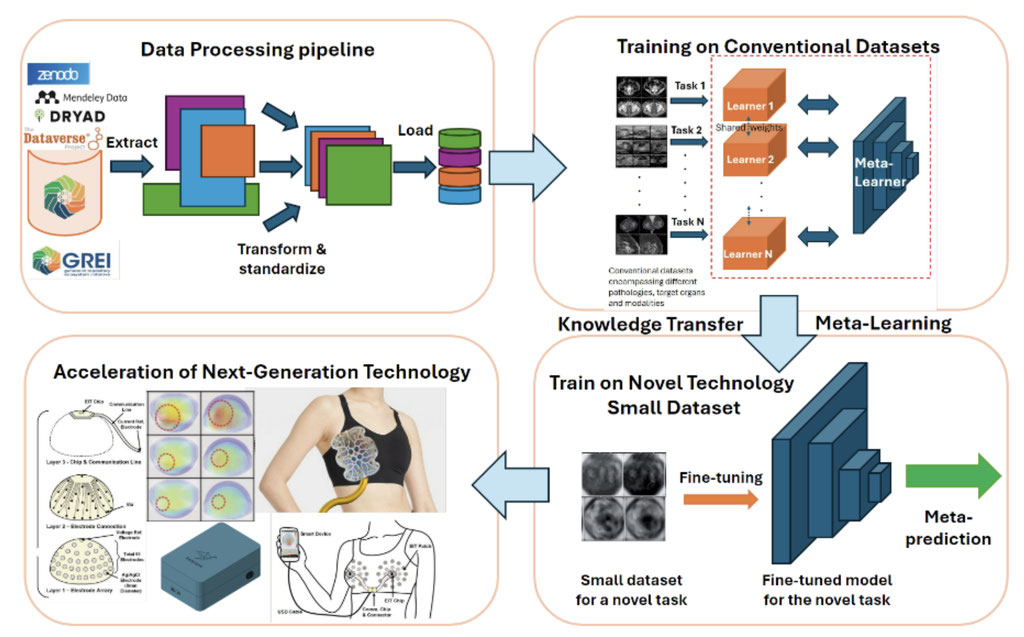
The research project focused on the development and evaluation of MEGATRON, a meta-learning framework aimed at improving early detection of breast cancer using Electrical Impedance Tomography (EIT). EIT is a promising imaging modality due to its low cost, portability, and non-invasive nature, but its adoption has been slowed by the lack of large-scale labeled datasets required for training robust deep learning models. To overcome this barrier, our project leveraged abundant open-source medical imaging datasets from GREI databases, and additional data from other sources, to construct an open-source data processing and meta-learning pipeline for few-shot EIT object detection tasks.
We implemented an open-source data processing pipeline designed to comply with FAIR principles, enabling automated ingestion, transformation, and storage of large, heterogeneous medical imaging datasets. GREI repositories served as a primary resource spanning mammography, ultrasound, MRI, and X-ray data across multiple anatomies including breast, brain, and chest, complemented by RSNA and TCIA datasets (see Table 1) contributing another 30k chest X-ray and breast MRI images. These sources encompassed hundreds of thousands of images, ensuring broad representation of imaging patterns. The pipeline harmonized file formats, removed patient-sensitive identifiers, filtered outliers, normalized resolution and intensity, standardized box annotations through coordinate transforms, and stored data as .png and .txt files within a deterministic directory hierarchy. Our pipeline, licensed under a CC BY-NC-SA, contains code, configuration files, and documentation designed to be findable, accessible, interoperable, and reusable (FAIR), enabling reproducible generation of standardized datasets for downstream meta-training and validation.
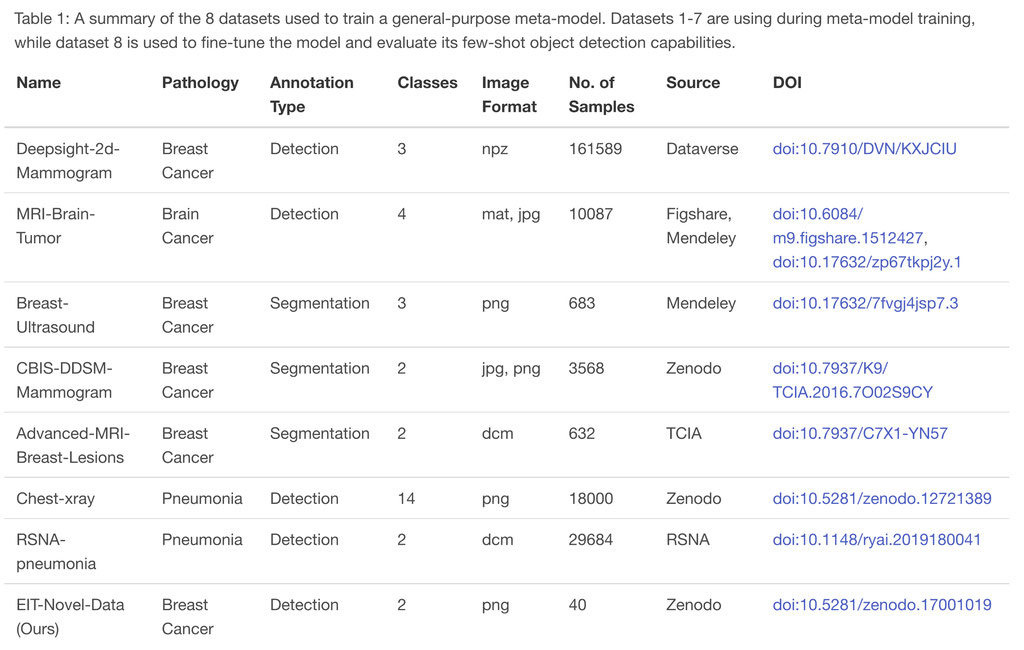
We employed a multi-task meta-learning approach to train a large meta-model for tumor detection. Training was performed on an A100 GPU. The Reptile algorithm was used to enable cross-modality transfer, while the base learner was an anchor-free object detection CNN with a CSP backbone, PAN-FPN neck, and an adaptive multi-head layer. We treated each dataset as a separate detection task. To simulate few-shot learning and enforce balanced task representation, we used an episodic training loop where the meta-model was exposed to only a small, fixed subset of randomly sampled images per task. The goal was to learn transferable feature representations from abundant conventional data that could generalize to our EIT dataset. After training, the meta-model was fine-tuned using a proprietary EIT dataset of only 40 labeled samples. Ablation studies were conducted to identify optimal hyperparameters, quantify how the number and combination of tasks spanning different modalities affect meta-learning generalizability, assess the impact of base learner architecture on accuracy, evaluate meta-model performance under extreme few-shot conditions, and determine the minimum fine-tuning required to maintain high accuracy.
The MEGATRON framework demonstrated strong performance on our very small EIT dataset. Specifically, the meta-model achieved 88% mean Average Precision (mAP), a substantial improvement over baseline transfer learning which achieved only 63% mAP. Further, under very few-shot learning scenarios, the model could achieve over 80% mAP50 while needing only a few more rounds of fine-tuning. The results validated our hypothesis that leveraging diverse conventional imaging data could significantly accelerate model development where high-quality EIT imaging data is limited. Ablation experiments revealed that increasing the number of tasks provided stronger generalization, although model accuracy was impacted when out-of-distribution modalities were included. These findings demonstrate the importance of task selection and diversity for application-specific meta-learning pipelines.
The project successfully addressed the central scientific question: Can we leverage cross-modality knowledge transfer to produce a generalized meta-model capable of few-shot detection on data-scarce modalities like EIT? Our results show that the MEGATRON framework offers a practical solution to the data scarcity challenge in EIT-based diagnostics. By creating a robust pipeline that integrates GREI and other open-source imaging datasets, we showed how secondary data analysis can empower innovation in medical imaging. The study’s methodological contributions include: (1) a robust, scalable and extensible data processing pipeline, (2) an adaptive, generalized meta-learning model that supports few-shot detection, and (3) a suite of ablation studies for systematic evaluation of model generalizability and knowledge transfer efficacy. The approach not only advances the scientific understanding of meta-learning in medical imaging but also offers a practical, open-source framework for accelerating diagnostic tool development in emerging imaging technologies.
The primary outcomes of our research include the development of a scalable, extensible meta-learning pipeline, identification of optimal model hyperparameters, assessment of task diversity on meta-model generalizability, evaluation of base learner size and architecture on multi-task performance, demonstration of few-shot detection on sparse EIT data and analysis of fine-tuning schedules. Additional benchmark studies confirm that the meta-model consistently outperforms both incremental learning and baseline transfer learning, demonstrating its ability to adapt efficiently without retraining from scratch or relying on massive architectures.
Systematic ablation studies yielded several key model insights. First, analysis of meta-learning rates established that a smaller rate (β=0.05) yielded the highest mAP50, balancing accuracy with robustness to noisy gradients. Second, experiments on the number and diversity of tasks used during training demonstrated that generalization follows an inverted U-shaped trend, with five tasks providing optimal meta-model performance, while additional out-of-distribution tasks led to negative transfer. Third, evaluation of base learner architectures revealed counterintuitive results, with smaller models outperforming larger ones trained without β-warmup, illustrating the importance of aligning network capacity with data scale to prevent overfitting. Fourth, experiments on fine-tuning schedules highlighted that, while fewer epochs could achieve >90% mAP50, they led to unstable performance, whereas extended fine-tuning improved consistency and reduced overfitting. Fifth, the meta-model achieved 88% mAP50 on limited EIT data versus 63% for the baseline model. Finally, compared to incremental transfer learning, the meta-model completely avoided catastrophic forgetting. Together, these results indicate that meta-learning can effectively leverage conventional imaging data to accelerate the development of models for novel modalities like EIT.
We addressed replicability and reproducibility through a robust data processing and training pipeline built on open-source libraries, including PyTorch, Ultralytics, PyDicom, PIL, tqdm and OpenCV. The selected training datasets featured diverse file formats and annotation systems. Our standardized data processing pipeline, capable of running on CPU and GPU nodes, was designed to harmonize these sources, remove patient-sensitive information, and implement a standard metadata schema for multi-task detection. Each processed dataset was stored in the same deterministic file hierarchy, with a data.yaml file in YOLO format for specifying paths and class definitions, enabling easy retrieval using standard dataloaders. All experiments were carried out under controlled configurations with fixed random seeds for reproducibility, and model performance was evaluated using standard metrics, with full specification of hyperparameters, warmup/decay schedules, architectures, and dataset splits.
To enable reuse, we documented hardware requirements, environment setup and software execution steps in a GitHub repository. The codebase's modular design, along with editable configuration files allow selective pipeline execution, with support for extending to new tasks. Users can submit tickets and receive support on questions. Validation checks and error handling mechanisms generate logs and safely re-initiate failed processes without comprising prior outputs. This open-source setup ensures that researchers can reproduce the findings and extend the analysis to other GREI data for new applications.
This project demonstrates that meta-learning can effectively mitigate the challenges of scarce training data in new imaging modalities. The outcomes, shared in a website (sup. doc 1), provide a blueprint for the clinical deployment of EIT-based tools and establish a generalizable framework for accelerating diagnostic innovation and improving patient outcomes through faster technology translation.
This research advances the field of medical diagnostics and wearable technology, especially in the emerging field of precision medical imaging where each individual's history and data is unique. Our work demonstrates that meta-learning can effectively overcome data scarcity in domains such as Electrical Impedance Tomography (EIT), paving the way for at-home screening tools and precision diagnostics. By systematically evaluating task and modality diversity, meta-model parameters, and base learner architectures, the study provides actionable insights into designing meta-models that generalize across multiple diagnostic tasks. The resulting framework enables accurate few-shot detection on sparse datasets, offering a scalable approach for developing predictive models in settings where large annotated datasets are impractical.
From a human health perspective, this work has the potential to accelerate the clinical translation of non-invasive imaging technologies, thereby improving early detection and dynamic monitoring of breast cancer which will lengthen lifespans and alleviate financial burdens. By leveraging conventional imaging data to train models for new modalities, the approach can reduce reliance on costly or invasive diagnostic procedures, enhance diagnostic accuracy, and support faster, more equitable access to screening and preventive care.
The proposed project was completed within the award period, with no major revisions to the scope or approach.
The project encountered several constraints related to the availability and quality of EIT data. After a detailed review of the public EIT datasets we intended to use, we found them to be inconsistent, often lacking key descriptors needed to interpret annotations, and, in some cases, missing images. To address these issues, we opted to collect our own proprietary EIT imaging dataset, ensuring high resolution images with accurate annotations and compatibility with our meta-learning framework.
In contrast, conventional imaging datasets provided a reliable source of high-quality labeled data, but they presented the added challenge of handling heterogeneous datasets from different repositories, with multiple file formats and varying annotation systems. To address this, we developed a robust, automated data processing pipeline with mechanisms for future extensibility to new data. The pipeline can retrieve data from multiple repositories, supporting both API-based queries and direct downloads. It can handle a variety of archive formats (.tar, .tgz, .7z, .zip), preserve provenance and versioning, and standardize imaging data (DICOM, JPG, PNG, HDF5, MAT, NPZ) into a consistent structure, ensuring reproducibility and streamlined downstream processing.
a) Images were checked for corruption by verifying that headers and metadata were readable during decompression. Outliers e.g., empty arrays, invalid intensities and incomplete image-label pairs were removed. Coordinate systems were standardized, and bounding box overlays validated using specialized routines. Dataset similarity metrics e.g., t-SNE and Wasserstein distance were used to quantify the eligibility of conventional data. Preprocessing steps outlined previously helped achieve data consistency and completeness for training.
b) Barriers included heterogeneous file formats, annotation systems, and metadata standards, requiring extensive data wrangling. Missing or mismatched labels reduced usable data, and incomplete annotation descriptors were common in older repositories. Inconsistent resolutions and annotation systems across modalities further complicated standardization, but error-handling mechanisms and validation checks ensured that the final datasets were consistent.
Our project directly targets the barriers to data reuse and analysis by designing a robust open-source data processing pipeline. Public imaging repositories presented heterogeneity in file formats, annotation systems, metadata standards, image resolution, as well as missing or corrupted files. We addressed these issues through automated validation, outlier filtering, metadata normalization, and harmonization of annotations across detection and segmentation tasks. To overcome analysis challenges, we processed and stored datasets in deterministic formats to comply with standard dataloaders, enabling reproducible model training. The framework transformed modality-specific data into reusable homogenized inputs for rigorous meta-learning experiments.