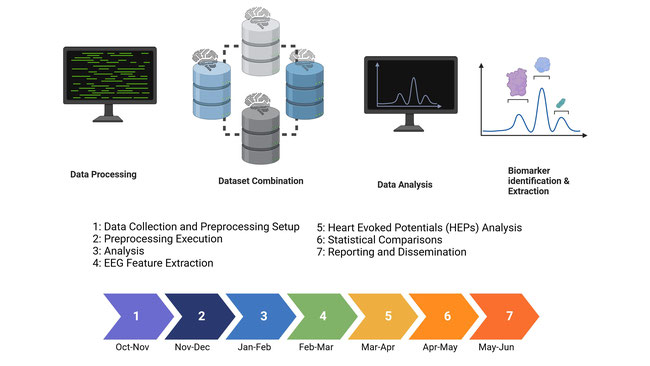
The project addresses the need for improved diagnostic tools for neuropsychiatric disorders through the use of EEG data. Due to lack of subjectivity in current diagnostics, there is a demand for objective biomarkers. In order to find those biomarkers we will build a comprehensive EEG data library from both healthy individuals and patients diagnosed with neuropsychiatric disorders. We will collect raw EEG data and develop a preprocessing pipeline to process and combine them. Also, we will analyze relevant EEG features such as synchronization metrics, coherence, power, and heart-evoked potentials, between neuropsychiatric patients and healthy controls. We except an identification of novel biomarkers that could serve as diagnostic tools.The project has the potential to revolutionize neuropsychiatric diagnostics by providing a data-driven foundation for the use of EEGs. This approach could significantly improve early diagnosis and treatment, with broad implications for public health.
The project aims to identify EEG-based biomarkers that can serve as diagnostic or prognostic tools for neuropsychiatric disorders, including Autism, Schizophrenia, PTSD, anxiety, and depression. By leveraging large-scale datasets from the GREI, the BRAEIN will analyze EEG signals to extract clinically relevant features that differentiate healthy individuals from patients with neuropsychiatric conditions.
OSF (https://osf.io/ufet7/): EEG time-series, raw data, 177 participants (https://osf.io/pnvay/): EEG time-series, raw data, 24 Autistic Adults and 28 neurotypical controls
Zenodo (https://zenodo.org/records/7315010): High-resolution EEG, raw data, 35 participants
Dryad (https://datadryad.org/stash/dataset/doi:10.5061/dryad.kd51c5bbf): EEG time series, raw data, 40 participants
(https://datadryad.org/stash/dataset/doi:10.5061/dryad.8gtht76pw): EEG signals with event markers, processed data, 230 participants
Mendeley (https://data.mendeley.com/datasets/sbyj5f6c3k/1): EEG signals, raw and processed data, 47 participants
(https://data.mendeley.com/datasets/7r4z3p3g4m/1): EEG signals from cognitive tasks, likely processed data, 16 participants
(https://data.mendeley.com/datasets/gsxphk87mc/3): EEG time Series, raw, substantial dataset with multiple recordings and conditions, 29 participants
(https://data.mendeley.com/datasets/2rpcmmmx53/2): EEG time-series, raw data, 38 participants
The BRAEIN will utilize EEG datasets available through the GREI repositories to conduct the secondary analysis. The repositories we will use host raw and processed EEG data from studies focusing on neuropsychiatric disorders which align perfectly with the project's goals.
The datasets from these repositories will be downloaded, formatted into a unified structure, and then stored in a local database for further analysis. By using GREI repositories, we ensure that the data is sourced from diverse studies, encompassing both healthy individuals and patients. This enables a robust comparison between cohorts and increases the statistical power of the findings.
The integration process involves:
By incorporating data from these repositories, the BRAEIN will be able to leverage a wide array of publicly available EEG datasets, ultimately expanding the scope of the research findings.
October - November: Data Collection and Preprocessing Setup
November - December: Preprocessing Execution
January - February: Analysis
February - March: EEG Feature Extraction
March - April: Heart Evoked Potentials (HEPs) Analysis
April - May: Statistical Comparisons
May - June: Reporting and Dissemination
The BRAIEN library aims to generate a comprehensive set of EEG-based biomarkers for neuropsychiatric disorders. The primary research outcome will be the identification of these biomarkers, which could eventually serve as diagnostic and prognostic tools for clinicians. The expected outcomes include studying the implications of synchronization between different brain areas in the development of selected diseases, analyzing power and coherence, and, finally, identifying the potential role of brain-body cross-talk via heart-evoked potentials, something never before used in this context.
The results of the BRAIEN project will be disseminated through various channels, including peer-reviewed publications, conference presentations, and by making the data, code, and findings publicly accessible. BRAIEN will adhere to the FAIR and CARE principles, ensuring the data is findable (all EEG datasets and metadata will be indexed in public databases with appropriate documentation and persistent identifiers), accessible (data will be made openly available), interoperable, and reusable. Additionally, the analysis will only be conducted on de-identified data, with no personal identifiers, thus preserving patient anonymity.
Neuropsychiatric disorders affect nearly one-third of the global population, imposing a significant burden on individuals and healthcare systems. Despite advancements in understanding the pathophysiology of these disorders, no specific neurofunctional biomarkers have been definitively established for diagnosis or prognosis. Currently, diagnoses rely largely on subjective symptom reports and clinical observation, which can lead to delayed or inaccurate diagnoses, suboptimal treatment, and inconsistent outcomes.
This proposed project aims to address this gap by identifying EEG-based biomarkers that can serve as objective, neurofunctional indicators of neuropsychiatric disorders. These biomarkers have the potential to revolutionize clinical practice by providing reliable, real-time data on brain activity that directly reflects underlying neuropsychiatric dysfunction. The availability of such biomarkers could significantly enhance diagnostic precision, allowing clinicians to detect these conditions earlier and more accurately. This would lead to improved outcomes by enabling timely interventions and reducing the misdiagnoses that are common with symptom-based assessments alone.
In terms of treatment, EEG biomarkers could also play a crucial role in predicting treatment responses. For example, different EEG biomarkers could be used to tailor therapies based on individual brain activity, paving the way for personalized medicine in neurology and psychiatry. This approach would allow healthcare providers to customize treatment plans according to the neurobiological profiles of their patients, increasing the efficacy of interventions and minimizing side effects from ineffective treatments. Furthermore, the use of EEG as a noninvasive, cost-effective, and widely accessible tool positions it as a practical solution for the regular monitoring of patients over time.
All the team members have research backgrounds, with a special focus on genomics and neurosciences. Alejandro and Fylaktis are currently doing their PhD, in neuroscience-applied AI, with a special emphasis on EEG-extracted features for training machine learning models to predict response to epilepsy and PTSD. Glikeria has a Μaster's in Biomedical Sciences, and a strong background in genomics, data analysis, and data visualization. All the team members have a strong grasp of statistics and have worked with different programming languages and statistical tools such as Python, R, SPSS, and GraphPad.
After establishing the project pipeline, we examined the available resources in the challenge to ensure that we had sufficient datasets to perform an analysis with robust statistical power. Our aim is to include a wide range of diseases, making the library both comprehensive and highly relevant for clinical practice. While our project focuses on a single biomarker, we will adopt a holistic approach, taking into account the various potential variations in EEG signals. This strategy will allow us to develop a diverse set of biomarkers with potential clinical applications.