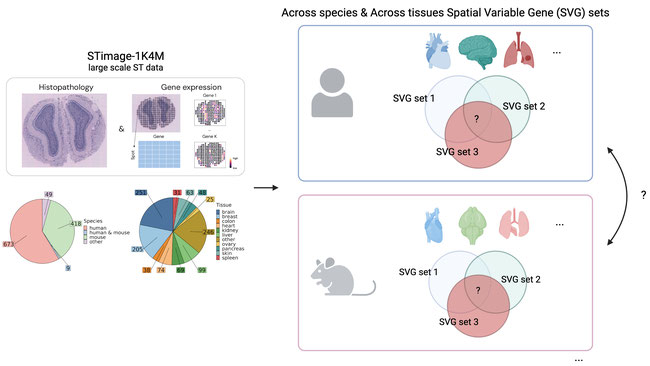
Spatial transcriptomics (ST) technologies have revolutionized gene expression studies by preserving the spatial context of cellular organization in tissue samples. Spatially variable genes (SVGs) are key to understanding tissue molecular architecture and its impact on biological processes and diseases. In this study, we aim to leverage the comprehensive STimage-1K4M dataset for a secondary analysis to investigate pressing biological questions including but not limited to whether SVG sets are more conserved within the same tissue across different species or across different tissues within the same species. By mapping SVGs across diverse species and tissues, we aim to uncover patterns that reveal functional consistencies and evolutionary mechanisms of spatial gene expression. The findings will enhance diagnostic tools, inform therapeutic strategies, and provide insights into disease pathogenesis, ultimately advancing spatial transcriptomics and its applications in biomedical research.
SVGs are pivotal in understanding the complex molecular architecture of tissues and how this architecture influences both normal biological processes and disease states. These genes, whose expression patterns show significant variations across different spatial domains within a tissue, offer insights into the role of cellular heterogeneity and the microenvironment's role in health and disease. By studying SVGs, researchers can gain a deeper appreciation of the cellular responses to physiological and pathological conditions within tissues, which is crucial for developing targeted medical interventions.
Motivated by the importance of SVGs, our study aims to leverage the rich data in the STimage-1K4M dataset to explore several fundamental questions about the nature and distribution of these genes. We are particularly interested in understanding the relationship between SVG sets across tissues and species. We aim to build an SVG dendrogram across tissues and species, answering questions including which two tissues have the most similar SVG sets with in same species and whether SVG sets are more conserved within the same tissue across different species or more similar across tissues within the same species. This investigation will help elucidate the evolutionary and functional consistencies of spatial gene expression and reveal the underlying biological mechanisms that shape tissue function across various species.
The primary dataset, STimage-1K4M, curated by our team and accepted by NeurIPS 2024, is available at Zenodo and Huggingface. We anticipate its broader impact like AMOS for medical image segmentation, and Quilt-1M for histopathology, presented in previous NeurIPS. STimage-1K4M is the first large-scale ST multimodal dataset, containing 1,149 slides and over 4 million spot-level data points covering 50 tissue types and 8 species. This dataset integrates both high-resolution histopathology images and spatial gene expression data, making it an invaluable resource for large-scale ST research.
This project will utilize cutting-edge statistical models and machine learning techniques tailored to detect SVGs, specifically, we will benchmark 37 existing methods designed for SVG detection and develop new statistical tests to assess their effectiveness. The optimal SVG sets identified through this process will then be further analyzed to address scientific questions using advanced machine learning and statistical methods.
Data preparation and initial SVG benchmarking will commence within the first three months, incorporating detailed statistical analysis and preliminary machine learning modeling. In the subsequent two months, we will determine the most effective ways to utilize the SVG sets across different tissues and species. This phase may also include integrating additional datasets, such as bulk RNA-seq and single-cell RNA-seq data, to validate our findings. The final month will focus on synthesizing and concluding our research findings.
Our research project aims to deepen the understanding of SVGs across various species and tissues, leveraging the comprehensive STimage-1K4M dataset. The anticipated outcomes of this study include detailed maps of SVG distribution and their comparative analyses across different biological contexts. We expect to reveal fundamental insights into how SVGs vary by species and tissue type, potentially uncovering universal patterns or unique tissue-specific expression profiles. These findings could significantly impact genetic research, disease understanding, and the development of targeted therapies.
To ensure broad dissemination of our research findings, we will engage with both academic and clinical audiences through multiple channels. Firstly, we plan to publish our results in high-impact, peer-reviewed journals within the fields of genetics, computational biology, and translational medicine. Additionally, we will present our findings at leading international conferences and workshops such as the Conference on Neural Information Processing Systems (NeurIPS), the International Conference on Machine Learning (ICML), the Conference on Statistics in Genomics and Genetics (STATGEN), and the American Society of Human Genetics Annual Meeting (ASHG), providing us a platform to reach a global audience of researchers and practitioners.
In adherence to the FAIR principles, our project will ensure that all datasets, methodologies, and results are Findable, Accessible, Interoperable, and Reusable. We will achieve this by depositing all data and software tools developed during the project into recognized open-access repositories such as GitHub with appropriate metadata and standard data formats. These resources will be accompanied by clear documentation to facilitate their use by other researchers and stakeholders. Additionally, where applicable, we will respect the CARE principles by considering the Collective benefit, Authority to control, Responsibility, and Ethics, particularly in relation to data originating from diverse biological sources.
To address replicability and reproducibility, our project will implement rigorous documentation of all experimental designs, analytical methods, and computational procedures. This approach includes using version-controlled software development practices and providing detailed protocols for all analyses. Moreover, we will use standardized data processing pipelines and share these through open-source platforms, allowing other researchers to replicate and validate our findings under similar or varying conditions. By committing to these practices, our project aims to set a benchmark in the field for robust, transparent, and ethical research that can be built upon by future studies in ST and beyond.
Our proposed research project on SVGs using the STimage-1K4M dataset is poised to make significant contributions to several scientific disciplines, particularly within genetics, computational biology, and personalized medicine. By mapping and analyzing SVGs across different species and tissues, our study will provide unprecedented insights into the spatial dynamics of gene expression. These insights will enhance our understanding of how genetic variability within tissues can influence both normal biological processes and the pathogenesis of diseases.
One of the key aspects of this project is the ability to reveal relationships between genes at a deeper level, including their spatial interactions and changes. The analysis of SVG sets across different tissues and species allows us to observe not just the expression levels of genes but also how these expressions are spatially arranged and interrelated. This spatial relationship layer, which is inaccessible through traditional genomic studies that do not consider spatial context, can uncover new dimensions of gene function and regulation.
In terms of human health, the impact of this research could be transformative. Understanding the spatial arrangement of genes and their expression levels within tissues will directly influence the diagnosis and treatment of diseases. For diagnosis, SVG analysis could lead to the development of more precise biomarkers that are specific to the pathology of different tissue types. This specificity could improve the accuracy of diagnostic tests, allowing for earlier detection of diseases such as cancer, where the localization of abnormal gene expression within tissue architecture is crucial.
Furthermore, in treatment and prevention, insights from SVG patterns might inform targeted therapy approaches. For example, if certain SVGs are associated with the progression of a specific type of cancer, therapies can be developed to target these genes or the pathways they influence. Additionally, understanding how these genes interact within their spatial context could help in designing interventions that are not only targeted but also minimize side effects by affecting only the diseased cells and not the surrounding healthy tissues.
Moreover, this research has the potential to impact preventive medicine by providing insights into the tissue-specific gene expressions that underlie complex diseases. This can lead to better lifestyle and treatment recommendations tailored to the genetic makeup of individuals, potentially preventing the onset of disease or its progression.
By advancing our understanding of ST and its implications for health and disease, the proposed project stands to significantly advance scientific knowledge and directly contribute to improved human health outcomes. The integration of this knowledge into clinical practice could revolutionize how we diagnose, treat, and prevent diseases, ultimately leading to enhanced patient care and health management.
Our team is led by Dr. Yun Li and Dr. Didong Li, both affiliated with the University of North Carolina at Chapel Hill. Dr. Yun Li is a professor in the Departments of Genetics and Biostatistics, and Dr. Didong Li is an assistant professor in the Department of Biostatistics. Together, we have collaborated on several projects related ST, including the collection of the STimage-1K4M dataset. Dr. Yun Li specializes in the development of statistical methods and their application to the genetic dissection of complex diseases and traits. Dr. Didong Li's expertise lies in the development of statistical methods for robust inference in complex and high-dimensional data. His areas of focus include manifold learning, nonparametric Bayesian inference, information geometry, and spatial statistics.
Key considerations to ensure the success of our proposed research project on SVGs include rigorous data management, robust methodological frameworks, and comprehensive stakeholder engagement. Effective data management will be critical, involving meticulous handling of the STimage-1K4M dataset and the documentation of the experiments. We will adopt cutting-edge computational techniques, like multi-core and cloud computing, tailored specifically for high-dimensional and spatial data to ensure that our analyses are both precise and scalable. Additionally, regular collaboration and communication among team members and with external experts will be crucial to continuously refine our methods and align our findings with current scientific standards. Engaging with the broader scientific community through publications and presentations will also be vital to validate and disseminate our research outcomes, ensuring that our work contributes meaningfully to advancements in genetics.