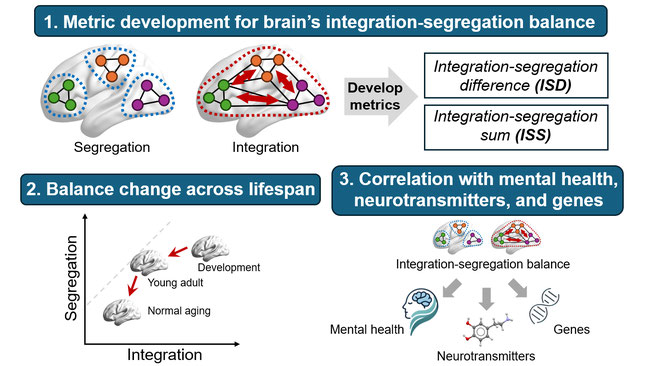
Our project quantifies the integration-segregation balance in brain networks across the lifespan. We introduce metrics—Integration-Segregation Difference and Sum—to measure balance at network and regional levels. Using public datasets, we investigate how integration and segregation change during development, adulthood, and aging. Additionally, we identify which brain networks primarily drive these changes, and whether specific thalamic nuclei exhibit distinct patterns. We also explore how this balance correlates with cognitive and emotional capacities, personality traits, and mental health, along with its relationship to neurotransmitter levels and gene expression. These analyses offer insights into how brain network dynamics influence behavior, cognition, and mental well-being across the lifespan, providing a foundation for potential advances in addressing age-related neurological and mental health conditions.
Secondary Analysis Project
Our project aims to investigate how the integration-segregation balance in brain networks changes across the lifespan and its correlation with cognitive and emotional capacities, personality traits, and mental health. We recently proposed a novel network-based metric that measures the integration-segregation balance and validated it to anesthesia and sleep datasets (accepted in Nature Communications, to be published by Nov 2024). We will apply these metrics—Integration-Segregation Difference (ISD) and Sum (ISS)—to measure the dynamic balance between network integration and segregation at both the network and regional levels. This project will uncover how brain network dynamics influence cognition and mental well-being, offering insights into age-related neurological and mental health conditions. Additionally, we will explore relationships between network balance and molecular factors such as neurotransmitter levels and gene expression.
Data Utilization
We will utilize functional connectivity datasets (young adults and aging) from the Zenodo repository (https://zenodo.org/records/6770120) and an fMRI dataset covering development (5-21 years) from the Human Connectome Project. We will also incorporate neurotransmitter data and gene expression data from the Allen Brain Atlas, providing molecular insights relevant to our analyses.
Incorporation of GREI Repository Data
We plan to use the functional connectivity dataset for resting-state fMRI (young adults and aging) available in the Zenodo repository, which participates in the GREI.
Methods and Analysis
We will apply network neuroscience methods to analyze brain connectivity patterns. Using ISD and ISS metrics, we will assess how the balance between integration and segregation changes over development and aging in large-scale brain networks and specific regions. Based on the functional connectivity matrices from the Zenodo repository, we will calculate network- and region-level metrics, quantifying differences and sum in integration and segregation.
Additionally, we will perform correlation analyses between network balance metrics and sex, cognitive, emotional, and personality traits from the HCP datasets. We will explore relationships with neurotransmitter levels and gene expression using dominance analysis and gene ontology analysis.
Suggested Timeline
Research Findings and Expected Outcomes
Our project aims to quantify how the integration-segregation balance in brain networks changes across the lifespan. By analyzing public lifespan datasets, we expect to uncover patterns of change in brain network dynamics during development, adulthood, and aging. Specifically, we anticipate that integration will decrease during development and more gradually in aging, while segregation may show a rapid decline in later stages of life. We expect these changes to be driven primarily by subcortical networks, with distinct patterns emerging in the unimodal and transmodal nuclei within the thalamus. Additionally, we anticipate that deviations in network balance will correlate with alterations in cognitive function, emotional regulation, and psychological well-being across the lifespan. Moreover, we expect to find links between these brain network dynamics and molecular factors, such as neurotransmitter levels and gene expression.
Sharing of the Findings
We are committed to sharing our findings with the scientific community. Key dissemination avenues include:
FAIR Principles
We fully adhere to the FAIR principles, ensuring our data, code, and results are openly available and reusable. Key steps include:
Replicability and Reproducibility
We prioritize replicability and reproducibility through these actions:
Our project aims to quantify the integration-segregation balance in brain networks across the lifespan, contributing to network neuroscience, cognitive neuroscience, and neurobiology. By introducing novel network metrics (ISD and ISS), we offer new insights into how brain network dynamics evolve across development, adulthood, and aging. These metrics allow us to assess how different brain regions and networks interact to support cognitive and emotional functions and relate to molecular factors like neurotransmitters and gene expression.
Contributions to Scientific Disciplines
Impact on Diagnosis, Treatment, and Prevention
By advancing the understanding of brain network dynamics and their relationship with cognitive and biological factors, we lay the groundwork for future innovations in preserving cognitive function and improving mental health throughout the lifespan.
Our team consists of two members: Zirui Huang, Ph.D., and Hyunwoo Jang, M.S., both based at the University of Michigan Center for Consciousness Science. We have been collaborating closely for the past three years. Zirui is a Research Assistant Professor in Anesthesiology with over 50 publications and extensive experience in analyzing fMRI data, particularly in the context of consciousness and anesthesia. Hyunwoo, a Ph.D. student in the University of Michigan Neuroscience Graduate Program, is advised by Zirui and specializes in network neuroscience, focusing on the integration-segregation balance of brain networks.
Our collaboration is highly integrated, as we work in the same building, meeting daily to discuss progress and research goals. Our most recent joint work, accepted in Nature Communications (to be published by Nov 2024), examined integration-segregation balance changes during anesthesia and sleep, further solidifying our expertise in this area. Together, we bring a comprehensive skill set in statistical analysis, neuroimaging, and network-based approaches to tackle complex brain dynamics. Our strong teamwork, underpinned by close communication and shared expertise, positions us well to successfully complete the proposed project.
1. Data Quality and Selection: We use high-quality public lifespan datasets (HCP-Development, Young Adults, and Aging), as well as neurotransmitter and transcriptome datasets, providing robust coverage across life stages for comprehensive analysis.
2. Methodological Rigor: We employ novel network metrics—Integration-Segregation Difference (ISD) and Sum (ISS)— to quantify balance at network and regional levels. Our pipeline ensures methodological rigor, benchmarking the metrics’ performance using established methods.
3. Collaborative Expertise: Our team’s expertise in fMRI data analysis, network neuroscience, and statistical modeling ensures we can handle the project’s complexity. Daily interactions drive a dynamic, productive collaboration.
4. Ethics and Data Integrity: We adhere to ethical standards, ensuring non-discriminatory data use and maintaining confidentiality. We are committed to open science, sharing results and methods to ensure transparency and reproducibility.