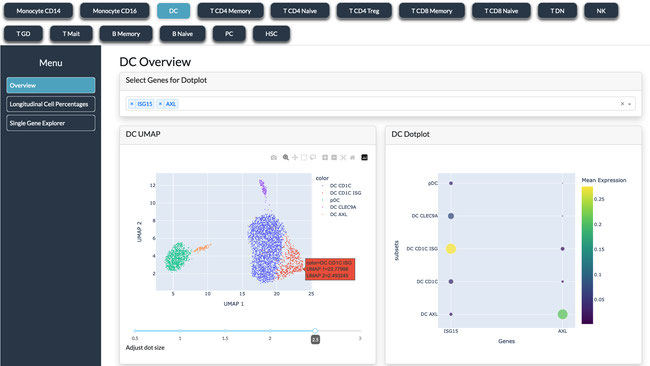
Our secondary analysis will leverage single-cell RNA sequencing of longitudinally sampled peripheral blood mononuclear cells to investigate immune responses to SARS-CoV-2. In building our innovative, educational, browser-based tool, we aim to empower users with no biological or computational experience to explore immune cell subsets and track longitudinal changes across immune populations. This tool offers a novel approach to systems immunology education, eliminating the complexity of existing solutions that require technical expertise or are not intuitive and do not readily excite potential users. Our platform will increase accessibility to cutting-edge research, facilitating public engagement with advanced immunological data and raising awareness about immune responses to disease. This initiative has the potential to broaden scientific understanding and inspire future scientists by making sophisticated immune analysis interactive, intuitive and easy to grasp.
This project will leverage data from the study by Pekayvaz et al., our analysis will focus specifically on peripheral blood mononuclear cells (PBMCs) to explore systemic immune responses (n=22 non-infected controls, n=29 pneumonic COVID-19, n=53 ambulatory infected). The dataset includes longitudinal samples from hospitalized individuals and those who were less affected. This dataset is hosted in Zenodo, a GREI repository, ensuring adherence to open science principles and broad accessibility making it ideal for our educational platform’s seamless data access and proper documentation. Our browser-based approach also exemplifies how GREI repositories can serve as pivotal hubs for educational tools that extend the reach of biomedical research to the general population.
Data Sources and Types: The data consists of single-cell RNA sequencing (scRNA-seq) of PBMCs sampled over multiple time points. We will focus on educating individuals in how to identify and cluster different immune cell subsets such as monocytes, dendritic cells, natural killer cells, T cells, and B cells using gene marker expression. The project will utilize longitudinal sampling to highlight changes in immune cell populations over time, especially in those who were severely affected by COVID-19. This will allow for an in-depth analysis of immune dynamics during infection to excite new immunologists and bioinformaticians.
Methods and Analysis: This browser-based tool will be built using JavaScript and Python Dash deployment frameworks, offering an accessible, user-friendly platform with no requirement for technical expertise. The data will be preprocessed and analyzed using the Scanpy pipeline for single-cell RNA-seq, augmented by the Ucar lab’s specific workflows. Our analysis will focus on clustering immune cells based on their marker gene expression, employing algorithms such as Leiden clustering for visualization. The tool will display differential gene expression, longitudinal trends in cell-type percentages over time, and differences in those who were more affected by COVID-19, with a strong emphasis on interactive usability like our previous work (see Supporting Documents: Viz23).
Timeline:
Phase 1 (1 month): Preprocess PBMC scRNA-seq data and begin integration within the platform. Action items include data cleaning, normalization, and clustering of immune cell subsets based on marker gene expression.
Phase 2 (3 months): Develop the interactive browser-based platform. Users will be able to categorize cell clusters by gene expression and explore longitudinal data in real time. Simultaneously, we will deploy the tool on the web using Python Dash.
Phase 3 (2 months): Expand the platform to include educational modules that guide users through key immunological concepts and bioinformatics techniques. A user feedback system will be introduced, including a comment and rating system to refine the platform based on user experience.
The proposed research aims to create a web-based, interactive platform that makes cutting-edge scRNA-seq data analysis accessible to the public. Users will be able to learn via interactive visualization of PBMC data. The platform will educate users in how to identify and filter cells by type via gene expression. Showcasing how immune cell populations change over time across patients, particularly in response to viral infection, will excite new immunologists and bioinformaticians alike.
Online Platform: The platform will be freely accessible online, hosted via our lab’s server. No installation or technical setup will be required, enabling users from all backgrounds to explore immune cell data in an intuitive, educational environment.
Educational Modules: We will develop interactive guides that teach users how scRNA-seq data is analyzed, including clustering algorithms and gene expression analysis, bridging the gap between advanced research and educational content.
User Engagement: The platform will incorporate a comment and rating system to gather feedback, enabling iterative improvement based on user experience.
Educational Outreach: We will promote the platform through presentations at relevant conferences and workshops, as well as targeted outreach to educational institutions, particularly those focused on biology, immunology, and computational sciences.
Findable: The data underlying this project is hosted on Zenodo, making it easy to locate through a permanent DOI. The platform will incorporate clear links to the data source.
Accessible: The platform is browser-based, ensuring that users need no specialized software or computational skills to interact with the data. The interface will be designed for usability, with comprehensive guides to assist users in exploring scRNA-seq data.
Interoperable: The platform will follow common standards used in scRNA-seq analysis, such as AnnData and Scanpy, making it interoperable with other tools and ensuring that data formats can be used in a wide array of research contexts.
Reusable: To support transparency and reproducibility, the platform’s codebase and associated analysis pipelines will be made publicly available on GitHub, ensuring that users can freely reuse and adapt them for further research or educational purposes.
The project will adopt CARE principles by ensuring that data usage respects privacy and reinforcing the importance of ethical data use, particularly in vulnerable populations.
Replicability and Reproducibility: The entire analysis workflow will be documented, with all scripts and methods made available through GitHub. Our use of open-source frameworks (Scanpy, Python Dash) ensures that the analysis can be replicated in different environments, promoting transparency and accountability. By adhering to standardized pipelines for single-cell data analysis, the project will ensure that findings can be independently verified and reproduced by other researchers.
The proposed research project will have a transformative impact on both the scientific community and the general public by democratizing access to advanced single-cell RNA sequencing analysis. This project will provide an intuitive, browser-based tool for exploring immune cell subsets and their gene expression, offering an unprecedented opportunity for education, awareness, and engagement with systems immunology. The scientific significance of this tool lies in its ability to bridge the gap between cutting-edge research and public understanding, empowering the next generation of immunologists and raising awareness about immune health.
Contributions to Bioinformatics and Computational Biology: The platform simplifies complex computational workflows into an interactive, educational, browser-based interface. This is especially impactful for students and researchers without a computational or immunology background, exposing them to current methods used in modern single-cell biology.
Educational Outreach: By offering educational modules, the project contributes significantly to science education. Future immunologists can actively engage with real data, gaining a deeper understanding of how immune cell populations change during infections or chronic conditions. The platform also facilitates self-paced learning and exploration, making it an excellent resource for educators.
Impact on Human Health
Raising Public Awareness: This platform will be a resource for the general public, who will be able to interact with immune cell data from donors suffering from COVID-19. By making immune responses tangible and understandable, the tool can increase awareness of how critical immune health is for overall well-being. The general public will learn how immune cells fight infections like SARS-CoV-2, gaining knowledge of different immune cell types, and understanding why immune system function is crucial for disease prevention.
Prevention and Early Diagnosis: Through this educational tool, users will gain insights into immune system dysfunctions that underlie many diseases. This deeper understanding could inspire interest in immune monitoring as a preventive health strategy, encouraging earlier interventions in conditions caused by immune dysfunction.
Engagement with the Next Generation of Immunologists: This project is designed to invigorate the next generation of scientists to engage with immunology from a data-driven perspective. By removing the technical barriers often associated with single-cell RNA-seq analysis, the tool allows students to easily focus on biological insights.
Transformative Educational Impact: The platform’s educational focus will create an inclusive environment where anyone, regardless of their computational background, can engage with and understand immune health. Ultimately, this tool will broaden public understanding and spark future research aimed at improving bioinformatics accessibility.
Our team consists of three members collaborating within the Ucar Lab at the Jackson Laboratory:
Dr. Luke Trinity (Ph.D. Computer Science, M.S. Data Science). My research is focused on using statistical techniques to study single-cell RNA-seq data in aging populations. I bring technical expertise in web-based educational tool development like my Viz23 platform for visualization of gene expression.
Dr. Sathyabaarathi Ravichandran (Ph.D. Computer Biology, B.Tech. Bioinformatics): A senior postdoctoral associate, Dr. Ravichandran specializes in understanding age-associated changes in immune responses to vaccination. With her deep understanding of immunology, she contributes to the biological context of our platform, ensuring that the data is interpreted in a meaningful way for both researchers and the general public.
Giray Naim Eryilmaz (M.S. Computer Engineering): As a research data analyst Giray has extensive experience developing web platform frameworks. His skills in software development and python deployment ensure that our platform will operate smoothly and efficiently for all users.
Together, we combine expertise in bioinformatics, immunology, and data science which will enable us to create a tool that democratizes single-cell RNA-seq analysis. Our collaborative effort draws on each member’s strengths, ensuring that the platform is both scientifically rigorous and user-friendly. We work closely to cross-pollinate and build on established scRNA-seq pipelines.
To ensure the success of this research project, we will draw on the strengths of existing tools, (e.g., Cell x Gene, Cell Guide), incorporating their best features for exploring and visualizing RNA-seq data. Our tool will be distinct in that it is specifically tailored for educational immune cell analysis, i.e., entirely browser-based with learning modules. Our focus is on interactive visualization, usability, and accessibility, supported by our team’s deep expertise in immunology and single-cell RNA-seq analysis.
Our intuitive interface will empower users with no computational or biology background to understand immune cells in our blood. Incorporating user feedback via a comment and rating system will help us refine and improve the platform over time. By leveraging proven frameworks and focusing on educational impact, we are confident our tool will raise awareness of immune health and advance public understanding of systems immunology.