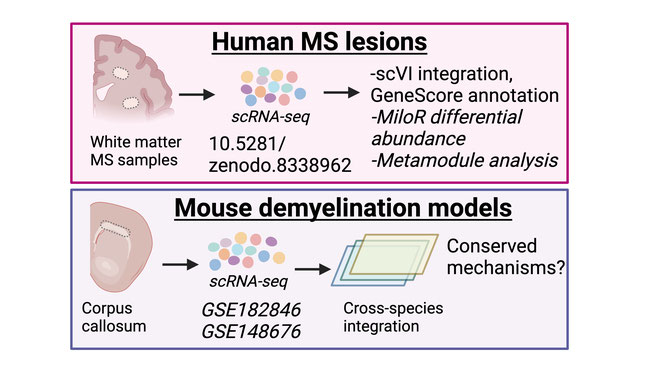
Demyelination, the breakdown of protective myelin around nerve fibers, plays a major role in diseases like Multiple Sclerosis (MS), which causes progressive neurological disability. Our research focuses on both human MS tissue and mouse models of demyelination to better understand how the disease progresses and how the body attempts to repair itself. We propose to use new computational tools to reanalyze the largest single-cell RNA dataset of human MS lesions to discover new molecular processes linked to the loss and repair of myelin. Furthermore, we will compare findings from human MS tissue with mouse models to identify shared repair mechanisms by undertaking a cross-species integration analysis. This research aims to connect human disease with animal models, providing fresh insights into MS and possibly identifying new ways to promote myelin repair in neurodegenerative conditions.
Secondary Analysis:
We propose a secondary analysis of the recent scRNA-seq data that includes brain tissue of 54 MS patients and 26 controls, focusing on the molecular changes in demyelinated and remyelinated white matter lesions (Macnair et al- link 7). Importantly, the data includes neuropathologically staged lesion information, allowing us to stratify samples by disease severity and providing a unique opportunity to explore molecular pathways across lesion types.The project, which leverages data from the GREI repository Zenodo (DOI: 10.5281/zenodo.8338962), includes a quality-filtered cell x gene matrix with raw counts that is 5 GB and annotated with metadata such as donor ID, age, sex, lesion type, and diagnosis.
Reanalysis Methods:
Our reanalysis will use updated tools, for example, using the scVI model for better biological detail retention during batch integration (Luecken et al- link 6). We will perform hierarchical cell-type labeling to define broad cell classes, states, and subtypes using an unbiased gene scoring approach, allowing for robust cluster merging based on biological phenotype. To detect cell subtypes enriched in specific lesion types, we will calculate differential abundance statistics using MiloR, a tool well-suited for analyzing continuous cell states (Dann et al- link 5). A key innovation of this project is the application of meta-module analysis to predict gene co-expression networks across patient samples (Nano et al- link 8). This method is scalable across large datasets and is expected to overcome sample-specific variability, and uncover novel molecular pathways relevant to patient subgroups and lesion progression. Finally, we will leverage the newly developed cell communication protocol to reveal cell crosstalk across samples, applied for the first time in human MS data (Baghdassarian et al- link 4).
Cross-Species Analysis:
In parallel, we will perform a cross-species analysis to compare human MS data with mouse models of remyelination. Our reanalysis of the human dataset will focus on white matter lesions, allowing us to draw parallels with reanalyzed scRNA-seq datasets from mouse models of remyelination (Pandey et al; Shen et al- link 9, 10). Our previous analysis of mouse scRNA-seq, including time points of peak demyelination and remyelination, has revealed critical cell-cell crosstalk among the main cells involved in repair. By integrating these findings with human data, we aim to identify conserved pathways that could inform future mechanistic studies.
Timeline:
The reanalysis of human data and cross-species comparison is projected to take 6 months. We will optimize our existing pipeline, developed for analysis of the existing mouse datasets, for human samples. An additional 2 months will be required to prepare the manuscript and build the Github repository. As part of our dissemination strategy, we will develop a publicly available Shiny app for exploring our results, allowing broader accessibility of our findings.
Outcomes and Outputs
Our project focuses on reanalyzing scRNA-seq data from human MS white matter lesions to uncover cellular and molecular pathways involved in demyelination and remyelination. We aim to identify disease-associated cellular states, such as activated microglia and oligodendrocyte precursor cells (OPCs), that drive both pathological and regenerative processes. Using newly developed computation tools, we will analyze transcriptional signatures in specific cell types, identifying putative transcription factors (TFs) regulating the changes, and ligand-receptor pairs that underlay cellular communication pathways. Furthermore, we will perform a cross-species analysis by comparing human data with existing mouse datasets, aiming to identify conserved mechanisms and to better define the relevance of animal models to human disease.
Dissemination of Results
Our primary goal is to publish the results in a high-impact peer-reviewed journal, while concurrently releasing a preprint on bioRxiv while we undertake the revision process. We will also present findings at conferences focused on neurodegenerative diseases, glial cell biology and computational biology, such as the upcoming GRC meeting on Glia-Neuron Crosstalk. To enhance accessibility, we will develop a shiny app to visualize key results, allowing users to explore gene expression patterns and meta-module analyses across species. This web-based tool will facilitate a deeper understanding of cellular heterogeneity and gene regulatory pathways in both human MS and mouse models, serving as a valuable resource for researchers.
Replicability and Reproducibility
We are committed to adhering to the FAIR and CARE principles in our research. All datasets and metadata will be properly annotated and shared through open repositories. The human scRNA-seq data is already publicly available on Zenodo, while the reanalyzed mouse data will be published on Figshare with clear metadata, including sample identifiers and treatments, to ensure transparency. Code used for the analysis will be shared on Dr. Aboelnour’s personal GitHub as markdown notebooks showing outputs where applicable for reproducibility. Additionally, environment configuration files will be published in Github as YAML files that specify the software versions and dependencies used. Together, this annotation should ensure that the analysis can be replicated in a controlled computing environment. This transparency is crucial for building confidence in our secondary analysis and facilitating future research and meta-analyses.
Our proposed research has the potential to significantly advance the understanding of MS pathology and open new avenues for research into interventions that target pathways involved in promoting remyelination. MS is a leading cause of neurological disability, and while existing disease-modifying therapies can alleviate some symptoms, they largely fail to prevent progressive neurodegeneration driven by demyelination. Our research aims to address this gap by uncovering new molecular mechanisms involved in remyelination through the analysis of human MS lesions and comparative analysis with mouse models of remyelination.
Expected Outcomes
We anticipate that our project will identify key transcriptional regulators and pathways enriched in disease-associated states within human MS lesions. By identifying disease-associated cellular states, our study will shed light on potential cell-type-specific therapies aimed at enhancing remyelination, a process that remains poorly understood in human neurodegenerative diseases. Our novel meta-module analysis will predict gene co-expression networks across patient samples and lesion types that may underlie remyelination failures in progressive MS. Furthermore, our work will seek to identify cellular crosstalk between glial cells, illuminating important yet understudied tissue-level biology.
By comparing human MS lesions with mouse models, we expect to uncover both conserved and unique pathways. Critically, we will be able to show what pathways have direct relevance between animal models to human disease pathology. Using these conserved molecular mechanisms that promote remyelination, we can target future validation efforts to pathways that likely contribute to MS directly, streamlining the identification of new therapeutic targets, such as TFs or signaling molecules involved in oligodendrocyte regeneration. This research aims to bridge experimental models and clinical relevance, ultimately informing the development of therapies for MS and other demyelinating disorders.
Impact on Diagnosis, Treatment
A key prediction of the previous analysis of this human MS data is that patient heterogeneity in MS may mask the effectiveness of neuroprotective and pro-regenerative therapies in clinical trials. For example, the authors predict that patients whose oligodendrocytes fail to mature may benefit most from therapies promoting oligodendrocyte differentiation. This subgroup-based approach could revolutionize how MS patients are stratified in clinical trials, enabling personalized treatment strategies tailored to molecular characteristics. Importantly, our meta-module analysis could provide independent verification of these molecular signatures, and uncover additional biological features that stratify patients.
Our team is led by Dr. Katrina Adams, Assistant Professor at the University of Notre Dame, and Dr. Erin Aboelnour, a postdoctoral researcher in Dr. Adams' lab. We focus on generating novel datasets and analyzing existing scRNA-seq data to map gene regulatory pathways and cell-cell interactions during remyelination in mouse models. Dr. Adams specializes in neurobiology, the use of genetic tools, and lineage tracing to understand how modulating these pathways can impact remyelination. Dr. Aboelnour brings expertise in computational methods for multi-modal single-cell data analysis.
Dr. Adams has extensive experience in single-cell RNA sequencing (scRNA-seq) and neurodegenerative disease models, with her postdoctoral work at the Center for Neuroscience Research investigating molecular mechanisms in oligodendrocyte development. Her expertise has been showcased in Nature Communications (Adams et al- link 3) and Nature Neuroscience.
Dr. Aboelnour joined the lab after working with Dr. Boyan Bonev at the Helmholtz Institute in Munich, where she gained experience in analysis of Hi-C, scRNA-seq, and ATAC-seq. She is skilled in using advanced computational tools like the scVI model and meta-modules to investigate cellular heterogeneity and gene regulatory networks. The combined expertise of our team in neurobiology and computational analysis will allow us to uncover complex biological features in these patient samples and in vivo analysis of our results.
Key considerations to ensure the success of our proposed research project include the strong institutional support at the University of Notre Dame, which provides access to state-of-the-art bioinformatics infrastructure and a collaborative environment of experts in computational biology. This ensures we have the technical resources and expertise required to perform advanced scRNA-seq analysis, including differential gene expression and pathway analysis. Our team is highly experienced in these methodologies, with a track record of success in neurodegeneration research. The complementary skills of Dr. Adams in neurobiology and Dr. Aboelnour in computational analysis creates a robust foundation for the project. Additionally, our expertise using in vivo models will allow us to not only generate new hypotheses, but to validate and test these ideas, increasing the impact and value of our research approaches to the field of remyelination research.