menu

Submission

introduction
title
INSITE: Integrating scRNAseq for Tcell Engineering
short description
Integrating T-cell scRNA-seq data from diverse sources to enhance T-cell engineering through targeted perturbations for improved therapies
Phase 1 Submission Form
Overview / Abstract

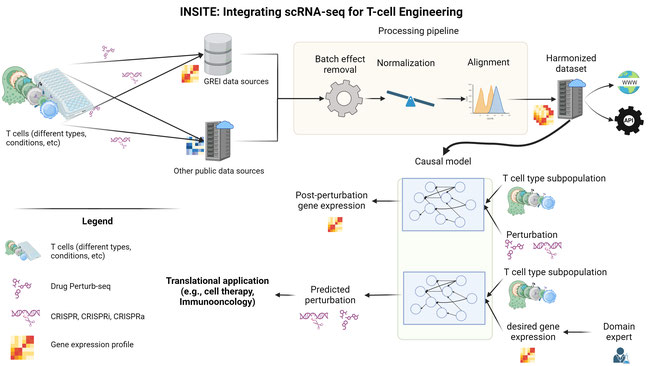
This project aims to advance T-cell engineering for immunotherapy by developing a comprehensive computational framework that leverages existing perturbational single-cell RNA sequencing (scRNA-seq) data. We will first consolidate and harmonize publicly available T-cell perturbational scRNA-seq datasets in GREI repositories, creating a unified, high-quality resource accessible to researchers. Next, we will develop a predictive computational model with uncertainty quantification to forecast gene expression changes in T-cells in response to various perturbations, utilizing causal analysis, machine learning approaches, and Bayesian methods. Finally, we will identify specific genes to modulate to achieve desired gene expression profiles, facilitating the design of engineered T-cells with enhanced therapeutic efficacy. The outcomes include a harmonized dataset, a causal predictive model, and produced code base and libraries.

Secondary Analysis: Research Aims

This project aims to leverage existing perturbational single-cell RNA-sequencing (scRNA-seq) data to enhance T-cell engineering for therapeutic applications. By integrating, analyzing, and modeling publicly available T-cell perturbational data, we seek to determine how to modulate T-cell gene expression through targeted perturbations to guide engineering of T-cells for therapy.

Aims
  • Aim 1: consolidate and harmonize existing T-cell perturbational scRNA-seq data. The first aim focuses on integrating perturbational scRNA-seq datasets related to T-cells from various sources. These datasets include CRISPR knockouts, CRISPR interference (CRISPRi), CRISPR activation (CRISPRa), and drug perturbation experiments.
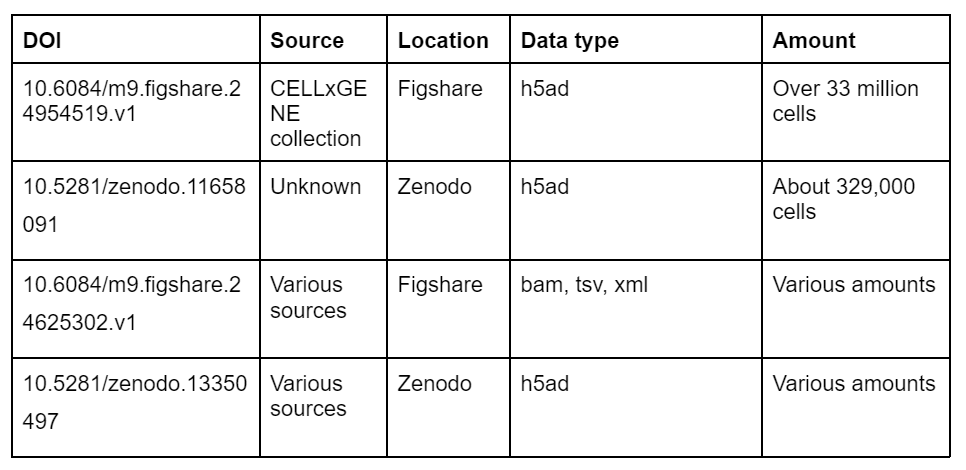
    • Data Utilization: We will source data from multipl  GREI (e.g., Figure 1) and other repositories (e.g., Gene Expression Omnibus).
    • Methods: We will develop a pipeline that applies batch correction techniques (e.g., Harmony, ComBat) and normalization methods (e.g., scTransform) to ensure the datasets are comparable. This harmonized dataset will serve as the foundation for the subsequent predictive modeling tasks.

Figure 1. Some of the projects primary data sources.

  • Aim 2: develop a predictive model for T-cell gene expression responses to perturbation with uncertainty quantification. The second aim involves constructing a computational model that can predict T-cell gene expression changes in response to a wide array of perturbations. Importantly, this model will include uncertainty quantification, providing measures of confidence in its predictions.
    • Methods: We will use causal machine learning techniques to predict gene expression outcomes. The model will be trained and validated using interventional cross-validation, ensuring its generalization to unseen perturbations.
  • Aim 3: optimize T-cell engineering to achieve desired gene expression profiles. In the final aim, we will leverage the predictive model to develop a computational framework that identifies the optimal gene perturbations required to engineer T-cells and move it toward a desired gene expression profiles.
    • Methods: This framework will use inverse modeling and optimization algorithms to search the perturbation space for the most effective gene modulation strategies. By collaborating with immunologists, we will refine the optimization process to focus on clinically relevant gene expression targets.

Timeline

We will complete this project within 6 months using an iterative approach where we aim to complete an iteration in every two months (8 weeks).

  • W 1-3: collect, harmonize, and integrate scRNA-seq datasets. Apply batch correction and normalization.
  • W 4-5: develop and refine the predictive model with uncertainty quantification.
  • W 6-7: implement the optimization framework for T-cell engineering.
  • W 8: finalize the analysis, and prepare findings for dissemination.
GREI Repository Data Sets
Figshare
Zenodo (CERN and Northwestern University)
DOI (Digital Object identifier) of GREI Repository Dataset
10.6084/m9.figshare.24954519.v1
10.5281/zenodo.11658091
10.6084/m9.figshare.24625302.v1
10.5281/zenodo.13350497

Note: we have developed a crawler to find all related T-cell datasets in Zendo and Figshare, as some datasets are not findable with simple or advanced datasets (for example due to lack of annotation and metadata). We will use more repositories as we find them, and enhance their findability by incorporating useful metadata in a separatee dedicated repository.
Outcomes and Outputs

Expected research outcomes

  • A harmonized dataset integrating T-cell perturbational scRNA-seq data, serving as a resource for future studies.
  • A predictive model forecasting gene expression changes upon perturbations with uncertainty quantification.
  • A computational framework for optimizing T-cell engineering strategies to improve therapeutic interventions.
  • A website or an API endpoint where users can query our model and simulate the effects of perturbation.
  • A paper that presents our dataset, causal discovery method, and the results.

Dissemination of findings

  • Open-access journals: we will submit our research to high-impact, peer-reviewed journals such as Nature Communications or Cell Systems.
  • Generalist repositories: the harmonized dataset, along with the predictive models and computational framework, will be made freely available via GREI repositories with assigned DOIs to ensure proper attribution and traceability.
  • GitHub and DockerHub: we will release the computational pipeline and predictive model as an open-source software package on GitHub and DockerHub, along with detailed documentation and tutorials.
  • Interactive platform: we will develop a website or an API endpoint where users can query our T-cell model and simulate the effects of perturbation. In the future, we plan to allow researchers to upload their own data, helping to continually refine and update the model.

Addressing FAIR principles

Our believe in FAIR principles were strengthened while we were searching for primary data for this project as we were hindered by their limited implementation in datasets. 

  • Findability: we will host all datasets and models on GREI repositories with assigned DOIs and comprehensive metadata. We also crawl GREI repos for all related datasets and augment them with annotation and metadata.
  • Accessibility: all data will be openly accessible under permissive licenses, such as Creative Commons Attribution 4.0, allowing broad reuse without restrictions.
  • Interoperability: we will use standardized file formats, such as h5ad for single-cell data, and consistent gene identifiers like Ensembl to ensure compatibility with existing bioinformatics pipelines.
  • Reusability: detailed documentation, including metadata and standardized analysis protocols, will accompany all data releases.

Replicability and Reproducibility

  • Data sharing transparency: all datasets and analysis pipelines will be fully transparent and made available via open-access repositories, ensuring that others can replicate our findings.
  • Version-controlled pipelines: the entire analysis process, from data preprocessing to predictive modeling and optimization, will be managed through GitHub with version control to ensure that others can easily follow and reproduce our workflows. We publish containerized out-of-the-box pipelines on DockerHub.
  • Comprehensive documentation: our detailed documentation will include the computational environment, software dependencies, and step-by-step instructions for recreating the analysis.
Impact/ Scientific Significance

The proposed project aims to make significant contributions across several scientific disciplines as well as best practices for data reuse and secondary analysis.

  • Impact 1: therapeutic impact particularly in the realm of immunotherapy and immune-mediated conditions.
    • Enhanced immunotherapy strategies: by identifying optimal gene targets for modulation, the project directly contributes to the development of next-generation T-cell therapies, such as CAR-T cells, for cancer treatment. Engineering T-cells with desired gene expression profiles can improve their efficacy, specificity, and safety, leading to better patient outcomes.
    • Drug Development and repurposing: understanding T-cells' response to various drugs can inform the development of new therapeutics and the repurposing of existing ones.
    • Autoimmune and infectious disease management: likewise, by controlling T-cell responses, it may be possible to mitigate harmful immune reactions or enhance protective immunity.
  • Impact 2: immunology and T-cell biology. By consolidating and harmonizing existing T-cell perturbational scRNA-seq data, this project will create a comprehensive and unified dataset. This resource will enable a deeper understanding of T-cell responses to various genetic and chemical perturbations, uncovering novel insights into T-cell function, differentiation, and activation pathways. Such knowledge is crucial for advancing basic immunological research and can inform the development of new hypotheses and experimental designs.
  • Impact 3: computational biology and machine learning. Developing causal predictive models with uncertainty quantification introduces innovative computational tools to the field. By employing advanced causal discovery and machine learning techniques, the project addresses the challenge of predicting complex biological responses to perturbations with a measure of confidence. This contributes to the broader application of machine learning in biological systems, promoting the integration of computational and experimental biology.
  • Impact 4: bioinformatics and data integration. The project's approach to data harmonization sets a precedent for integrating heterogeneous datasets derived from diverse experimental conditions. Establishing robust pipelines for batch correction, normalization, and data alignment contributes valuable methodologies to the bioinformatics community. These enhance the ability to perform meta-analyses and comparative studies, which are essential for translating high-throughput data into meaningful biological insights.
  • Impact 5: contributions to best practices for data reuse and secondary analysis. This project advances best practices in data reuse by developing pipelines for harmonizing and integrating data from multiple sources and experimental conditions, adherence to FAIR principles and enhancing the findability of existing datasets, and promoting reproducibility and replicability
Team

Our team consists of an experienced Assistant Professor and a skilled PhD candidate, with complementary expertise, and a track record of collaboration and success: 

  • Amir Asiaee, PhD - Assistant Professor of Biostatistics, Vanderbilt University. Dr. Asiaee's journey in computational biology includes a PhD in Computer Science from the University of Minnesota, a postdoctoral fellowship at Ohio State University (focused on modeling cancer progression and combination drug therapies), and the reception of the prestigious K99 grant from NHGRI (focused on the causal effects of regulatory molecules). His areas of expertise include machine learning, computational biology, and bioinformatics, with a particular emphasis on causal inference and discovery. 
  • Kaveh Aryan, PhD Candidate - Computer Science, King’s College London. Aryan's educational background includes a BSc in Software Engineering and an MSc in Artificial Intelligence. Presently, his research is focused on mathematical models of causality. Before joining King's College London, he worked as a software engineer and data scientist with an interdisciplinary focus.

Team coherence and collaboration. The relationship between our team members, surpasses mere supervision, encompassing friendship, dedication, and synergy:

  •  Second place in the NCATS 2023 Bias Detection Challenge (as "Martin Luther Kings" team)
  • Paper "A Causal Framework for Gene Expression Prediction in scRNA-seq data" (draft)
Considerations

The key considerations to ensure the success of the proposed project are:

  • Team's expertise in computational biology, AI and machine learning, best research practices, and software engineering. This is crucial for the successful completion of various stages of the project.
  • Team's history of collaboration which means they have established effective communication channels and understand each other's working styles.
  • Team member's dedication and determination as manifested in their professional journey.

(P.S. Image credit: created by BioRender)

Supporting Documents
Provide up to 10 resources for the evaluation of your secondary research project including but not limited to: ● The persistent identifier of the dataset(s), other than GREI dataset DOIs already listed above, to be used in the proposed project (where available) ● Tools/workflows or resources to be utilized in the proposed project ● Relevant references or scientific publications that directly relate to the proposed project
Non Scored Criteria
Please complete this information. It will not be scored by the evaluation panel.
Entity Participation
Participate as an independent Team (i.e., registering as a group of individuals competing together but not on behalf of an established organization, institution, or corporation)
Research Discipline (non-scored criteria)
computational biology, gene regulatory network, T-cells, causal discovery, computational immunology
IDeA State (non-scored criteria)
No
All Team Member Information - Name, Organization, Job Title, and Email address
Amir Asiaee (Team Leader), Ph.D. - Assistant Professor of Biostatistics, Vanderbilt University, amir.asiaeetaheri@gmail.com

Kaveh Aryan, Ph.D. Candidate - Computer Science, King’s College London, kaveh.aryan01@gmail.com
MSI (non-scored criteria)
No
Participation in prior DataWorks! Prizes (non-scored criteria)
No
Team Point of Contact Eligibility
yes
Eligibility (non-scored criteria)
Yes, I confirm that I have read and meet the terms of eligibility for this challenge