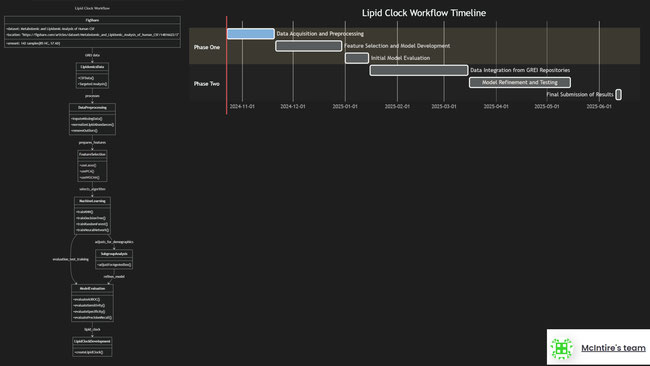
Our analysis aims to create a Lipid Clock, a predictive tool that uses cerebrospinal fluid (CSF) lipid profiles to estimate biological age and assess cognitive decline risk in Alzheimer's Disease (AD) patients and healthy controls (HC). The project leverages the publicly available dataset, Metabolomic and Lipidomic Analysis of Human CSF, licensed under CC0, which contains 142 CSF samples (85 healthy controls, 57 AD patients). Machine learning algorithms will be applied to identify lipid biomarkers of biological aging and neurodegenerative risk. The Lipid Clock will be critically evaluated alongside other models, such as the Aging Clock, to highlight how lipid-specific changes can offer insights into biological aging and cognitive decline, particularly in AD. By focusing on lipid biomarkers, this project aims to deepen our understanding of how lipid metabolism contributes to disease progression.
1. Proposed Secondary Analysis
This project aims to develop and validate the Lipid Clock, a predictive tool that uses lipid profiles from CSF to estimate biological age and predict the risk of cognitive decline, focusing specifically on AD and HC. The Lipid Clock will utilize machine learning techniques to identify lipid biomarkers associated with AD and biological aging.
2. Data Utilization
- Source: The dataset Metabolomic and Lipidomic Analysis of Human CSF, is publicly available via Figshare.
- Location: https://figshare.com/articles/dataset/Metabolomic_and_Lipidomic_Analysis_of_human_CSF/14816622/3.
- Data Type: Lipidomic and metabolomic profiles from 142 CSF samples (85 HC and 57 AD patients).
- Amount: 142 samples spanning ages 20 to 88.
3. Incorporation of GREI Data
The project will align with GREI principles by potentially integrating datasets from the GREI repository (e.g., AD-related cohorts).
4. Methods and Analysis
- Data Preprocessing: Imputation of missing data, normalization of lipid abundances, and removal of outliers.
- Feature Selection: LASSO regression and PCA will be used to identify the most relevant lipid biomarkers. We will group lipids based on their co-expression patterns using the R package WGCNA which identifies modules that may be biologically relevant.
- Machine Learning Algorithms: Various algorithms like k-Nearest Neighbors (kNN), Decision Trees, Random Forest, and Neural Networks will be tested to identify the model with the highest predictive accuracy.
- Evaluation Metrics: Models will be evaluated using AUC-ROC, sensitivity, specificity, and Precision-Recall Curve, focusing on accurately predicting biological age and cognitive decline risk.
- Subgroup Analysis: The model will adjust for demographic factors like age and sex to ensure the predictions' reliability across different groups.
5. Suggested Timeline
Phase One: October 23, 2024 – January 15, 2025
- Data Acquisition and Preprocessing: October 23 - November 20, 2024
- Collect and clean the CSF lipidomic data, impute missing values, normalize, and remove outliers.
- Feature Selection and Model Development: November 21 - December 30, 2024
- Use LASSO regression , PCA and WGCNA for feature selection, followed by training machine learning models.
- Initial Model Evaluation: January 1 - January 15, 2025
- Evaluate models using performance metrics such as AUC-ROC and Precision-Recall curves.
Phase Two: January 16, 2025 – June 14, 2025
- Data Integration from GREI Repositories: January 16 - March 15, 2025
- Integrate additional datasets from GREI to strengthen the model and enhance generalizability.
- Model Refinement and Testing: March 16 - May 15, 2025
- Refine and validate on the Metabolomic and Lipidomic Analysis of Human CSF.
- Final Submission of Phase Two Results: June 11 - June 14, 2025
- Prepare and submit final results, including detailed reports on the Lipid Clock's performance and validation.
Research Findings and Expected Outcomes
The project aims to develop the Lipid Clock, an innovative tool to estimate biological age and predict the risk of cognitive decline using CSF lipid profiles. Expected outcomes include identifying lipid biomarkers associated with Alzheimer's Disease (AD) and refining predictive models through machine learning techniques.
Dissemination of Findings
The research findings will be disseminated via peer-reviewed journal articles, conference presentations, and stored in an open-access repository, in alignment with GREI requirements. We will also acknowledge and respect the contributions of the primary authors responsible for the original dissemination of the dataset used. This approach ensures broad accessibility and visibility while honoring the foundational work upon which this project builds, ultimately facilitating knowledge-sharing within the scientific community.
FAIR and CARE Principles
The project will adhere to the FAIR principles by providing well-documented datasets and making data and metadata accessible in standardized formats through the GREI repository. The CARE principles will also be applied to ensure ethical and culturally sensitive data management practices, especially when dealing with potentially vulnerable groups, to maintain community trust and equitable benefits.
Replicability and Reproducibility
To ensure replicability, all methods, algorithms, and source code used in the project will be well-documented and made publicly accessible in open repositories such as GitHub. Detailed workflows, including preprocessing steps, model training processes, and evaluation methods, will be made available, thus enabling other researchers to replicate and validate the findings, promoting transparency and robustness in secondary analyses.
Scientific Significance
This research project aims to advance scientific understanding of the role lipids play in neurodegenerative diseases, particularly AD. By developing the Lipid Clock, which predicts biological age and cognitive decline risk through lipid profiles in CSF, the study will contribute to disciplines like lipidomics, neurology, and aging research.
Contributions to Scientific Disciplines
The project will deepen insights into lipid metabolism, expanding our understanding of biological processes underlying cognitive decline. Current research highlights the importance of lipid regulation in brain health, yet its implications for neurodegenerative diseases remain unclear. The Lipid Clock will help clarify the role of lipid biomarkers, offering a novel approach to studying the aging brain and contributing to predictive models for Alzheimer’s progression. By focusing on lipid-based biomarkers, the study broadens the field of precision medicine, where personalized interventions based on molecular signatures are being explored for various diseases. In terms of machine learning, this project applies advanced algorithms to a relatively underexplored area—CSF lipidomics—further contributing to data science methods in health research. By testing algorithms like LASSO, PCA, kNN, and Random Forest, it advances model development techniques for predicting complex health outcomes like cognitive decline, enriching both biomedical informatics and machine learning applications in healthcare.
Diagnosis, Treatment, and Prevention
The Lipid Clock has the potential to revolutionize the early detection of AD. By accurately estimating biological age and identifying individuals at high risk of cognitive decline through lipidomic profiles, this tool can contribute to more timely diagnoses and prognoses. In clinical settings, it can detect early biomarkers of AD long before symptoms emerge, offering a valuable window for intervention through non-invasive measures including life-style modification. For treatment, this research could lead to the identification of lipid biomarkers that could serve as targets for novel therapies. Understanding lipid metabolism’s contribution to AD pathology allows for precise interventions that may modify lipid-related pathways to slow or prevent disease progression. If certain lipid patterns are found to correlate with increased AD risk, therapies could regulate those lipids, potentially slowing cognitive decline and improving outcomes.
From a preventive perspective, the Lipid Clock could become a standard tool for screening at-risk populations. Identifying lipid biomarkers associated with neurodegeneration enables targeted lifestyle changes, early preventive treatments, or therapeutic trials aimed at halting disease progression. Since lipid metabolism is influenced by diet, lifestyle, and medication, personalized recommendations based on lipid profiles could lead to preventive strategies tailored to an individual’s molecular health.
Laura B. McIntire: An Assistant Professor of Pharmacology and Director of the Lipidomics and Biomarker Discovery Lab at Weill Cornell, is an expert in lipid biology, lipidomics, and neurodegenerative diseases, particularly AD. Her work investigates the role of lipid dysregulation in AD progression, focusing on phosphoinositide metabolism and acyl chain remodeling. She is using advanced techniques such as imaging mass spectrometry to identify new lipid metabolic pathways and potential therapeutic targets, aiming to better understand lipid function in neurodegenerative diseases and identify viable therapeutic targets.
William J. Dartora: A postdoctoral associate specializing in biostatistics and epidemiology, with expertise in lipid metabolism and cognitive decline. He has extensive experience applying data science, statistics, and machine learning to lipidomics and transcriptomics for biomarker discovery. His work includes developing R programs for statistical analysis, data visualization, and novel biomarker discovery methods. He is proficient in R, Python, SAS, and SPSS. Dr. Dartora also conducted Genome-Wide Association Studies (GWAS) at UT Health, focusing on genetic associations with disease traits, and worked in Brazil on prospective cohort studies, contributing to chronic disease research.
Collaboration: Together, we combine our expertise in statistical analysis, lipid biology, and biomarker discovery to explore innovative approaches in neurodegenerative disease research.
Key considerations for the success of this project include the development of a reliable Lipid Clock using cerebrospinal fluid lipid profiles to predict biological age and risk of cognitive decline in Alzheimer’s disease (AD). Leveraging advanced machine learning models and a robust dataset, we aim to gain meaningful insights into the lipid dysregulation associated with AD. The success of the Lipid Clock will improve early diagnosis and intervention strategies, providing personalized health diagnostics and potentially slowing the progression of neurodegenerative conditions by advancing the accuracy of health diagnostics.