
Our analysis of nationally representative National Health Interview Survey (NHIS)-IPUMS data from 2013-23 shows that combining bisexual, something else, and I don’t know categories for young people indicates enormous increases in these identities, with totals for women age 18-25 exceeding 17%. Despite increasing prevalence and social acceptance of lesbian, gay, and bisexual+ people, our analysis shows that the mental health of young bi+ people has deteriorated rapidly across the decade. Due to rising prevalence, bi+ mental health issues are now affecting a substantial percentage of the population, especially young women. To better understand this bisexual mental health crisis, we propose to conduct a secondary analysis of Maimon’s Bisexual Identity Denial Study (BIDS) data, collected in 2017-18. This data set contains a sample of nearly 450 bisexuals and a large array of psycho-social variables, allowing us to dissect some of the potential reasons bisexual mental health is so poor.
The NHIS is a nationally representative survey of the non-institutionalized U.S. population, conducted annually by the Centers for Disease Control using a complex stratified sampling design; the Minnesota Population Center hosts harmonized data on their publicly available website. Sample sizes vary across years and questions, but our starting sample for sexual orientation contains 329,515 total respondents. We utilize specially constructed pooled sample weights to look at the demographic factors affecting mental health decline from 2013-2023—which are all the years for which sexual orientation was asked of adults. Our mental health measures include:
· Subjective cognitive impairment: “Do you have difficulty remembering, concentrating, or both?” which captures symptoms of several mental disorders.
· Kessler 6 measures, which are a well-validated set of 6 questions to screen for depression, which were asked in 2013-18, and then again in 2021; following IPUMS’ recommendation, we have recoded this variable dichotomously
· Mental health medication, combining separate questions asking respondents if they are currently taking medication for depression, or worry, nervous, or anxious feelings.
The smaller but more focused BIDS study, hosted on Figshare, contains two samples of bisexual undergraduates and respondents on MTurk from 2017-18, collected by Melanie Maimon and colleagues; we obtained a questionnaire and codebook by emailing Dr. Maimon. The original study analyzed the two samples separately; however, our analyses show that though the two samples differ in gender and age composition, they are identical for all outcomes of interest, and we thus intend to combine samples to increase statistical power, leaving a final sample of around 450 respondents. The original key outcome variable here is (untreated) depression, as measured by an index similar to the Kessler 6. The major predictors include feelings of: belonging, other people treating one’s personal bisexual identity as illegitimate, other people treating bisexuality as illegitimate in general, and other people believing negative things about bisexuals. The authors’ original analysis focused on using these variables in a path analysis to predict depression, finding feelings of belonging to be the major factor directly affecting depression. We propose to extend the authors’ original analysis to treat some of these variables as dichotomous rather than continuous, switching focus to cross-tabulations and multivariate logistic regression analyses. We are particularly interested in exploring the effects of age (as a proxy for cohort effects) and gender on the predictor variables as they relate to depression. Although BIDS data are not based on a representative sample of bisexuals, combined analysis with representative NHIS data from this period will allow us to estimate non/representativity.
Preliminary analyses are underway, and we expect to complete all analyses by early February 2025.
Our preliminary analyses of the weighted NHIS data show major increases in the number of young bi+ people over the last decade: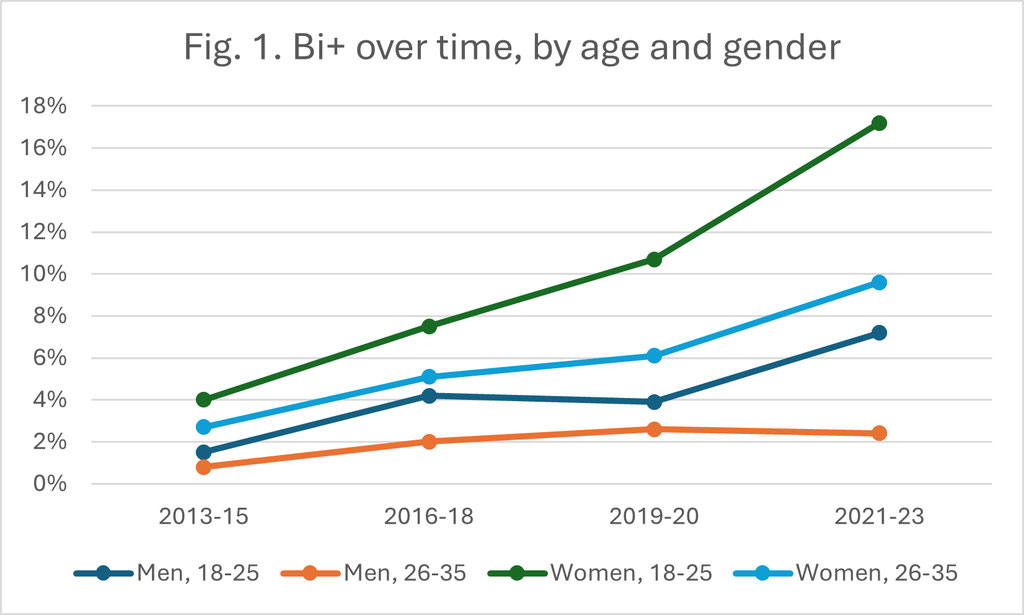
Despite these increases, subjective cognitive impairment appears to have greatly worsened, and utilization of anti-depression and anti-anxiety medication has risen across the same time period for young bi+ people:
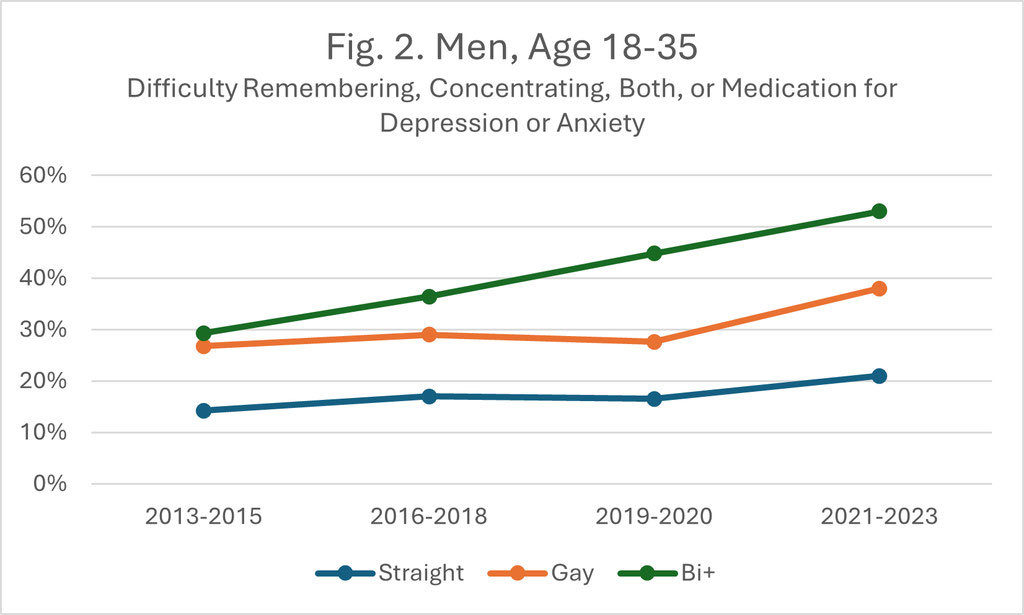
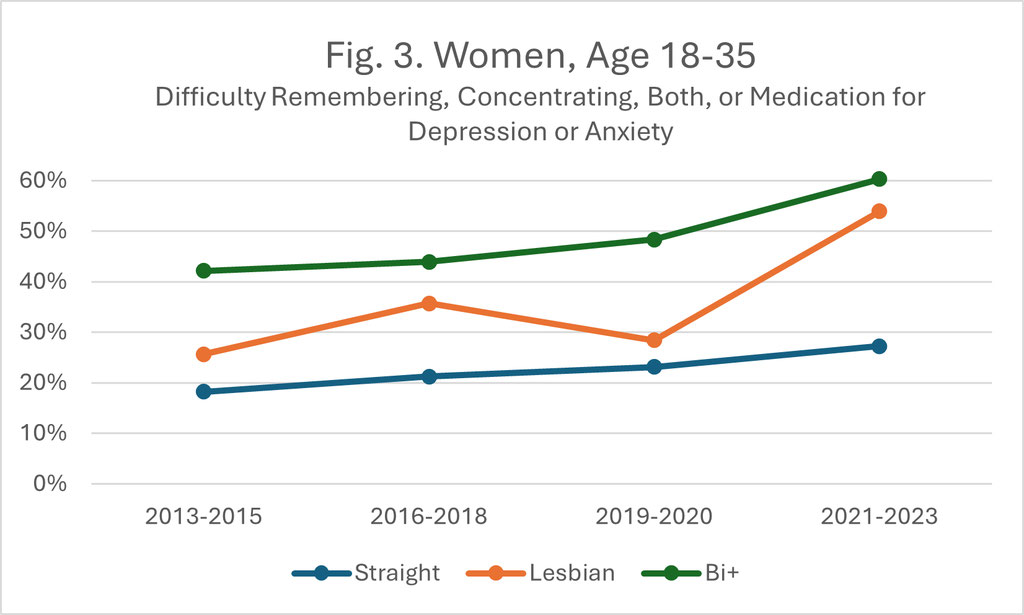
In further analyses, we intend to explore the intersection between mental health medication use, cognitive impairment, and depression, with particular emphasis on which sexual orientation/demographic groups are most likely to be medicated but still experiencing symptoms, and groups who are experiencing symptoms but are unmedicated.
NHIS data also allow us to construct a representative portrait of the mental health landscape of bisexuals during the 2017-18 time frame that the BIDS data were collected. For example, 78% of BIDS respondents were age 18-35, but NHIS data for the same period show that 70% of bisexuals and 58% of bi+ people were in this age range at that time. From the NHIS, we graphed any difficulty remembering and/or concentrating; medication for depression or anxiety; the combination of those two; people with values higher than 13 on Kessler 6 depression inventory; Kessler numbers combined with medication; and a final value combining cognitive difficulties, depression, and mental health medication use in 2017-18:
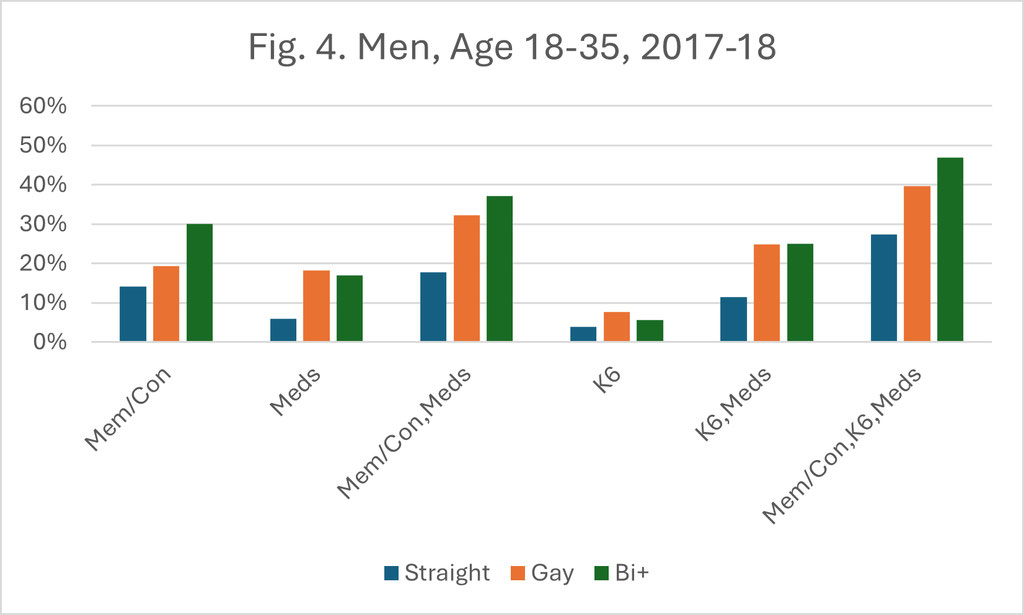
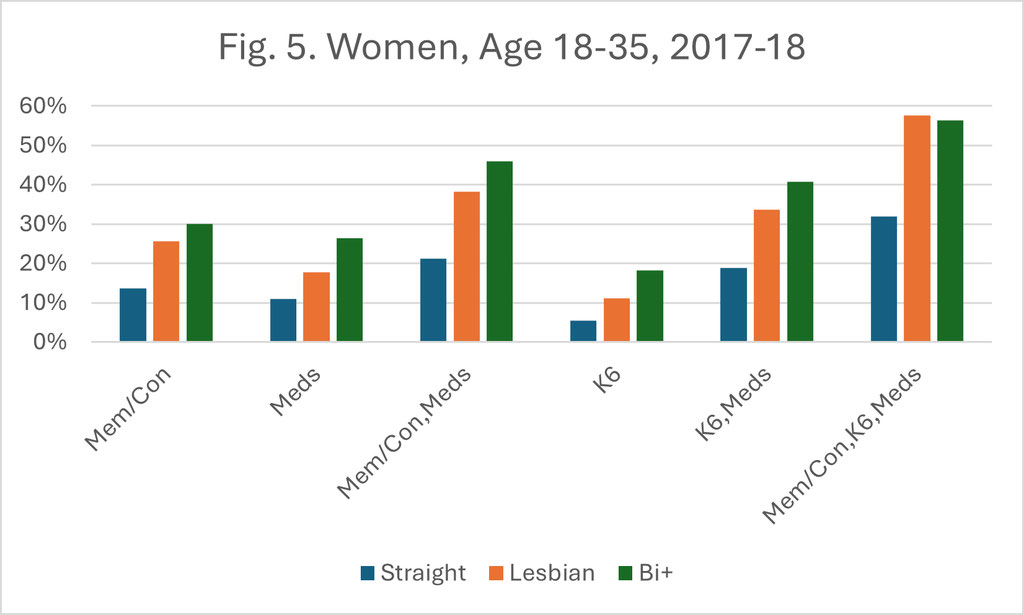
Since the depression measure on the BIDS study is very similar to Kessler values, these values indicate that their depression measure is functionally unmedicated or unsuccessfully medicated depression. We intend to explore the Kessler values on the NHIS as a continuous variable as that information is in BIDS, and to treat the BIDS depression outcome as a dichotomous variable (depressed/not depressed) to see if results change.
Our preliminary analysis of BIDS has found significant differences by age and gender on variables which looked improbably insignificant in the authors’ original analysis, which did not break out demographics. For example, women age 18-25 were significantly more likely to feel that other people doubt the legitimacy of bisexuality as an identity than same age men; bisexuals 18-25 were significantly more likely to feel they did not belong socially because of their bisexual identity than older respondents; and depressive symptoms were highly inversely correlated with age. In general, we hope to use BIDS to explain some of the nuances in trends relating to bisexual health that we have found in NHIS results.
We anticipate presenting findings at future Population Association of America meetings, and would enthusiastically participate in presentations and publications associated with Dataworks. The primary investigator is published in several academic journals and anticipates submitting results to journals such as American Journal of Public Health. All data used in this analysis are already publicly available, and log files will be available upon request to replicate results.
Recent calls by Queer scholar-activists have plead for more research on the possibly unique mental health experiences of LGBTQ+ people, coining the term neuroqueer to refer to the apparently high presence of Autism Spectrum Disorders (ASD), Attention Deficit Hyperactivity Disorders (ADHD), as well as mood and personality disorders in this subgroup. These mental health issues are generally believed to be strongly connected to other health disorders in this group, including chronic pain, sleep disorders, and migraines. Previous research on mental health disparities has almost exclusively targeted reports of depression and anxiety, and has tended to group all sexual minorities (lesbians, gays, and bisexuals) together. To the best of our knowledge, our study is the first to separate out bisexual+ people, while also assessing both cognitive health and mental health—as well as accounting for the effects of mental health medication use. In particular, broadening our analysis to include a measure that could encompass ADHD (difficulty remembering and concentrating) allows us to paint a broader picture of the mental health crisis of young bi+ people than previous analyses focusing solely on depression and anxiety have been able to do.
Nearly all literature on this topic has relied on a “minority stress model” to explain observed differences in outcomes between straight and non-straight physical and mental health. This “theory” argues that the stressful life experiences of LGB+ people take a toll on health. While this theory likely explains some of the observed differences in LGB+ and straight health outcomes, our analyses with NHIS data strongly suggest that it is insufficient to explain the dire and extremely rapid mental health declines of young bi+ people across the last decade, who by all accounts should have been experiencing less stress than older generations who have not experienced this decline. With NHIS data, we will be testing the effects of potential changes in mental health medication use as one variable explaining these differences, along with potential changes in well-documented associated physical issues like chronic pain and disrupted sleep.
Maimon’s dataset contains many of the key variables of interest that might be connected to major psychological variables predicting (untreated/unsuccessfully treated) bisexual depression. With a large enough dataset to compare three different age groups, we can estimate some very important aspects of psychosocial experiences affecting bisexual depression across generations. These include changes in depression, as well as factors which might account for much of why bisexuals experience so much depression. By dissecting age- and gender-related differences in key factors like feelings of belonging, identity certainty, bisexual legitimacy, and bisexual stereotyping, we may be able to aid in developing better targeted and more effective treatment for young bi+ mental health problems.
Engineering Dynamics is an interdisciplinary team that integrates social sciences with engineering disciplines, including psychology, data science, sociology, and Artificial Intelligence/Machine Learning (AI/ML). Our lead researcher, Julie Fennell, has a Ph.D. in Sociology and has been researching pansexual communities for over a decade and has published books and articles on gender and sexuality. She draws from her observations and experiences as a bisexual woman in bisexual communities to elucidate quantitative and qualitative research on bisexual lives. Further expertise comes from Bethel Quick, a Ph.D. student in Psychology, who is studying Queer mental health issues. Team captain David Kaniss has a M.S. in Systems Engineering with a focus on data science. Engineering Dynamics is proud to research an issue with significant personal and societal impacts.
The team was formed around the belief that “engineering is a people problem,” meaning that engineering challenges cannot be fully addressed without understanding the human element involved. Our problem-solving philosophy combines insights from as many relevant disciplines as possible as we tackle both physical and social science issues. Our research into the bisexual mental health crisis has included delving into research on the biological determinants of mental health, technical explorations into AI/ML, psychology, sociology, and public health.
Our project is limited by the lack of representativity in the BIDS data set, as well as lack of data in that source on the way that mental health medications may affect respondents’ experience of depressive symptoms and perceptions of negative experiences as a bisexual. However, representative NHIS data allow us to estimate how the lack of data on medication in BIDS may be affecting our results, and to estimate non/representativity. BIDS data also lack direct measures of change in variables of interest over time, which would be ideal for our research. However, again, NHIS data allow us to fill in this gap by looking at bisexual mental health in relevant age groups across time, highlighting 2017-18 to compare and contrast with earlier and later periods. This construction will permit us to estimate the different effects of age versus cohort effects within the BIDS data, and we can thus make inferences about how the psycho-social variables in BIDS might have changed across age and time.