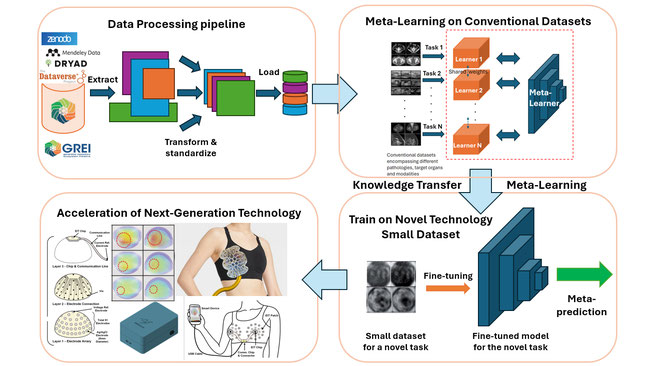
In 2023, nearly one-third of all new cancer diagnosed in US women was breast cancer. Mammography is the leading breast cancer detection method. But, current mammography practices have many challenges, including radiation-exposure, accessibility & accuracy, that create the need for improved diagnostic tools. Contemporary, non-invasive methods such as Electrical Impedance Tomography (EIT) have shown the potential to offer an inexpensive, portable alternative to conventional methods. These new imaging modalities can be paired with machine learning to improve and speedup their detection capabilities. However, the adoption of novel EIT tools in a point-of-care setting is hindered by the lack of real-world EIT data for training models. Meanwhile, vast amounts of conventional imaging data are available but remain underutilized. There is an urgent need to reuse and repurpose existing conventional datasets to accelerate development of novel imaging tech like EIT for accurate & early detection.
In our secondary analysis, we will design, implement and evaluate a meta-learning model trained on conventional medical imaging data and tested on limited EIT data to validate the deployment of such a model on EIT diagnostic tools. This research is critical for revealing new insights into the generalizability of machine learning models across different modalities, specifically showing how well a model trained on abundant conventional data can adapt to sparse datasets. Datasets from novel imaging modalities often lack the diversity and volume needed for robust model generalization. Meta-learning offers a solution by enabling models to "learn how to learn," allowing them to generalize to new, unseen tasks with minimal data. By training ML models on conventional datasets, we can accelerate the development of new diagnostic tools like EIT, enabling fast and accurate diagnoses with limited data.
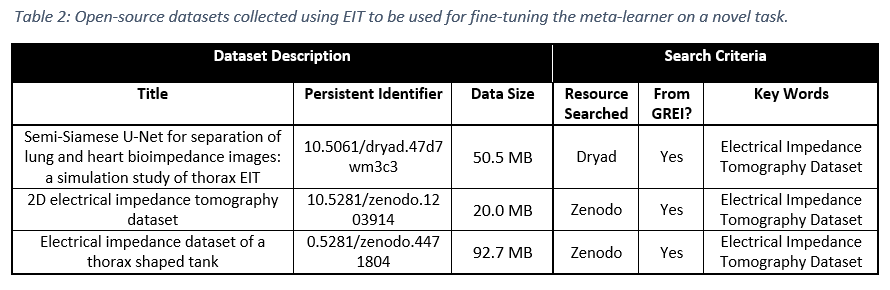
From GREI sources, we identified >1500 GB of data from Zenodo, Dryad, Mendeley & Dataverse that will serve as the conventional dataset for meta-learning. We found 5 cancer imaging datasets for various target organs that were collected using Mammography, Ultrasound and MRI (see Table 1). For the novel task, we found 3 EIT data sets from Dryad and Zenodo (see Table 2). The total EIT data is no more than 160 MB in size, highlighting the data scarcity gap for new technologies that our project aims to address.
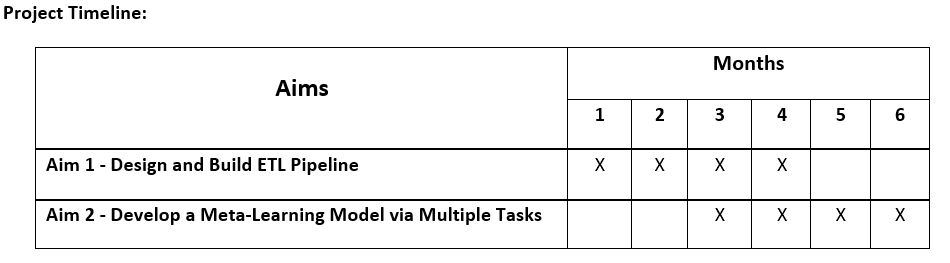
Aim 1: Develop a data processing pipeline to ingest and reuse large open-source datasets from GREI
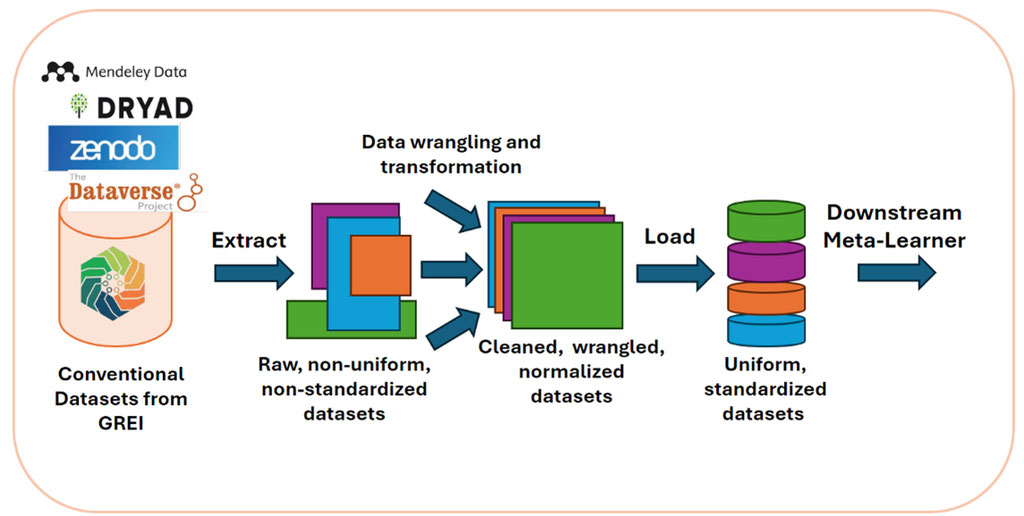
The data from GREI will encapsulate open-source, conventional medical imaging datasets for cancer diagnosis from a variety of anatomies, such as breast, lung, prostate, and brain, and different imaging modalities, i.e. mammography, ultrasound, MRI, X-ray. Following best practices, data processing will be achieved via a robust ETL pipeline to transform datasets to a standardized form. The output data shall be an aggregate collection of data from a multitude of imaging domains and shall meet the final structure and shape required by the downstream model.
Aim 2: Utilize Meta-Learning to enable few-shot learning on novel imaging tasks:
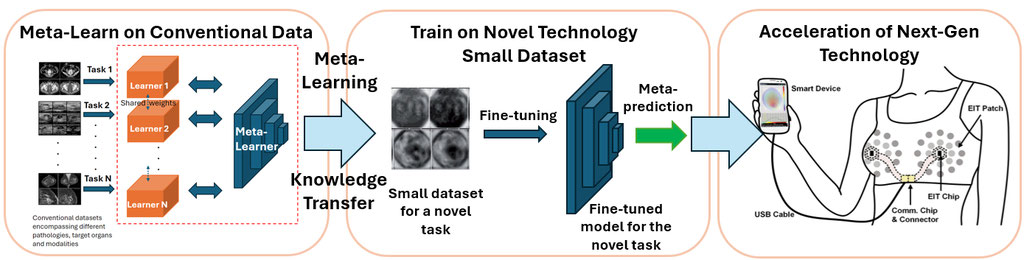
A meta-learning algorithm will be used to train multiple learners on conventional data. In meta-learning, the training data is a distribution of related tasks that allows data efficient adaptation to a novel task. Training across multiple tasks will maximize the diversity of learned features. The complementary information will allow generalization and few-shot learning capabilities towards new tasks with limited data. The model will be fine-tuned on the task of early detection using 3 small EIT datasets from GREI. Ablation studies will identify and analyze the optimal model configuration and identify critical components for both the base learners and the meta-learner. 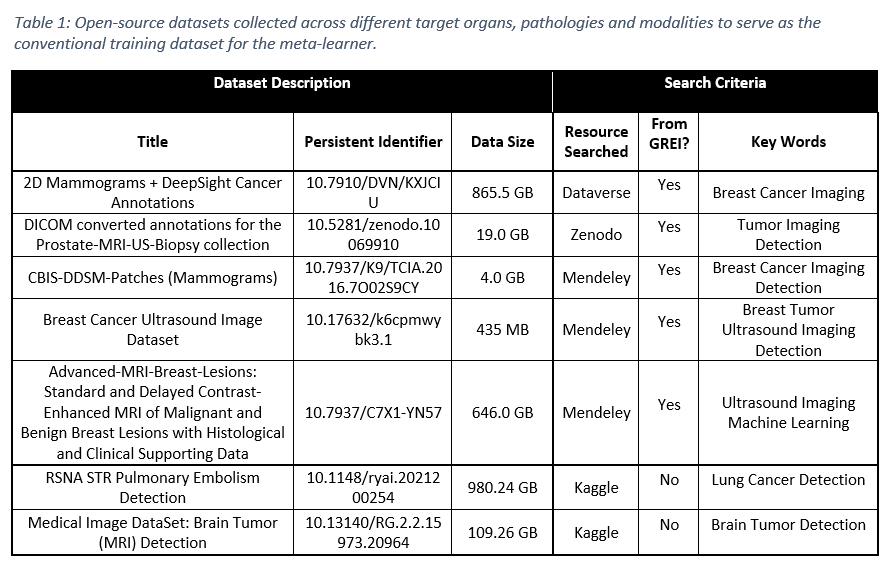
This framework, though applied to EIT data here, is adaptable to various domains to accelerate advanced technologies and diagnostics. See Supplement 1 for more details.
Successful completion of this work will deliver a validated, scalable, open-source data processing pipeline and meta-learning model to accelerate novel EIT diagnostic tools. The highly automated pipeline will standardize and integrate various GREI datasets, enabling the reuse of existing biomedical datasets in aggregate & enabling meta-learning models to extract universal feature representations, facilitating few-shot learning for novel imaging tasks. This data reuse strategy allows us to develop generalizable solutions for novel technology that circumvents the massive effort and resources needed to manually generate/collect & annotate high-quality experimental or synthetic data.
The expected outcome is that training on multi-domain tasks will produce a meta-learner with strong foundational feature recognition, capable of generalization and yielding low false negative/false positive rates, and over 90% mean Average Precision(mAP), recall & Intersection over Union(IoU) on sparse, unconventional datasets. Fine-tuning will improve the meta-learner for the EIT detection task. Ablation study results will be analyzed, with a focus on understanding the model's sensitivity to changes in architecture, sample size, task partitioning, and hyperparameters. Successful completion of these studies will provide a comprehensive understanding of the factors that most significantly influence the detection performance of the meta-learning model. This will allow for model refining, reduction of unnecessary complexity, and will guide future decisions on diversity and number of base learners required, and the degree of fine-tuning needed. While this work is aimed towards EIT, the findings can be applied to numerous domains to accelerate leading-edge technologies and diagnostics.
The results shall be shared on a dedicated GitHub project repository in tabular format, with explanations and illustrations of the model behavior and associated ablation studies. A discussion forum will be available to answer research questions.
To align with FAIR, the pipeline will reflect transparency and accessibility at its core. All pipeline binaries and packaged meta-learning models will be uploaded to Zenodo for persistence and searchability. The processing pipeline and trained models will also be accessible on GitHub under a CC BY-NC-SA license, with full documentation on setup, installation, and execution to allow future users to easily replicate and reproduce our results. To ensure the data is processed in an ethical and non-discriminatory manner, all patient-specific identifiers will be stripped.
To align with CARE, all data obtained/ shared with indigenous communities will be processed by ensuring respect of cultural values especially by anonymizing data and obtaining consent prior to any commercial activities. Collective benefit focused on advancing healthcare innovation in remote areas that directly impact members of indigenous communities is a major motive for EarlyByrd Medical.
Challenges with Existing Techniques: Initial strategies for developing novel EIT diagnostics for early cancer detection include acquiring extensive domain knowledge to design physics-based algorithms to process the raw measurements for image reconstruction and detection. Recently, deep learning methods have shown promise for various imaging tasks, offering fast inference but requiring massive training data, often from synthetic or experimental sources. Collecting this data demands significant effort, as it requires both domain knowledge and needs specialized equipment and personnel. Furthermore, if the data lacks diversity or realistic noise, the model may perform well in idealized conditions but fall short in clinical settings.
Impact on Diagnosis and Prevention: The impact of our data reuse approach in medical diagnostics is profound, particularly in addressing critical healthcare challenges. Traditional methods like mammograms and MRI, though widely used, involve high costs, radiation, and discomfort, leading to lower screening compliance. For instance, around 1 in 8 women will face a breast cancer diagnosis, but many skip regular screenings due to these issues [1]. The financial burden of late-stage cancer treatments can exceed $150,000 per patient [2]. Despite advancement of cost-effective, portable, non-invasive early detection technologies, the lack of sufficient real-world data limits their effectiveness. This scarcity impedes new diagnostic tool development, prolonging patient suffering, increasing caregiver burden and healthcare costs. Our project focuses on integrating conventional datasets to address the data gap and improve diagnostic accuracy of novel technologies such as EIT diagnostic tools.
Technique Transferability: Data scarcity is a significant challenge in many scientific disciplines where gathering real-world data is costly, difficult, or dangerous. In connectomics, mapping the human brain’s connections is resource-intensive, requiring vast computational power, with current datasets being hard to produce and analyze. Rare diseases also suffer from small datasets, limiting predictive model development. Drug efficacy translation from preclinical to clinical trials faces similar data challenges, with a high percentage of drugs failing in testing. Meta-learning can improve early predictions of drug success. In fields like quantum computing and space exploration, where data generation is slow and expensive, the ability to repurpose existing data or apply few-shot learning becomes critical.
To conclude, this research project will present meta-learning models as a cornerstone for accelerating the development of novel technology in diagnostics and beyond, leveraging conventional datasets to overcome the limitations posed by data scarcity, and reduce the reliance on cumbersome synthetic data generation and manual annotation methods.
[1]A. Myklebust et al., Eur J Radiogr, vol. 1, pp. 66–72, Jun. 2009
[2]The Mesothelioma Center, Aug 2024
We represent EarlyByrd Medical LLC, an early-stage startup led by women founders. We design tools to advance early detection of breast cancer.
Bindi Nagda, PhD is the CTO of EarlyByrd Medical, where she spearheads the development of advanced image processing and ML algorithms, while overseeing the deployment of these models on the company's proprietary EIT diagnostic platform. Nagda is an Applied Mathematician with over 5 years of experience in computational biology, statistics and computer vision. She is skilled in multiple programming languages and is proficient in utilizing statistical libraries.
Nashaita Patrawalla, PhD serves as a research scientist for EarlyByrd Medical focusing on device development and the FDA approval process. Patrawalla specializes in tissue engineering and biomaterials, and has over 5 years of experience using data-driven models for prediction of mechanical properties. She is skilled in data analysis software such as Python, MATLAB, and R, which she applies to large-scale datasets for statistical analysis.
Lilah Henderson, M.Sc. is a data analyst at EarlyByrd Medical. Henderson has been with EarlyByrd Medical for over 2 yrs and has aided in data engineering & statistical analysis. Henderson is a Chemical Engineer with skill sets in a variety of areas including data analytics, financial accounting, schedule driven project management, and R&D. She has over 3 years of experience in a wide range of industries as both a financial analyst and an engineer.
Data quality & data integration are paramount to the project’s success. For optimal model performance, it is essential that the datasets represent various population groups and conditions, allowing the models to generalize effectively to real-world scenarios. Using a variety of GREI sources addresses this concern. Moreover, harmonizing data formats, standardizing annotations, and addressing discrepancies between datasets is critical since inconsistent data inputs could undermine the models' robustness. This is achieved through our ETL pipeline.
Fine-tuning the meta-learner on limited data requires a careful balance between model generalization and performance on scarce data. It is critical that the meta-learner doesn't overfit to the small datasets. Striking this balance will allow the model to perform well in real-world scenarios while making the most of limited data. Ablation studies are essential to ensure this balance and to avoid overfitting and component redundancy.