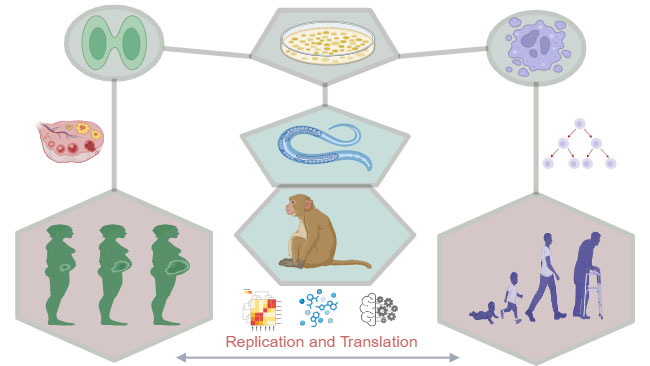
Life science research flows from cell to society. Cell culture mechanisms are replicated in model organisms before translation to advance human health and flourishing. This investigation will leverage transdisciplinary metabolomics data to characterize two pillars of organic life: aging and reproduction.
Using secondary data [D1, D2] and published results [1], we will identify metabolomic signatures of senescence and cell cycle phases, representing cellular aging and reproduction. Continuing the research paradigm, we will assess replication of in vitro profiles within data describing the aging of model organisms [D3] and reproductive fitness of non-human primates [D4]. We will culminate our analyses by translating findings to understand the metabolic alignment between cellular senescence and human aging/mortality [D5-D8], as well as explore the clinical relevance of cell division to reproductive outcomes, including pre-term birth, gestational age, and early embryonic arrest [D9-D12].
DATA: 12 metabolomics datasets spanning cell culture, model organism, and human studies: Dryad [D1, D2, D4-D7, D11, D12], Harvard Dataverse [D3], Zenodo [D8], and Mendeley Data [D10].
AIM 1: Identify metabolomic signatures of senescence, cell cycle, and follicular phase. D1 includes a 20-day profiling of fibroblasts during replicative senescence. We will apply repeated measures ANOVA to identify senescence-related signatures by examining time- and treatment-dependent changes in metabolite levels. We will also retrieve cell cycle signatures from the literature [1]. D2 comprises profiles collected from in vitro oocyte maturation media before maturation onset, after 24 hours, and from blastocyst-conditioned media collected 8 days post-fertilization. One-way ANOVA will be employed to assess differences in metabolite profiles across conditions, with Tukey's HSD and pairwise t-tests (FDR < 0.05) to identify condition-specific differences. We will use MetaboAnalyst for quantitative enrichment and WGCNA in R for weighted correlation network analyses to identify biochemical pathways and metabolite clusters related to cellular aging and reproductive fitness.
AIM 2: Assess replication of in vitro profiles in model organisms. D3 includes multi-omic data from young vs. aged yeast cells. Differential analyses will be conducted to identify genomic (DESeq2), proteomic (limma), and metabolomic signatures (MetaboAnalyst/OPLS-DA). Multi-Omics Factor Analysis will identify common patterns across ‘omics layers. D4 comprises repeated urine/blood metabolomic profiles from pregnant rhesus macaques and their infants. Linear mixed-effects models will be used to identify age-related signatures, followed by repeated measures ANOVA to assess group differences over time (lme4). Signature identification will be accompanied by pathway enrichment analysis and comparisons with findings from in vitro profiles at the metabolite and pathway levels.
AIM 3: Explore translation to human studies. Metabolite panels identified in AIMS 1-2 will be used to create predictive models of human aging using measurements from old and young subjects [D6, D7]. Several classification algorithms will be employed to determine the most suitable fit, including logistic regression, random forest, support vector machines, gradient boosting machines, and neural networks. Datasets will be divided into training and testing subsets, with cross-validation to mitigate overfitting. We will use hazard models to assess associations with morbidity [D8], mortality [D5], and adverse pregnancy outcomes [D9-D12].
TIMELINE:
1: Harmonize and identify conserved metabolites available in multiple studies (Oct – Dec)
2: Concurrently analyze cell, organismal, and human data to independently identify metabolites associated with target outcomes (Jan – Feb)
3: Hypothesis-driven application of conserved metabolites from cell studies into model organism and human data (Mar – Apr)
4: Graphically and lexically summarize results (May – Jun)
This project aims to identify and translate metabolomic signatures of cellular aging and reproduction from in vitro and model organism data to human aging, mortality, and reproductive outcomes. Using secondary data from D1 and D2, we expect to detect specific metabolomic profiles associated with in vitro models of cellular senescence and follicular health, respectively. Quantitative enrichment and weighted correlation network analyses will be conducted to uncover the biochemical pathways and metabolite clusters most associated with cellular aging and reproductive fitness.
Next, we expect cross-species validation to replicate our findings from the in vitro metabolomic profiles in simple (i.e., yeast; [D3]) and complex (i.e., rhesus macaques; [D4]) model organisms. Comparable metabolites and pathways implicated in aging and reproduction are expected, suggesting the evolutionary conservation of these processes.
These findings will be applied to human datasets [D5-D12] to investigate the metabolic underpinnings of aging, mortality, and reproductive health. First, we will test whether metabolites linked to cellular senescence in model organisms predict human aging using data from younger and older adults [D5-D8]. We will also explore the association of these markers with adverse pregnancy outcomes such as pre-term birth, early embryonic development arrest, and spontaneous labor [D9-D12]. Identifying metabolomic markers of cellular senescence correlated with these reproductive outcomes could suggest novel pathways for improving reproductive health and fitness.
Dissemination of results will be a priority, with new datasets deposited in public repositories like Dataverse and the NIH’s National Metabolomics Data Repository to adhere to the FAIR principles. Moreover, our code will be made available via open-source platforms such as GitHub to promote reuse and further exploration. We anticipate publishing at least one manuscript in peer-reviewed metabolomics, aging, or reproductive health journals and presenting at key conferences and symposia. We will also ensure that findings pertinent to underrepresented populations, including Indigenous communities, are shared with these communities in ways that improve their health outcomes without merely promoting external academic or institutional goals (following CARE principles). Indeed, several of our datasets (e.g., [D6, D8, D11]) include a considerable percentage of non-white participants and individuals from developing countries. We will prioritize contacting these studies' first- and last-authors to share our results.
Replicability is at the core of this project as we assess the consistency of metabolomic signatures across multiple species and datasets. Rigorous statistical methods will ensure the reliability of our results. Furthermore, we will publish all protocols and workflows to enable other researchers to replicate our findings and conduct further analyses using our methodologies.
Metabolic roots of aging and reproduction. Aging occurs through a complex interplay of biological mechanisms, environment, and host behaviors over time [2]. Dysregulated metabolic pathways like mitochondrial dysfunction and insulin resistance are hallmarks of aging and cellular senescence. Though senescence initially protects against DNA damage, oxidative stress, and cancer, the buildup of senescent cells and inflammatory markers can lead to age-related diseases [3-4]. Environmental and behavioral factors can further accelerate functional decline [5-9]. For example, reproduction is characterized by extensive physiological shifts in our immune [10-12], metabolic [13-14], vascular [15-16], and endocrine systems [17]. As a result, evolutionary theory predicts functional and energetic constraints to somatic maintenance and defense, leading to accelerated aging; this tradeoff is called the “costs of reproduction” [18-19].
Basic science studies suggest a dynamic interplay between aging, metabolism, and reproduction. For instance, telomere shortening activates cell death pathways and is linked with aging and reduced fertility [20-22]. Indeed, in Caenorhabditis elegans, reduced reproduction through germline cell loss can lead to an extended lifespan [23]. Moreover, the prenatal plasma metabolome is one of the most robust predictors of gestational age and labor onset [24]. This suggests that reproductive signals influence metabolic pathways and contribute to aging. However, how these cellular phenotypes translate to key human outcomes, such as reproductive fitness and maternal health, remains unclear. Integrating data across biochemical pathways involved in aging and reproduction represents an appealing avenue to explore this. To address this, we suggest applying metabolomics — the comprehensive profiling of metabolites, their precursors, and their derivatives [25] — to study the biological processes implicated in premature aging and age-related diseases like cancer and cardiometabolic diseases [26-29].
Contributions and impact. A key challenge and knowledge gap in translating therapies is understanding whether processes observed in model organisms are conserved in humans. The metabolic profiles we identify could help spot translatable biomarkers and pathways playing a central role in senescence, aging, and reproductive dysfunction. These findings may be combined with other ‘omics data to identify hub metabolites and allow a holistic understanding of variability in aging trajectories (i.e., ageotypes) to enhance personalized healthcare [30-34]. A better understanding of aging pathways may inform policies, treatment courses, lifestyle changes, and targeted pharmacological interventions using senotherapeutics (i.e., drugs that eliminate or modify senescent cells), thereby improving and extending a healthy lifespan [35]. Such measures will become increasingly important as a large portion of the global population ages dramatically over the next 30 years [36].
Our collective was formed via a shared affiliation with the Consortium of Metabolomic Studies (COMETS), a partnership of prospective cohort studies working to accelerate the analysis of metabolomic profiles associated with chronic disease phenotypes. Dr. Hastings serves as Chair of the COMETS Early Career Interest Group, where he has worked with early career scientists, including Drs. Kachroo, Sharma, and Sanchez, to foster a collaborative support network with robust topical and analytical expertise. Our shared interest in using metabolomics to explore relationships between human aging and reproduction was the impetus for this DataWorks submission.
Dr. Hastings’s research uses machine learning to derive human biological age measurements from diverse data streams, including sequencing, epigenomics, clinical parameters, and metabolomics [S1].
Dr. Kachroo’s research involves identifying clinically relevant multi-omic biomarkers central to the developmental origins of respiratory diseases and other complex age-associated outcomes [S2].
Dr. Sharma has experience in applying advanced statistical methods and machine learning to identify multi-omic biomarkers and uncover the potential role of vitamins in lung health and biological aging [S3].
Dr. Sanchez’s research employs multi-omic and complex statistical modeling approaches to evaluate the impacts of environmental exposures on women’s health outcomes [S4].
Our unique statistical background in analyzing health outcomes specific to ‘omics, aging, and women’s health, as well as our established working relationship within COMETS, provides the foundation for this project's success. Through our research experiences, we have created harmonization data files that use hierarchical definitions to facilitate metabolite linkage across measurement platforms. Using these files, metabolites can be linked to a unique internal ID via mapping across identifiers from recognized databases (e.g., HMDB, KEGG, PubChem), vendor IDs, and biochemical names. This resource will be invaluable to this project, as our target datasets use different metabolomic platforms (e.g., NMR-based vs. LC-MS-based). If exact metabolites cannot be linked, we will conduct functional enrichment to identify higher-order pathways and domains represented amongst identifiable metabolites and test the replication and translation of these domains instead of individual metabolites.