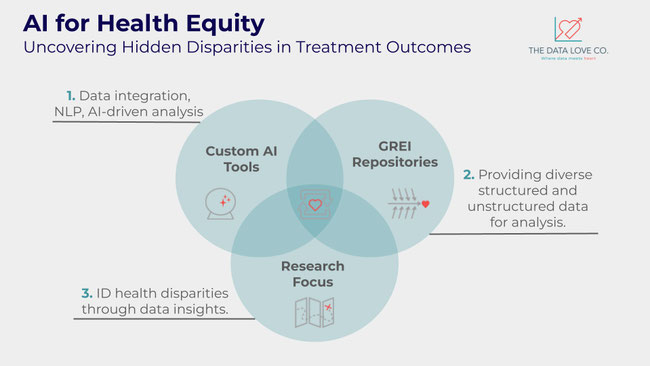
This project leverages data from GREI repositories and food desert datasets to analyze clinical trials, patient-reported outcomes, and social determinants of health. This study aims to identify how community-level factors like food access contribute to health disparities in treatment outcomes. Utilizing HeartBeat, a proprietary AI-powered data management tool, and Dorothy, an advanced AI for NLP and data synthesis, we will integrate diverse datasets, including food access data from USDA, CDC, and other sources, to uncover patterns that can inform targeted public health interventions.
Our project will conduct a secondary analysis to uncover community-level factors driving disparities in treatment outcomes among ethnic groups, rural areas, and low-income populations. By integrating data from seven GREI repositories and food desert datasets, we aim to generate actionable insights for public health interventions.
We will use structured and unstructured data from the following GREI repositories, accessed via APIs for efficient data retrieval:
Using HeartBeat and Dorothy, our AI, the project will involve:
The project will be completed in 6 months with key milestones:
Our project will uncover key factors driving health disparities, influencing scientific research and public health policy.
We will identify community-level factors like socioeconomic status, healthcare access, and food access that contribute to disparities in treatment outcomes. By integrating clinical trial data with social determinants of health and food desert data from sources such as the USDA Food Access Research Atlas and Feeding America's Map the Meal Gap, we aim to reveal patterns explaining these disparities. The findings will guide targeted public health interventions aimed at reducing inequities.
Our findings will be shared widely through:
We are committed to following both FAIR and CARE principles:
To ensure replicability and reproducibility:
By adhering to these principles and strategies, our project will deliver impactful, ethical, and accessible insights for the broader research and public health community.
Our project will significantly advance public health by addressing health disparities through advanced data analysis. By focusing on community-level factors influencing treatment outcomes among ethnic groups, rural areas, and low-income populations, our work will have broad implications for healthcare practices and public health policies.
Scientific Contributions
Integrating clinical trial data, patient-reported outcomes, social determinants of health, and food access data from sources such as the USDA Food Access Research Atlas and Map the Meal Gap, our research will uncover complex factors driving health disparities. This holistic approach marks a critical step forward in understanding and addressing these disparities.
Impact on Healthcare
Our research will inform clinical practices and public health strategies:
Best Practices in Data Reuse
Our project will serve as a model for data reuse in public health:
Long-Term Impact
The project’s impact will extend beyond immediate findings:
Our project will have a lasting impact by advancing scientific knowledge, shaping public health policies, and improving health outcomes in underserved communities.
The Data Love Co., co-founded by Jasmine Motupalli and Irzana Golding, combines expertise in AI, data science, and strategic leadership to address complex challenges through advanced analytics.
We collaborate closely, leveraging our complementary skills and a shared commitment to innovation. Regular strategic meetings and collaborative tools ensure effective communication and project management. Our combined experience in statistical analysis, AI, and data management positions us to deliver robust, actionable insights for this project.
Key considerations to ensure the success of this project include: