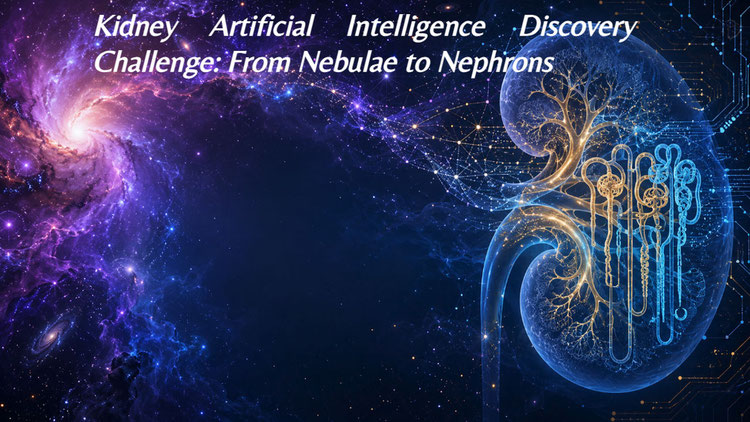
The subject of this challenge is the application of artificial intelligence, machine learning, computer vision, and related computational methods to identify previously unrecognized or under-characterized patterns in data generated by the Kidney Precision Medicine Project, or KPMP, a project supported by the NIDDK. The challenge, titled “Kidney Artificial Intelligence Discovery Challenge: From Nebulae to Nephrons,” seeks to advance a new discovery paradigm for kidney disease research by adapting anomaly-detection approaches used in astronomy and other data-intensive fields to the analysis of kidney tissue images, multi-omics data, spatial data, and associated clinical information.
Kidney disease affects approximately 35.5 million people in the United States, yet important gaps remain in understanding disease heterogeneity, mechanisms of progression, treatment response, and opportunities for earlier intervention. The National Institute of Diabetes and Digestive and Kidney Diseases (NIDDK) established the Kidney Precision Medicine Project (KPMP), a multi-site research initiative focused on improving our understanding of kidney disease at the molecular and cellular levels.
KPMP’s primary goal is to collect and comprehensively analyze human kidney biopsy tissue from individuals with chronic kidney disease (CKD) or acute kidney injury (AKI). These data are used to develop the Kidney Tissue Atlas, a detailed resource that maps kidney cell types, tissue structures, disease pathways, and potential therapeutic targets.
KPMP has generated a growing repository of high-quality, multi-scale data, including whole slide images, spatial and molecular data, and clinical information from individuals with chronic kidney disease and acute kidney injury. These data provide an unprecedented opportunity to examine kidney disease at the tissue, cellular, molecular, and patient levels. However, traditional hypothesis-driven analyses and classification-based machine learning approaches may fail to detect rare, subtle, spatially complex, or unexpected patterns that fall outside existing disease categories.
This challenge is being issued to explore whether “fresh computational eyes” can reveal hidden patterns in KPMP data that may not be readily apparent through conventional analysis. The challenge is inspired by recent work in astronomy, where artificial intelligence methods have been used to identify rare gravitational lenses and other anomalies in archival telescope images that had previously been examined by human experts. Similarly, this challenge asks whether novel approaches, such as AI-based anomaly detection, semi-supervised learning, similarity search in learned embedding spaces, and human-AI collaborative review can be translated to kidney pathology and precision nephrology.
The desired solutions are conceptual, methodological, and collaborative approaches that support anomaly-based discovery in KPMP data. The participants will focus on image-based feature discovery by identifying novel, patterns, objects, or anomalies in kidney pathology images. Participants will detect anomalies, demonstrate how computational or other methods can reveal previously unrecognized structures or signals, and provide supporting evidence for their findings. Participants may also explore how detected features could support patient stratification, including approaches to group or reclassify patients based on image-derived anomalies in combination with clinical parameters or other KPMP data. Assigning molecular mechanisms to newly identified features is a longer-term goal and may be addressed through a future challenge. The challenge is expected to emphasize rigorous human-AI collaboration, with pathologists, nephrologists, and other kidney domain experts validating and interpreting computationally identified anomalies.
The objective of the challenge is not merely to classify known disease states, but to stimulate new approaches for discovering patterns in imaging data that may improve understanding of kidney disease mechanisms and inform future precision medicine efforts. Potential areas of focus may include novel tissue features, unusual cellular or structural arrangements, spatially localized disease signatures, patterns associated with progression risk, markers of treatment response, or multi-modal signatures that link morphology to molecular pathways and clinical outcomes.
The intended effect of the challenge is to catalyze cross-disciplinary collaboration that may include astronomers, AI researchers, computer vision experts, pathologists, nephrologists, and multi-omics scientists. In the near term, the Challenge is expected to produce a cross-disciplinary network of investigators, a catalog of priority anomaly-detection targets in KPMP data, conceptual analytic pipelines, and a strategic white paper or roadmap. The challenge winners may also be invited to serve as co-authors or contributors to an anticipated publication arising from this effort. In the medium term, the winning solutions may be used to further the development of technical specifications, data preparation and governance approaches, working groups, and future proposals for computational infrastructure and validation studies. In the long term, the Challenge is intended to incentivize the development, testing, and delivery of solutions that can enable future discovery of novel disease subtypes, progression markers, therapeutic response signatures, and validated tools that may ultimately improve patient care.
Ultimately, the challenge aims to accelerate progress toward precision nephrology by helping researchers identify patient subgroups and patterns that can inform new treatment options, improve treatment selection, enhance patient outcomes, and support more efficient use of public resources for individuals with acute or chronic kidney disease.
Challenge Launch: September 15, 2026
Submission Start/End: November 5, 2026 through April 29, 2027
Judging Start/End: April 30, 2027 through June 30, 2027
Winner Announced: September 1, 2027
The National Institute of Diabetes and Digestive and Kidney Diseases (NIDDK) is conducting this Challenge under the America Creating Opportunities to Meaningfully Promote Excellence in Technology, Education, and Science (COMPETES) Reauthorization Act of 2010, as amended [15 U.S.C. § 3719]. NIDDK’s statutory authority is set forth in the Public Health Service Act at 42 U.S.C. § 285c, which provides that the general purpose of the Institute is the “conduct and support of research, training, health information dissemination, and other programs” with respect to, among other areas, kidney, urologic, and hematologic diseases.
The NIDDK Kidney Artificial Intelligence Discovery Challenge: From Nebulae to Nephrons is consistent with and promotes this statutory authority because it is designed to stimulate research and related scientific activities concerning kidney disease, including chronic kidney disease and acute kidney injury. The challenge requires the exclusive use of KPMP data, limited to publicly available (“open”) data in the KPMP Kidney Tissue Atlas (i.e., no use of “controlled” data subject to a data use agreement), to identify previously unrecognized or under-characterized disease patterns. By seeking computational approaches that may reveal novel morphological, spatial, multi-modal, or clinically relevant signatures of kidney disease, the challenge directly supports NIDDK’s authority to conduct and support research and other programs related to kidney diseases.
NIH will provide participants with access to a common set of eligible KPMP images rather than relying on images supplied by individual participants (https://www.kpmp.org/available-data). The Kidney Precision Medicine Project (KPMP) protects research participant privacy using information security, de-identification, and honest broker reviews. All public data is de-identified. No personally identifiable information (PII) is included in the images or associated clinical data.
The total prize purse for this challenge is $100,000 in cash prizes. NIDDK anticipates making up to three cash prize awards, subject to the quality of submissions received and the judges’ evaluation of eligible submissions under the judging criteria described in this announcement.
The prize structure is as follows:
Prize | Amount |
| First Place | $50,000 |
| Second Place | $30,000 |
| Third Place | $20,000 |
| Total Prize Purse | $100,000 |
NIDDK reserves the right to award fewer than the anticipated number of prizes, to not award any prizes, or to allocate prize amounts differently among eligible winners, if submissions do not meet the requirements of this challenge or if the judging panel determines that such action is appropriate under the evaluation criteria. NIDDK will not award more than $100,000 in total cash prizes under this challenge unless the prize amount is increased after notice is provided in the same manner as the initial announcement and the increase is approved by the HHS Secretary, consistent with the America COMPETES Reauthorization Act.
No non-monetary prize is offered under this challenge, except that winners may receive public recognition through NIH or NIDDK communications, challenge-related materials, presentations, or other appropriate dissemination channels.
The Award Approving Official will be Dr. Griffin Rodgers, Director of the NIDDK.
Prizes awarded under this challenge will be paid by electronic funds transfer and may be subject to federal income taxes. HHS/NIH will comply with the Internal Revenue Service withholding and reporting requirements, where applicable.
Entities participating in this challenge are encouraged, but not required, to request and obtain a free Unique Entity ID (UEI), if they have not already done so, via SAM.gov as this will expedite prize payment. Additional information can be found at https://sam.gov/content/entity-registration.
NIH/NIDDK reserves the right, in its sole discretion, to (a) cancel, suspend, or modify the challenge, or any part of it, for any reason, and/or (b) not award any prizes if no submissions are deemed worthy.
Basis Upon Which a Winner Will be Selected.
Submissions received by the deadline will first undergo administrative triage to confirm participant eligibility, submission completeness, and relevance to the challenge scope. Complete, in-scope submissions from eligible participants will then be reviewed by an Evaluation Panel composed of scientific, technological, clinical, and commercialization experts using the Judging Criteria described below. The Evaluation Panel will provide its assessments of eligible submissions to the NIH Judging Panel.
The NIH Judging Panel, composed of federal employees with expertise relevant to the challenge, will review the Evaluation Panel’s assessments and select winners, subject to final approval by the Award Approving Official. NIH does not intend to provide participants with individual reviews or summaries of reviewer feedback.
1. Discovery and Novelty — 50 points
Evaluate the extent to which the submission identifies image features (e.g., patterns, objects, anomalies) in whole-slide kidney biopsy images that are rare, unexpected, scientifically meaningful, or potentially novel.
Evaluators and Judges should consider:
How strong is the visual or analytical evidence supporting the novelty or scientific relevance of the findings?
How well does the submission distinguish potentially meaningful discoveries from common background variation, technical artifacts, or expected histologic findings?
What is the likelihood that the identified findings could support new biological, pathological, clinical, or imaging-related hypotheses?
Possible quantitative considerations may include precision among top-ranked features, expert-confirmed discovery rate, novelty score, rarity frequency, enrichment over baseline methods, or rank position of seeded or expert-validated findings.
2. Technical Approach and Performance — 30 points
Evaluate how well the method detects, ranks, retrieves, clusters, or localizes rare, hidden, or expert-validated findings in whole-slide kidney biopsy images.
Evaluators and Judges should consider:
How well does the submission meet the requirement to identify unusual or discovery-relevant findings rather than simply classify routine slide-level categories?
How well does the submission document the full workflow, including preprocessing, model development, training or inference procedures, ranking methods, and post-processing?
How effectively does the method reduce false positives from staining variation, tissue preparation artifacts, scanner effects, or common histologic background?
To what extent did the participant demonstrate that the approach generalizes beyond the data used for method development?
To what extent did the participant provide meaningful confidence, uncertainty, or reliability estimates for flagged findings?
How well does the submission identify ambiguous cases, borderline findings, likely false positives, and expected failure modes?
Possible quantitative metrics may include top-k precision, mean reciprocal rank, average precision, area under the precision-recall curve, localization overlap, clustering purity, retrieval accuracy, false-positive rate, expert review burden reduction, performance on held-out test sets, degradation under pre-analytical variability.
3. Scientific Interpretability and Expert Usability — 20 points
Evaluate how effectively the submission describes how detected features could support patient stratification, including approaches to group or reclassify patients based on image-derived anomalies in combination with clinical parameters or other KPMP data, enabling pathologists, nephrologists, imaging scientists, or other relevant domain experts to review, understand, and assess the flagged findings.
Evaluators and Judges should consider:
How well does the submission connect computational outputs to observable image features, biologically plausible interpretations, and patient stratifications?
To what extent did the participant demonstrate why specific slides, regions, patches, clusters, objects, or anomalies were flagged?
How useful are the interpretability outputs for expert review, such as heatmaps, localization maps, representative image patches, cluster summaries, similarity searches, feature descriptions, or concise rationales?
Are explanations specific enough to help experts distinguish between true candidate discoveries, artifacts, and uncertain cases?
Does the team include, consult, or collaborate with experts who can evaluate kidney biopsy findings and assess scientific relevance?
Possible quantitative or semi-quantitative considerations may include expert usability ratings, time required for expert review, inter-rater agreement on flagged findings, percentage of outputs with interpretable localization, or agreement between model explanations and expert annotations.
Registration and Submission Process:
Submission Requirements:
Submission requirements are being finalized as part of challenge design and will be published in full on the HeroX challenge page before the submission window opens. In general, participants can expect that submissions should clearly describe the discoveries identified through analysis of the KPMP whole-slide kidney biopsy imaging data. For each discovery, participants should provide the supporting evidence and scientific rationale for why the finding is considered rare, novel, or otherwise scientifically meaningful. Submissions should also describe the technical methods and analytical approaches used to generate the findings, including relevant assumptions, validation procedures, and measures used to assess the reliability of the results. Participants should identify any limitations of the methods or analyses and discuss how those limitations may affect interpretation of the findings. Solutions will also need to be provided in a runnable form that allows HeroX to independently execute and verify the reported findings.
The official announcement for the Kidney Artificial Intelligence Discovery Challenge: From Nebulae to Nephrons can be found on nih.gov/challenges.
Participants will be required to identify whether they are registering as one of the following: as an Individual (i.e., registering on behalf of yourself), as an independent Team (i.e., registering as a group of individuals competing together but not on behalf of an established organization, institution, or corporation) or as an Entity (i.e., registering as a group of individuals competing together on behalf of a legally established organization, institution, or corporation). Participants will need to provide the name, affiliation, and contact information of all individuals competing in this challenge as part of a Team or on behalf of an Entity. All participants will also be required to acknowledge that no federal funding will be used in the development of the challenge submission (see Participation Rule 1). All participants must certify they have read, understand, and agree to abide by the official eligibility rules, participation rules, and requirements for the challenge as stated in this announcement.
For Individuals: Each individual participating on behalf of themselves must be a citizen or permanent resident of the United States to be eligible to receive a cash prize.
For Teams: Each participating Team is required to identify a Team Captain who will register and submit on behalf of the Team members. The Team Captain is responsible for all communications with the challenge sponsors and, in the event of winning a cash prize, will be paid the prize directly and in full. To be eligible to receive a cash prize, the Team Captain must be a citizen or permanent resident of the United States. In the event that a dispute regarding the identity of the Team Captain who submitted the entry cannot be resolved to NIH’s satisfaction, the affected submission will be deemed ineligible.
For Entities: Each participating Entity is required to identify a Point of Contact who will register and submit on behalf of the Entity. The Point of Contact is responsible for all communications with the challenge sponsors. In the event of winning a cash prize, the prize will be paid directly and in full to the Entity, not to the Point of Contact. To be eligible to receive a cash prize, the Entity must be incorporated in and maintain a primary place of business in the United States. As stated in the Participation Rules, participants intending to use Federal grant or cooperative agreement funds must register for and participate in the challenge as an Entity on behalf of the awardee institution or organization. In the event that a dispute regarding the identity of the Point of Contact who submitted the entry cannot be resolved to NIH’s satisfaction, the affected submission will be deemed ineligible.
Submission Process and Requirements
Once participants have completed the registration step and established an account in the online submission portal accessible at the link above, they will be asked to upload the submission package.
All submission content must be provided in English and adhere to any length requirements stipulated in the submission portal. Submissions must not include the HHS’ logo or official seal or the logo of NIDDK, NIH or any of its components and must not claim federal government endorsement.
Participants must complete their submission and provide all the requested information in the portal no later than April 29, 2027. Participants who do not submit their complete submission in the portal by this deadline will not have their submission considered for this challenge.
All submissions must include a statement agreeing to the Challenge terms & conditions by including the following in the Cover Page: “I understand and agree that each innovator for the Challenge must comply with all terms and conditions of the Challenge rules, and participation in this Challenge constitutes each such innovator’s full and unconditional agreement to abide by these rules.” Submissions that do not include this language will be deemed non-compliant and will not be evaluated.
To be eligible to win a prize under this challenge, a Participant (whether an individual, group of individuals, or entity)
Shall have registered to participate in the challenge under the rules promulgated by the National Institutes of Health (NIH) as published in this announcement;
Shall have complied with all the requirements set forth in this announcement;
In the case of a private entity, shall be incorporated in and maintain a primary place of business in the United States, and in the case of an individual, whether participating singly or in a group, shall be a citizen or permanent resident of the United States. However, non-U.S. citizens and non-permanent residents can participate as a member of a team that otherwise satisfies the eligibility criteria. Non-U.S. citizens and non-permanent residents are not eligible to win a monetary prize (in whole or in part). Their participation as part of a winning team, if applicable, may be recognized when the results are announced.
Shall not be a federal entity or federal employee acting within the scope of their employment;
Shall not be an employee of the Department of Health and Human Services (HHS, or any other component of HHS) acting in their personal capacity;
Who is employed by a federal agency or entity other than HHS (or any component of HHS), should consult with an agency ethics official to determine whether the federal ethics rules will limit or prohibit the acceptance of a prize under this challenge;
Shall not be a judge of the challenge, or any other party involved with the design, production, execution, or distribution of the challenge or the immediate family of such a party (i.e., spouse, parent, step-parent, child, or step-child).
Shall be 18 years of age or older at the time of submission.
(1) Participants (whether individuals, groups of individuals, or entities) may not use federal funds from a grant award or cooperative agreement to develop their challenge submissions or to fund efforts in support of their challenge submissions.
(2) Federal contractors may not use federal funds from a contract to develop their challenge submissions or to fund efforts in support of their Challenge submissions.
(3) By participating in this challenge, each Participant (whether an individual, group of individuals, or entity) agrees to assume any and all risks and waive claims against the federal government and its related entities, except in the case of willful misconduct, for any injury, death, damage, or loss of property, revenue, or profits, whether direct, indirect, or consequential, arising from participation in this challenge, whether the injury, death, damage, or loss arises through negligence or otherwise.
(4) Based on the subject matter of the challenge, the type of work that it will possibly require, as well as an analysis of the likelihood of any claims for death, bodily injury, property damage, or loss potentially resulting from challenge participation, no Participant (whether an individual, group of individuals, or entity) participating in the challenge is required to obtain liability insurance, or demonstrate financial responsibility, or agree to indemnify the federal government against third party claims for damages arising from or related to challenge activities in order to participate in this challenge.
(5) A Participant (whether an individual, group of individuals, or entity) shall not be deemed ineligible because the Participant used federal facilities or consulted with federal employees during the challenge if the facilities and employees are made available to all Participants participating in the challenge on an equitable basis.
(6) By participating in this challenge, each Participant (whether an individual, group of individuals, or entity) warrants that they are sole author or owner of, or has the right to use, any copyrightable works that the submission comprises, that the works are wholly original with the Participant (or is an improved version of an existing work that the Participant has sufficient rights to use and improve), and that the submission does not infringe any copyright or any other rights of any third party of which the Participant is aware.
(7) By participating in this challenge, each Participant (whether an individual, group of individuals, or entity) grants to the NIH an irrevocable, paid-up, royalty-free nonexclusive worldwide license to reproduce, publish, post, link to, share, and display publicly the submission on the web or elsewhere, and a nonexclusive, nontransferable, irrevocable, paid-up license to practice, or have practiced for or on its behalf, the solution throughout the world. Each Participant will retain all other intellectual property rights in their submissions, as applicable. To participate in the challenge, each Participant must warrant that there are no legal obstacles to providing the above-referenced nonexclusive licenses of the Participant’s rights to the federal government. To receive an award, Participants will not be required to transfer their intellectual property rights to NIH, but Participants must grant to the federal government the nonexclusive licenses recited herein.
(8) Each Participant (whether an individual, group of individuals, or entity) agrees to follow all applicable federal, state, and local laws, regulations, and policies.
(9) Each Participant (whether an individual, group of individuals, or entity) participating in this challenge must comply with all terms and conditions of these rules, and participation in this challenge constitutes each such Participant’s full and unconditional agreement to abide by these rules. Winning is contingent upon fulfilling all requirements herein.
(10) As a condition for winning a cash prize in this challenge, each Participant (whether an individual, group of individuals, or entity) that has been selected as a winner must complete and submit all requested winner verification and payment documents to NIH within 10-20 business days of formal notification. Failure to return all required verification documents by the date specified in the notification may be a basis for disqualification of a cash prize winning submission.