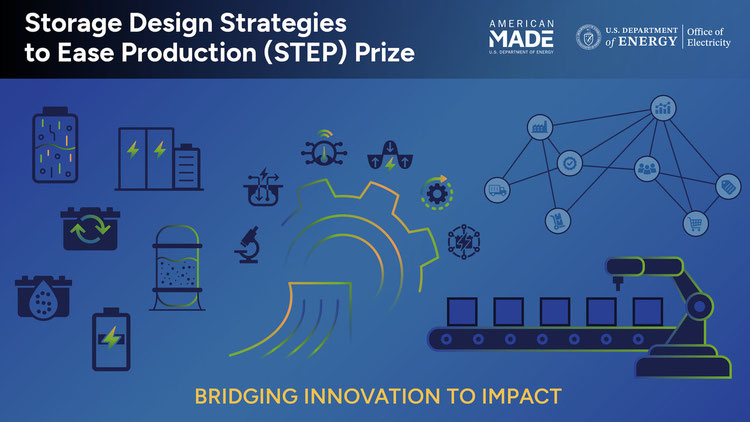
The Storage Design Strategies to Ease Production (STEP) Prize is a $500,000 two-phase competition explicitly designed to identify and foster innovative solutions for novel energy storage technologies. This prize targets a broad spectrum of innovators, including individuals, academic institutions, nonfederal government entities, small businesses, start-ups, entrepreneurs, and other inventors working on nascent or emerging energy storage innovations.
The Storage Design STEP Prize directly addresses historical challenges experienced by energy technologies during rapid scaling and market penetration, particularly those stemming from insufficient early-stage focus on manufacturability and supply chain resilience. By guiding competitors to integrate these critical considerations earlier in their design process, the prize aims to equip developers with the tools to mitigate future market deployment and adoption challenges, thereby accelerating the commercialization of robust, resilient, and economically viable next-generation energy storage solutions for the grid.
Background
The rapid expansion of the energy storage sector is critical for grid modernization and energy security. However, historically, the scaling and market integration of novel energy technologies have encountered significant roadblocks due to insufficient attention to manufacturability and supply chain resilience during early design phases. This persistent challenge often leads to inflated production costs, delayed market entry, and unsustainable dependencies. Recognizing this critical gap, the Storage Design STEP Prize is specifically structured to incentivize and guide innovators in integrating Design for Manufacturability (DFM) and robust supply chain strategies from the earliest stages of development, thereby de-risking nascent energy storage technologies and accelerating their path to commercially viable, resilient, and scalable deployment essential for national energy goals.
Prize Phases and Awards
The Storage Design STEP Prize employs a two-phase structure to incentivize innovators to integrate robust manufacturability and supply chain strategies directly into the design of novel energy storage technologies.
The first phase of the prize encourages competitors to identify and conceptualize solutions for known or anticipated production challenges specific to their innovative energy storage designs. Historical experiences from more mature energy storage technologies, where a lack of early consideration for manufacturing and supply chain logistics has often led to significant market deployment hurdles are useful examples. By focusing on these challenges at the design stage, the prize aims to prevent similar issues for next-generation storage solutions.
The winning design concepts from the initial phase will be eligible for the second phase. This phase will recognize competitors who have further developed and validated their Phase 1 winning solutions, demonstrating their potential to overcome manufacturing and supply chain barriers. This structure supports the DOE's broader objective of accelerating the commercialization of diverse energy storage technologies to enhance grid resilience and bolster domestic manufacturing capabilities.
Phase 1 Awards
In Phase 1, up to three Phase 1 Champions will receive $20,000 each in cash prizes and up to nine Phase 1 Finalists will receive $10,000 each in cash prizes. Additionally, all Phase 1 winners achieve eligibility to compete in Phase 2, provided that all other eligibility requirements are also met.
Phase 2 Awards
In Phase 2, up to two Phase 2 Champions will receive $100,000 each in cash prizes and up to three Phase 2 Finalists will receive $50,000 each in cash prizes.
Phase
Winners/Winning Teams
Prizes
Phase 1
Up to three (3) Phase 1 Champions
Up to $20,000 each ($60,000 total prize pool)
Up to nine (9) Phase 1 Finalists
Up to $10,000 each ($90,000 total prize pool)
Phase 2
Up to two (2) Phase 2 Champions
Up to $100,000 each ($200,000 total prize pool)
Up to three (3) Phase 2 Finalists
Up to $50,000 each ($150,000 total prize pool)
Guidelines
Please review the official rules for the complete application process and instructions for competing, including descriptions of solutions of interest and example energy storage technologies.
If you want to receive updates on the prize or have any questions, please subscribe by using the follow feature on the HeroX platform or message us directly at storageSTEPprize@nlr.gov.
This is your final reminder to submit all required materials for the Storage Design Strategies to Ease Production (STEP) Prize no later than 5 p.m. ET this Thursday, Oct. 8. Prize administrators highly recommend submitting your materials well ahead of the deadline to avoid technical difficulties or delays. Late submissions will not be accepted.
Don’t forget, all submission materials for the Storage Design Strategies to Ease Production (STEP) Prize are due no later than 5 p.m. ET on Thursday, Oct. 8. Prize administrators highly recommend submitting your materials well ahead of the deadline to avoid technical difficulties or delays. Late submissions will not be accepted.
All submission materials for the Storage Design Strategies to Ease Production (STEP) Prize are due no later than 5 p.m. ET on Thursday, Oct. 8.
Consider reviewing the following resources for your application:
Webinar recording: In case you missed the informational webinar on Aug. 6 or need a quick refresher on key prize details, you can watch a recording of the webinar here.
Official rules document: Prize administrators highly encourage all applicants to review the rules in their entirety before submitting any application materials. This document contains important definitions, useful scoring metrics, and full prize details.
Phase 1 submission template (optional): Applicants may use this optional template to format their submission materials.
Team registration instructions: If you’re new to the official prize platform, HeroX, you can find helpful instructions on how to register here.
Public forum: Use this forum to search for teammates or ask questions about the prize.
We look forward to receiving your submissions soon!
In case you missed the live informational webinar for the Storage Design Strategies to Ease Production (STEP) Prize on Aug. 6, you can view a recording of the event in the Resources section of the HeroX page. During the webinar, prize administrators covered prize background, Phase 1 submission materials, key deadlines, and more. Plus, administrators answered attendee questions during the live Q&A. You can find responses to competitor questions in the FAQ section of the HeroX page.
As a reminder, all submissions are due no later than 5 p.m. ET on Thursday, Oct. 8. Late submissions will not be accepted, so we highly recommend preparing your materials well ahead of the deadline. Read more about the application requirements in the official rules document.
Don’t forget, the Storage Design Strategies to Ease Production (STEP) Prize informational webinar is happening this Thursday, Aug. 6, at 1 p.m. ET. Register today to reserve your spot!
During the webinar, prize administrators will cover competitor eligibility, required submission materials, and other key details. Applicants who cannot attend the live webinar are encouraged to watch a recording of the event once it’s posted to HeroX.
Review the optional Phase 1 submission template, created to help applicants organize and align their information with the requirements in the rules document.
Post your questions in the public forum, where prize administrators and other potential partners can respond.
Yes, but it’s quick and easy. Just click the “Solve this Challenge” button on this page and follow the instructions to complete your registration. All you need to provide is your name and email address.
You can register as a team or an individual. Every American-Made Challenge has a section in the submission form where you will list your team and team members, and those members do not have to match your HeroX team. The team you build using the HeroX team function is not part of the review—only the team you list in the submission counts in the review of your materials. Therefore, you can register and submit as a team or an individual, and it does not affect the review of your submission. If your HeroX team is made up of multiple individuals, only the team captain will be able to begin the submission.
To aid your decision, we have created a guide found in the Resources tab.
Note: If you are competing in a prize with multiple phases, and if different people might submit at different phases for your team, we recommend building a team within HeroX and submitting that way, as you can swap the "captain" for your team, but keep the same team and permissions while just swapping the person who can actually submit the submission.
If you have a question not answered in the FAQ, post it in the Forum where a prize administrator will respond to you. This way, others who may have the same question will be able to see it.
No, if you are a contest winner you are receiving the prize for meeting or exceeding the contest goals.
The Submission Templates are found in the Resources tab.
The American-Made Network is a robust ecosystem of professionals and organizations designed to help competitors succeed using expertise, research facilities, and connections to other resources.
Network members are organizations—like test facilities, incubators, manufacturers, law firms, business development experts, and beyond—with expertise in a wide variety of energy and other tech sectors.
The National Laboratory of the Rockies (NLR) administers prizes and competitions on behalf of the U.S. Department of Energy (DOE). Each prize is funded by a single DOE office or multiple offices.
All of your files are uploaded as part of the submission form. Access this form by clicking the “Solve This Challenge” button. The submission form contains an upload option for each of the required file entries.
If you encounter an issue when attempting to submit an entry to the challenge, you may need to contact HeroX or the Prize Administrator.
You may try to connect with HeroX using the online form which appears in the bottom right corner of your browser window, it says Leave a Message.
You may also send a message to the Prize Administrator inbox at storageSTEPprize@nlr.gov.
Please allow at least 1 business day for a response.
For Phase 1, if our long-term target is 100% U.S. manufacturing and sub-assembly, how are near-term supply chain strategies evaluated if they leverage international non-FCOC allies (such as in Taiwan or Thailand) to achieve target market costs?
For Phase 1, competitors may describe near term supply chain approaches that use manufacturing or sub assembly in non-FCOC allied countries if those steps support early cost targets. Consistent with the prize's official rules, competitors should clearly explain how these near term choices fit into their overall plan—and how they transition toward the long term goal of 100% U.S. manufacturing. DOE will evaluate these strategies according to the prize’s stated requirements and scoring criteria, so teams should rely on the official rules for the full details.
Section 2.10.1 requires the 'majority of activities' to be performed in the U.S. How is this threshold measured by labor hours, overall spend, or where final system integration and engineering take place?
Section 2.10.1 doesn’t prescribe a specific metric for determining the “majority of activities.” DOE evaluates this requirement based on the totality of the work described—such as where engineering, integration, and key manufacturing steps occur—rather than any single measure like labor hours or spend. Teams should rely on the definitions and guidance in the official rules when describing how their activities meet this threshold.
What are the primary figures of merit?
The official rules define the figures of merit through the phase‑specific scoring rubrics. Reviewers evaluate submissions based on the criteria described in Sections 3.4.2 and 4.4.2—including problem‑solution fit, technical progress, manufacturability, cost‑reduction potential, and supply‑chain resilience. These rubric criteria constitute the primary figures of merit, and teams should rely on the official rules for the full list and definitions.
What sites should we use to host our introduction video?
Please use YouTube or Vimeo, and make sure the video is listed as public. Reviewers may not be able to access video links from other sites.
What is the Grid Storage Launchpad that Phase 1 winners will have access to?
The Grid Storage Launchpad (GSL) is a national capability for energy storage research located on the Pacific Northwest National Laboratory (PNNL)-Richland campus in Washington. This research facility, funded by the Department of Energy (DOE) Office of Electricity, is focused on creating batteries and energy storage technologies that are critical to support a reliable, affordable, secure, and resilient electrical grid. See https://www.pnnl.gov/projects/grid-storage-launchpad for more information.
Competitor Question
Response
Will the summary slide and introduction video be made public upon submission of the application, or only after the awardees have been selected and announced?
Items marked as public facing may be made public on the HeroX platform after the submission deadline has been reached. The introduction video must be a publicly-accessible link in order for reviewers to access it.
Could you please clarify whether:
a non-U.S.-based individual/company may submit directly to Phase 1;
a non-U.S.-based company may participate as part of a team led by a U.S.-eligible entity;
a foreign technology owner/start-up may participate if the submission includes a U.S.-based partner;
prize payments, if awarded, require the winning entity/team lead to be U.S.-based.
An individual prize competitor must be a U.S. citizen or permanent resident.
A group of individuals competing as a team may compete provided that the online account holder of the submission is a U.S. citizen or permanent resident, and any individuals competing as part of the team are eligible if they are legally authorized to work in the U.S.
Private entities must be incorporated in and maintain a primary place of business in the U.S.
All additional eligibility requirements are in Section 2.6 of the rules document, and the competitor must sign the eligibility statement as listed in that section when completing the submission.
Is my energy storage technology suitable for this prize competition?
Competitors will need to make their own eligibility determinations based on the rules document sections on Eligibility, Solutions of Interest, and Program Policy Factors. Please read these sections carefully to see if your specific situation applies to the goals of this prize.