menu

American-Made Program

 36,703

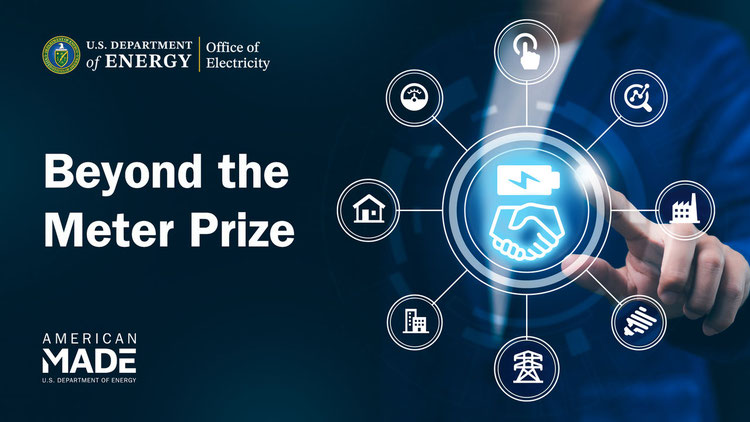
Beyond the Meter: Energy Storage Integration Prize

Submit innovative solutions that enhance affordability through integration and interoperability of BTM grid-edge technology
stage:
Phase 1 Launch
prize:
$3,400,000
more
Summary
Timeline
Updates13
Forum3
Teams344
Entries
Resources
FAQ
Summary

Background

The Beyond the Meter: Energy Storage Integration Prize is a two-phase competition funded by the U.S. Department of Energy’s Office of Electricity and will foster the development of next-generation energy- storage-enabled solutions, paving the way for an efficient and affordable energy future. The prize offers a total prize pool of $3,400,000 in cash prizes and $800,000 in vouchers to be used at a DOE national laboratory across two phases with two separate tracks. 

Behind-the-meter (BTM) storage is a powerful mechanism to lower energy costs for electricity consumers, delivering documented annual savings for households, reducing demand charges for commercial entities, and improving net present value for system owners. Realizing this potential, however, necessitates addressing existing interoperability challenges to ensure grid-wide coordination and efficient value stacking of BTM resources. BTM storage has the potential to unlock significant value for the grid and individual customers, especially when working in concert with other consumer-focused energy resources.  

The high cost and engineering complexity of integrating and coordinating consumer-focused energy resources designed by different entities can result in missed opportunities to co-optimally operate these assets and maximize their potential benefits.  

This prize will highlight innovative solutions that enhance affordability through integration and interoperability of BTM grid-edge technology and other grid-edge resources. By strategically deploying energy storage on consumers’ premises, the management of BTM assets can be optimized, facilitating the transition to a more reliable and affordable energy future. 


Competitor Tracks

This prize includes two distinct tracks—one focused on residential solutions and the other focused on commercial and industrial solutions: 

  • Residential Solution Track 
  • Commercial/Industrial Solution Track.

For both tracks, this competition encourages companies to form coalitions to demonstrate products and strategic plans for integrating and managing BTM grid-edge technologies alongside BTM ESS while reducing transaction costs. DOE is seeking solutions that are fully-integrated BTM before connecting or interacting with the grid-edge technologies.  

Submissions for the Residential Solution Track should highlight technologies that are intended for residential use (e.g., single-family homes, multifamily housing, apartments). Submissions for the Commercial/Industrial Solution Track should highlight technologies that are designed for larger-scale applications (e.g., commercial buildings, industrial facilities, warehouses, manufacturing plants, office complexes). 


Prizes

The Beyond the Meter Prize offers a total prize pool of $3,400,000 in cash prizes and $800,000 in vouchers to be used at a DOE national laboratory across two phases with two separate tracks.

Phase 1 - Introduction

Teams introduce their organization, present their products, and outline their strategic plans for further product development and collaboration with grid-edge technology vendors. Teams should work to identify other groups and vendors they can team with to create a coalition in Phase 2, where they can develop an interoperable product capable of seamless integration and effective management of BTM grid-edge technologies.

Up to three winning teams from each track—the Residential Solution Track and the Commercial/Industrial Solution Track—will receive up to $250,000 each in cash. Winning teams will receive $50,000 each after the announcement of Phase 1 winners and $200,000each after successfully attending and participating in the OE Energy Storage Peer Review in summer 2026. 

Phase 1 winners are also eligible to each receive a $100,000 voucher to redeem at a single DOE national laboratory at the conclusion of Phase 2 after submitting a Phase 2 HeroX submission and attending and participating in the OE Energy Storage Peer Review in summer 2027. A national laboratory voucher is a funding mechanism that allows teams to collaborate with DOE national laboratories to access specialized expertise, facilities, and technologies for advancing research, development, and innovation.

TrackWinnersPrizes
Residential Solution TrackUp to three $250,000 cash prize each and $100,000 voucher* each
Commercial/Industrial Solution TrackUp to three $250,000 cash prize each and $100,000 voucher* each

*Phase 1 winners are eligible to receive a $100,000 voucher if they submit a Phase 2 HeroX submission and attend and participate in the OE Energy Storage Peer Review in summer 2027. 

Phase 2 – Progress

Phase 1 winning teams will build on the foundation set in the first phase. Phase 2 requires teams to highlight significant progress in both their product development and collaboration efforts. Teams will be given sufficient time to refine their solutions, with the expectation that they will have formed a coalition to present a commercially ready product capable of seamless integration and effective management of BTM grid-edge technologies. 

In summer 2027, teams must provide evidence of advancements of their product and its interoperability at the 2027 OE Energy Storage Peer Review, where judging will take place. At this event, up to one winner from each track will be awarded $950,000, making attendance at the 2027 OE Energy Storage Peer Review a requirement for winning. The Phase 2 winner will also be awarded an additional $100,000 voucher to redeem at a single DOE national laboratory at the conclusion of Phase 2.

TrackWinnersPrizes
Residential Solution TrackUp to one $950,000 cash prize and $100,000 voucher 
Commercial/Industrial Solution TrackUp to one $950,000 cash prize and $100,000 voucher 


Guidelines

Please review the Official Rules document for the complete application process and instructions for competing. 

If you want to receive updates on the prize or have any questions, please subscribe by using the follow feature on the HeroX platform or message us directly at 

Who Can Participate?  

This prize is best suited for companies and coalitions already working on behind the meter grid-edge technology solutions. For full eligibility requirements, read the Official Rules document.   

Timeline
Updates13

Challenge Updates

BTM Prize Info Webinar Recording Now Available

March 3, 2026, 9:08 a.m. PST by NLR Prize Moderator

In case you missed the Beyond the Meter Prize informational webinar on Feb. 24, you can find a recording and a copy of the slides presented in the Resources tab. During the event, prize administrators covered:   

  • Prize background  
  • Key dates  
  • Submission material requirements 
  • Competitor eligibility  
  • Attendee questions. 

To read the full list of questions asked during the live Q&A portion of the event, check out Section 12 of the FAQ tab.   

We highly recommend all competitors watch the webinar recording and read the Official Rules document as you prepare your submission materials. As a reminder, all Phase 1 submission materials are due no later than 5 p.m. ET on April 30.   

We look forward to reviewing your applications soon!   


Register for the BTM Prize Info Webinar

Feb. 18, 2026, 7:25 a.m. PST by NLR Prize Moderator

Could your cutting-edge behind-the-meter storage solution help you win big? Learn more about the newly reopened Beyond the Meter Prize and ask questions during the follow-on Q&A at an upcoming informational webinar on February 24 at 12 p.m. ET. Hear from prize administrators about:  

  • Prize background 
  • Competitor eligibility  
  • Submission details 
  • Key dates and phase information 
  • And more! 

REGISTER TODAY to reserve your spot at the webinar! Can’t make the live event? Click “Follow” at the top of this page to receive important updates such as deadline reminders and a notification when the webinar recording has been posted.

Looking to build a team? Check out the latest post in the Forum tab to meet and collaborate with other potential prize participants. Create your own post with more information about your current team, organization, expertise, goals, and partnership needs. 

We look forward to seeing you at the webinar!  


Beyond the Meter Prize Reopened for Submissions

Feb. 3, 2026, 7:53 a.m. PST by NLR Prize Moderator

The U.S. Department of Energy’s Office of Electricity recently announced the reopening of the Beyond the Meter Prize.  

Now offering a larger prize pool of $3.4 million in cash prizes and $800,000 in vouchers to work with a national laboratory, competitors are encouraged to form coalitions to demonstrate their existing products and strategic plans to integrate and manage grid-edge technologies into behind-the-meter energy storage systems. Through collaboration with grid-edge technology vendors, teams will develop solutions that maximize the value and flexibility of these new, innovative energy resources for both consumers and the grid. 

Past applicants are encouraged to read the updated Official Rules document and resubmit their submission materials for consideration, though it is not required to resubmit if you no longer want to compete in the prize. Past applicants are also not required to apply for the prize with a new idea and may reapply with their original idea.  

For this prize, applicants will choose to submit their solutions to either the Residential Solution Track or the Commercial/Industrial Track. For both tracks, the solutions must be fully integrated behind the meter before connecting or interacting with the grid edge.  

Read more about the submission materials, competitor eligibility, and other key prize details in the Official Rules document.  

We look forward to seeing your applications soon!  


Claim Your Free DTECH 2026 Expo-Only Pass

Jan. 13, 2026, 3:20 p.m. PST by NLR Prize Moderator

Join the American-Made team at DTECH 2026 in sunny San Diego, CA, February 2–5!  

We’re excited to announce that the U.S. Department of Energy’s (DOE’s) Office of Electricity (OE) will be hosting a booth where past and future prize competitors can network and learn more about multiple new prizes, as well as other impactful funding opportunities and activities from OE.  

As part of our commitment to engaging the community and advancing innovation, we are offering 50 expo-only tickets to potential participants who are interested in attending. These tickets will be distributed on a first-come, first-serve basis, so don’t miss your chance to connect with us and learn more about how you can get involved. 

To claim your ticket, please use this link 

To ensure fairness, we kindly ask that requests for free expo tickets be limited to a maximum of two per group. 

PLUS: Interested applicants of the Beyond the Meter Prize are invited to a 90-minute networking session to learn more about the prize and connect with potential teammates.  

REGISTER TODAY to attend the networking session. 

We look forward to seeing you in San Diego! 


Beyond the Meter Prize Reopening in 2026

Dec. 16, 2025, 11 a.m. PST by NLR Prize Moderator

Thank you for your continued interest in the Beyond the Meter Prize. The U.S. Department of Energy (DOE) has been evaluating all funding opportunities, including prize challenges, to ensure appropriate resources are allocated efficiently, and that the Department's initiatives are in line with the statutory mission of DOE and the policies and priorities of the Administration and DOE. We appreciate your flexibility and patience during this process. 

Prize administrators are pleased to inform you that after DOE's review, we are relaunching the Beyond the Meter Prize with a modified timeline, forthcoming rules document, and new prize pool. Please closely review the HeroX timeline for updated deadlines. We look forward to seeing your submissions after the prize reopens in early 2026.

Don’t forget to follow the prize on HeroX to receive important competition updates including a notification when the updated prize rules document is available.


Forum3
Teams344
Entries
Resources
FAQ

Frequently Asked Questions

Yes, but it’s quick and easy. Just click the “Solve this Challenge” button on this page and follow the instructions to complete your registration. All you need to provide is your name and email address.

There are benefits to registering as a team or an individual. We want to highlight that every American-Made Challenge has a section in the submission where you will list your team and team members, and we do not review the teams you build using the HeroX team function. Therefore, you can register and submit as a team or an individual, and it does affect the review of your submission. 

To aid your decision, we have created this guide.

Note: if you are competing in a prize with multiple phases, and if different people might submit at different phases for your team, we recommend building a team and submitting that way as you can swap the "captain" for your team, but keep the same team and permissions while just swapping the person who can actually submit the submission. 

If you have a question not answered in the FAQ, we recommend that you post it in the Forum where someone will respond to you. This way, others who may have the same question will be able to see it. You may also send a message to the Prize Administrator inbox at .

No, if you are a contest winner you are receiving the prize for meeting or exceeding the contest goals. 

Innovation is about making ideas happen. The American-Made Network will accelerate and sustain solar innovation through a diverse and powerful network that includes national laboratories, energy incubators, facilities, and other valuable industry partners from across the U.S. who will engage, connect, mentor, and boost the efforts of competitors.

See who is in the network.

Connectors are the core component of the American-Made Network and are organizations that seek to support the efforts of competitors. Use this link to explore the Network to find potential partners and develop relationships.

Meet the Connectors. 

Power Connector organizations are a core group of Connectors that will work alongside NREL to implement parts of the program and secure additional resources and partners. Discover who they are and how they will help innovators succeed. 

Meet the Power Connectors. 

The National Laboratory of the Rockies (NLR) is the Prize Administrator for the American-Made Challenges. In this capacity NLR works closely with the U.S. Department of Energy to administer the challenges, maintain the website platform, assist in building the network, and pay prize money to the winning teams.  

All of your files are uploaded as part of the submission form, access this by clicking the "Begin Entry" button.  The submission form contains an upload option for each of the required file entries.  Only PDF files will be accepted for upload.

If you encounter an issue when attempting to submit an entry to the challenge, you may need to contact HeroX or the Prize Administrator. You may try to connect with HeroX using the online form which appears in the bottom right corner of your browser window, it says "Leave a Message".

You may also send a message to the Prize Administrator inbox at . Please allow at least 1 business day for a response.

All submissions will be reviewed in English. 


QuestionResponse
Is there any way to participate as reviewer?
Is the prize now open to applications other than "that produce electricity" as I saw at one point? 

Read more about the scope of the prize in the rules: https://docs.nlr.gov/docs/gen/fy26/98707.pdf


Is this competition would lead to any conference similar to Marine Collegiate competition?Phase 1 winners must attend the OE Energy Storage Peer Review in 2026 and 2027 but there is no specific conference tied to this prize.
Is this competition related to Battery storage at distribution or transmission level?This prize aligns with the OE Energy Storage Division’s broader mission to advance tools and methods to improve and simplify ESS integration across all levels of the grid, including generation, transmission, distribution, and consumer applications. By focusing on technology-neutral solutions, the competition aims to identify scalable approaches for improving consumer-focused energy resources control, integration, and interoperability.
What is the definition of DER and Beyond the Meter?

(See this content on page 5 of the Official Rules: https://docs.nlr.gov/docs/gen/fy26/98707.pdf)  

Behind-the-meter (BTM) grid-edge technologies refer to energy solutions located on the consumer's side of the electricity meter, enabling end users to better manage and optimize their energy consumption. These technologies include consumer-focused energy resources such as battery storage systems and smart home devices. By integrating BTM technologies, consumers can enhance energy efficiency, lower energy costs, and support grid stability by participating in demand response and peak load management. Furthermore, BTM technologies offer consumers greater control over their energy usage, contributing to a more resilient energy system.

So, Beyond and Behind the meter are the same?“Beyond” the Meter is just the name of the prize. The intent of the competition is focused on behind-the-meter solutions.
Would solutions incorporating resource aggregation (i.e. VPPs or similar) fit under the residential category or because of the scale fit the commercial/industrial prize?This question was answered live. Please watch the webinar recording for more information.
Are prototypes expected as part of Phase 1 submission?

A complete submission package for Phase 1 should include the following items:

 • Cover page (not public)

 • Narrative (not public)

 • Submission summary slide (will be made public)

 • Letters of commitment or support (optional) (not public).

 
Read more about the Phase 1 submission package in Section 3.6 in the Official Rules: https://docs.nlr.gov/docs/gen/fy26/98707.pdf


Does the "solution" need to be a physical product?

By the end of Phase 2, teams should be prepared to showcase a technology that is ready for testing and validation at a national laboratory and highlight collaboration with a coalition of BTM vendors and manufacturers in developing the solution.
 
Find more information in the Official Rules document: https://docs.nlr.gov/docs/gen/fy26/98707.pdf


Can someone be part of two different coalitions?

This question was answered live. 

Summary answer: Yes, it is possible for someone to be part of multiple coalitions. However, it's important to note that a team can only submit one official submission. For example, an individual or organization can be a partner on several submissions, but they can only act as the lead for one.
 
We encourage collaboration among teams, whether as leads or partners on multiple submissions. Teams can utilize the HeroX forum and its partnership opportunities feature to share information about their capabilities. This allows other teams to discover potential partners, work together, and aim for interoperability in their submissions.

Are solutions that are already commercially deployed accepted in phase 1?

This question was answered live. 

Summary answer: Yes. But there should be plans and actions set forth towards additional interoperability. 

If multiple organizations are involved on a project, can one organization lead submission/handle submission paperwork and another receive the funding or is a single point of contact expected?

This question was answered live. 

Summary answer: We will not dictate how teams or coalitions are formed or how roles are assigned; decisions on partnerships and submissions are entirely up to you. Organizations involved in the same project are free to structure their roles as they see fit. 

When submitting your proposal, it is required to specify the entity to which the prize funding will be paid. Beyond that, it is entirely your decision how team leadership and responsibilities are divided. Teams may choose to collaborate and submit a joint proposal with a designated lead, or multiple teams may independently submit their own proposals while partnering as collaborators.
 
Ultimately, there are many ways to structure partnerships and submissions, but these choices will be left to you and your team to determine.

Exactly how early will a voucher be available for winners? This strongly affects the opportunity to include a DOE lab in the project up front.

This question was answered live. 

Summary answer: In response to your question about the availability of vouchers for winners, vouchers will be awarded at the completion of the prize program, not during Phase 2. During Phase 2, Phase 1 winners will work closely with national lab researchers to develop a statement of work and define the scope of the voucher for post-prize validation and testing. We will assist you with matchmaking to identify the lab that best aligns with your project needs.
 
The decision to award vouchers at the end of the program is based on considerations of fairness and practicality. Releasing vouchers during Phase 2 may lead to discrepancies in the value perceived by different teams and a lack of equity as some teams might progress further with their vouchers than others. Additionally, the workload during Phase 2 is significant, as teams focus on advancing prototypes, ensuring interoperability, and meeting other prize-related objectives within a relatively short timeframe. Starting voucher-related lab work during this phase would be logistically challenging and could detract from teams' ability to complete their Phase 2 goals effectively.
 
By awarding vouchers after the program, we ensure equal opportunities for all teams to utilize the resources for validation and testing at a consistent pace. Beyond technical value, vouchers offer an opportunity to build lasting relationships with national labs. These connections can yield future collaborations, whether through additional funding opportunities or continued work stemming from the prize outcomes.
 
We hope this approach makes sense, as it has been thoughtfully designed to benefit teams both during and beyond the program's timeline.

Can you please elaborate what really mean by integration and interoperability here?

This question was answered live. 

Summary answer: In response to your question regarding integration and interoperability, these terms refer to simplifying the processes surrounding consumer-focused energy resources to create a seamless experience for users. For context, let's consider a scenario: Ms. McGillicuddy, a typical homeowner, is approached by four separate parties that offer various distributed energy resources. This results in multiple complex transactions, high maintenance costs, and difficulty in management for the average consumer.
 
Integration and interoperability aim to address these challenges by consolidating the functionalities of consumer-focused energy resources  into a single, cohesive system. Instead of navigating multiple transactions and vendors, users like Ms. McGillicuddy would interact with one vendor for a unified solution that achieves full consumer-focused energy resources value optimization. This streamlined approach reduces complexity while ensuring everything works together efficiently.
 
Within the context of this program, we are striving for innovative solutions that simplify these interactions and maximize the benefits of DERs through improved interoperability.

All team members should be US citizen?

Please review eligibility on page 9: https://docs.nlr.gov/docs/gen/fy26/98707.pdf


Why would a commercially deployed product be eligible for a prize if there is no new innovation?

This question was answered live. 

Summary answer: Regarding the question of why a commercially deployed product might be eligible for a prize, the answer lies in its ability to address a critical need related to interoperability. Specifically, we're looking for solutions that simplify and unify Distributed Energy Resource (DER) transactions.
 
The goal is to enable a single, integrated system where all consumer-focused energy resource components work seamlessly together. This would allow end users, like a homeowner, to interact with just one vendor, reducing complexity and achieving full optimization of consumer-focused resources value stacks. This level of interoperability represents significant innovation that enhances user experience, efficiency, and market applications, which is why such a solution could be recognized and rewarded.

So you do not want us to involve a DOE lab early?

This question was answered live. 

Summary answer: No, it is not necessary to involve a DOE lab early in the process, particularly during Phase 1. Researchers and national labs are not eligible to compete, and we want to ensure their time and resources are respected.
 
For Phase 1, we ask that participants refrain from engaging researchers or discussing potential vouchers that could be awarded in Phase 2. These interactions and collaborations are meant to occur in Phase 2, after the completion of Phase 1. If you win Phase 1, you will be provided a voucher simply by fulfilling the requirements of the events we've outlined. 

Additionally, if you already have a pre-existing relationship with a national lab, you may reference it in your narrative. However, letters of recommendation from national labs should not be submitted, as we will likely consider these void during Phase 1. Please focus on the scope and objectives of Phase 1, as we will provide assistance for national lab involvement during Phase 2