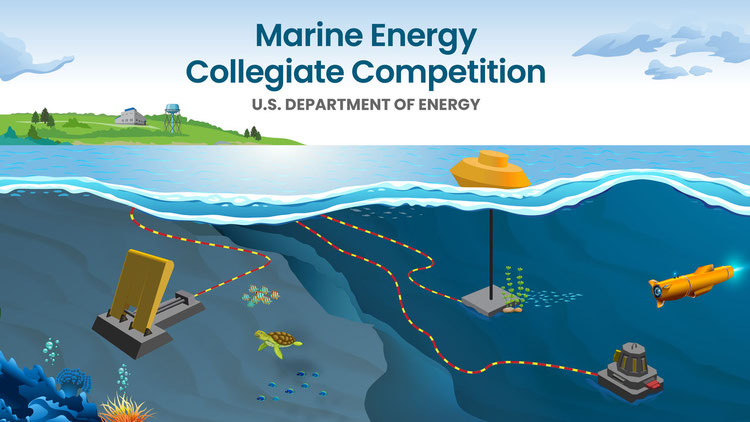
Marine energy—power generated from ocean waves, currents, tides, and temperature gradients—is one of the world’s largest untapped energy resources. Continued innovation is needed to optimize marine energy device designs and reduce costs to enable broader deployment.
The Marine Energy Collegiate Competition (MECC) invites interdisciplinary teams of postsecondary, undergraduate, and graduate students from a variety of academic programs to solve real-world marine energy challenges across coastal, maritime, and offshore markets. Through the competition, the U.S. Department of Energy (DOE) Hydropower and Hydrokinetic Office (H2O) seeks to inspire students to innovate in and accelerate the emerging marine energy industry.
The competition enables students to network with marine energy professionals, explore marine energy career pathways, develop professional skills, and gain insight into how marine energy can contribute to a reliable and affordable energy future.
Student teams selected in the 2027 application process will have 8–10 months to develop their concepts for presentation at the final event planned in May 2027. To demonstrate progress throughout the competition, teams will submit written deliverables according to a schedule described in the competition rules document.
Teams will also:
The 2027 competition will have two “leagues”—the Kilowatt League (foundational level) and the Megawatt League (advanced level)—with different participation requirements outlined below.
The Kilowatt League is designed for teams new to the competition or those seeking a scaled participation experience. The Megawatt League is designed for teams prepared to fully engage in all MECC challenges.
Both leagues are part of the same competition but participate in different challenges and have different submission requirements and prizes.
Teams must participate in all four core challenges:
Eligible for up to $15,000 per team for successful participation
Eligible for final grand prize cash awards
Required to submit midyear submissions and full final reports
Required to conduct two presentations at the final event
Teams must participate in the Community Connections Challenge and at least one of the following:
Teams interested in participating in the Build and Test Challenge must also participate in the Technical Design Challenge.
Designed for teams seeking a more flexible competition experience
Eligible for up to $15,000 per team for successful participation
Eligible for grand prize awards
Required to submit midyear submissions and final reports for selected challenges
Required to conduct two presentations at the final event
Teams will identify a promising coastal, maritime, or offshore market where marine energy could provide value and determine the most appropriate marine energy system to serve that market’s needs. Competitors will evaluate performance requirements for end users and develop a comprehensive business plan.
Teams will evaluate performance requirements within their selected market by identifying and interviewing at least three potential end users. Teams will complete a detailed design of a marine-energy-powered system or device to serve those users.
Teams will build a scaled prototype of their concept and perform a series of laboratory tests to meet their defined build and test objectives.
Teams will engage with marine energy professionals and relevant stakeholders to:
Teams will bring one poster to the final event summarizing their efforts in the Business Plan, Technical Design, and Build and Test Challenges. Including a summary of the Community Connections Challenge is optional.
Why participate?
The poster provides an opportunity to showcase your work to industry professionals, potential employers, and peers while strengthening your ability to communicate complex ideas visually and concisely.
During the final event, teams will have 90 seconds to present their concept and key findings.
Why participate?
The quick pitch strengthens public speaking skills, helps refine messaging, and provides exposure to professionals in the field.
Teams select their league during the application process.
Megawatt League teams may request to move to the Kilowatt League by March 1, 2027.
Kilowatt League teams may request to move to the Megawatt League by December 31, 2026.
Requests for league transfer may be made via email to the Prize Administrators at water.competition@nlr.gov.
Competitors will identify a promising market within the ocean economy. Students will then determine the best marine energy application within that market to address.
Teams may consist of a combination of undergraduate and graduate students but must be at least 50% students who are pursuing their bachelor’s and/or associate’s degree at the beginning of the competition. Only 50% of the team may be pursuing an advanced degree (master’s, Ph.D., etc.).
In keeping with the goal of growing a community of innovators, competitors are encouraged to form multidisciplinary teams while developing their concept, including but not limited to disciplines such as:
Non-U.S. institutions are eligible to participate on their own, without a U.S. university partner; however, these teams will not be eligible to receive cash prizes and must provide their own funding to support travel and competition expenses.
U.S. academic institutions must be accredited by the U.S. Department of Education.
Review the MECC 2027 Rules to learn more.
If you have any questions or want to receive updates on the prize, please subscribe by using the contact feature on the HeroX platform or message us directly at Water.Competition@nlr.gov.
 © 2026