

2027 Submittals Update
All 2027 HCC Submittals should be submitted through Canvas. Instructions will be sent out through Canvas.
HCC Organizers
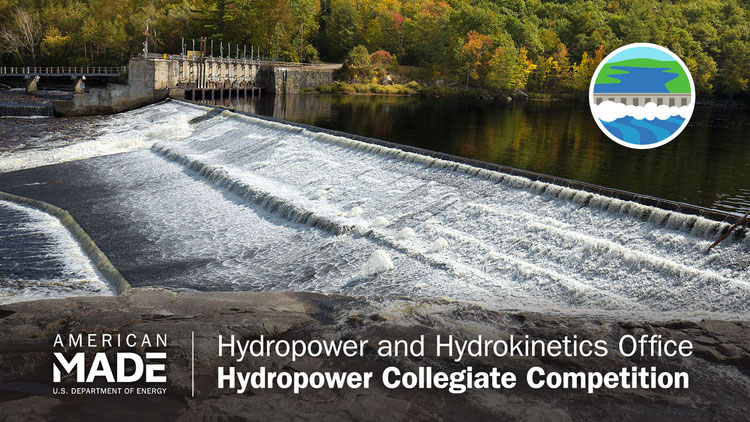
Hydropower provides Americans with reliable, affordable, and secure electricity and storage. The industry creates jobs in communities across the country, but nearly a quarter of the current U.S. hydropower workforce is eligible or approaching eligibility for retirement.
Hydropower plays a crucial role in our power system and has untapped potential and significant opportunity for growth. This growth can be realized with further innovation and a new generation of passionate, motivated innovators and entrepreneurs.
Launched in 2022, the U.S. Department of Energy's (DOE) Hydropower and Hydrokinetic Office (H2O) Hydropower Collegiate Competition (HCC) invites interdisciplinary teams of postsecondary, undergraduate, and graduate students from a variety of academic programs to solve complex hydropower challenges. Through the competition, H2O intends to offer students direct industry experience, valuable exposure to hydropower career pathways, and greater knowledge of hydropower’s potential to contribute to a reliable and affordable energy future.
The primary theme of the competition is innovations in hydropower, specifically, (1) the conversion of non-powered dams (NPDs) to hydroelectric dams, (2) the addition of pumped storage hydropower (PSH) to existing hydropower reservoirs, and (3) in-conduit hydropower. Through the HCC, competing teams can either advance existing technology or develop new technologies.
Competition Structure
The HCC will consist of five required challenges: Siting Challenge, Design Challenge, Community Connections Challenge, Design and Siting Poster, and Quick Pitch. Teams selected through the application process to compete in the main competition also have the option to compete in the Build and Test Challenge. Each challenge includes distinct submission requirements that selected teams are expected to complete to be awarded cash prizes.
HCC teams compete in the following contests:
General Competition Timeline
For a detailed competition timeline, please visit the Timeline tab.
Spring: HCC organizers open the application period for the 2027 competition. Interested teams fill out an application to compete during the school year.
Spring/Summer: HCC organizers select the teams who will participate in the competition.
Fall–Winter: Tentative in-person workshops; submission deadlines for midyear deliverables.
Winter–Spring: Submission deadlines for challenges and final reports.
Spring: HCC teams present their work at the HCC final event in late April/May 2027.
Competition Goals
Up to 15 teams will be selected to participate in the 2027 HCC.
Teams may consist of a combination of undergraduate and graduate students but must be at least 50% students who are pursuing their bachelor’s and/or associate’s degree at the beginning of the competition. Only 50% of the team may be pursuing an advanced degree (master’s, Ph.D., etc.).
Non-U.S. institutions are eligible to participate on their own, without a U.S. university partner; however, these teams will not be eligible to receive cash prizes and must provide their own funding to support travel and competition expenses.
U.S. academic institutions must be accredited by the U.S. Department of Education.
Interdisciplinary teams that include students with backgrounds in the following areas are highly encouraged:
Review the 2027 HCC Rules to learn more about the competition.
If you have any questions or want to receive updates on the prize, please subscribe by using the contact feature on the HeroX platform or message us directly at Water.Competition@nlr.gov.
Are you interested in the 2027 Hydropower Collegiate Competition, but not ready to lead a team?
While we encourage any interested school to apply for the 2027 Hydropower Collegiate Competition, we understand that not all schools may feel prepared to fulfill all of the competition requirements. In such cases, HCC organizers can assist you in partnering with a selected team that will act as the lead institution in the competition. Reach out to us at Water.Competition@nlr.gov. The details of the partnership will be determined by your school and the lead institution.
Please note that expressing interest does not guarantee a formal partnership.
 © 2026