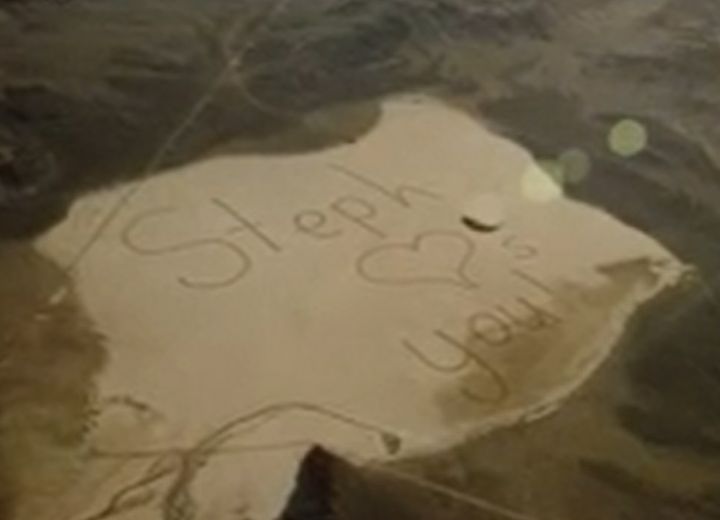
It seems no matter where humans are, advertisers quickly follow. Felix Baumgartner's jump a couple of years back from a high-altitude balloon? Sponsored mainly by Red Bull. Climbing Everest? Routinely sponsored by National Geographic. James Cameron's expedition to the bottom of the ocean? Also sponsored by National Geographic -- as well as Rolex.
So it was surprising that so much buzz came out of a recent Hyundai ad campaign talking about "Stephanie", a 13-year old that wanted to send a message to her father in space. Never mind that NASA has family conferences several times a month with its astronauts spending time on the International Space Station; no, Stephanie wanted to do something special.
"I think if we could write a really big message he will be able to see it from space," Stephanie says in the campaign, which is facing denials from NASA of it being linked to any of its astronaut corps. But the video claims that cars were used to draw a message visible from afar. You can see the video below, as well as the making-of video further down in this article.
Notably, NASA's advertising policy forbids current astronauts from taking part. "Astronauts or employees who are currently employed by NASA cannot have their likenesses or names displayed on any commercial products, advertisements or commercial product packaging," the policy says, adding that former astronauts (or the families of deceased astronauts) are free to do grant permission.
But advertising can still take place in other forms, which is why Pizza Hut was able to deliver pizzas to space in 2001, for example. WiseGeek points out that many nations have placed a ban on obtrusive space advertising, meaning advertising that you could see beamed from space on Earth. This would make it difficult to put a floating billboard in orbit or to alter the surface of the Moon somehow to see an ad from Earth, from example.
Space being such an expensive endeavour -- and one that is so high-profile -- makes it a natural target for advertisers. And as private companies take bolder endeavors into the final frontier, it's possible we may see more of it. The private venture Mars One wants to send people to Mars on the back of selling television rights that in turn would be financed by sponsors.
It is a little simplistic to ask oneself about whether or not to stop advertising in space, because the reality is space is full of companies already. SpaceX and Orbital Sciences regularly bring cargo to the International Space Station on their own spacecraft. Several private companies launch rockets, including United Launch Alliance that supplies the military. And numerous private companies can proudly cite NASA as a customer for one project or another, such as Boeing and Lockheed Martin.
But what sorts of advertisments are suitable? This will be a question that comes to the fore as more private citizens get the chance to venture into space. Virgin Galactic and XCOR are both companies looking to bring private tourists into space in the next few years. Who will sponsor their expensive rides? In some cases, it very well could be partnerships.
What do you think is best?
Top image: A still from Hyundai's "message to space" video.